Irwin Shaw - The Young Lions
Здесь есть возможность читать онлайн «Irwin Shaw - The Young Lions» весь текст электронной книги совершенно бесплатно (целиком полную версию без сокращений). В некоторых случаях можно слушать аудио, скачать через торрент в формате fb2 и присутствует краткое содержание. Жанр: Классическая проза, на английском языке. Описание произведения, (предисловие) а так же отзывы посетителей доступны на портале библиотеки ЛибКат.
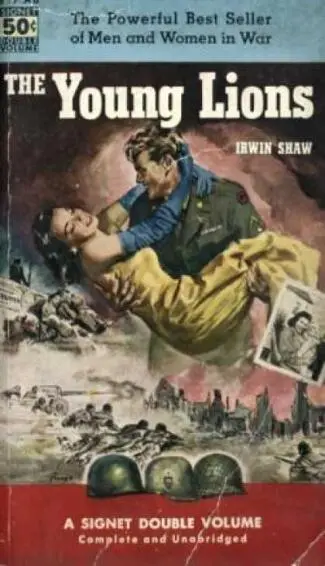
- Название:The Young Lions
- Автор:
- Жанр:
- Год:неизвестен
- ISBN:нет данных
- Рейтинг книги:4 / 5. Голосов: 1
-
Избранное:Добавить в избранное
- Отзывы:
-
Ваша оценка:
The Young Lions: краткое содержание, описание и аннотация
Предлагаем к чтению аннотацию, описание, краткое содержание или предисловие (зависит от того, что написал сам автор книги «The Young Lions»). Если вы не нашли необходимую информацию о книге — напишите в комментариях, мы постараемся отыскать её.
The Young Lions — читать онлайн бесплатно полную книгу (весь текст) целиком
Ниже представлен текст книги, разбитый по страницам. Система сохранения места последней прочитанной страницы, позволяет с удобством читать онлайн бесплатно книгу «The Young Lions», без необходимости каждый раз заново искать на чём Вы остановились. Поставьте закладку, и сможете в любой момент перейти на страницу, на которой закончили чтение.
Интервал:
Закладка:
"No future," Behr repeated reflectively, staring out across the stretched barbed wire to the sea. "No future."
Behr was a Sergeant in Christian's new Company. He was a quiet, powerfully built man of about thirty, whose wife and two children had been killed in Berlin in January by the RAF. He had been wounded on the Russian Front in the autumn, although he refused to talk about it, and had only come to France a few weeks before Christian had arrived there after his leave in Berlin.
In the month that Christian had known him he had grown very fond of Behr. He had seemed to like Christian, too, and they had begun to spend all their spare time together, on long walks through the budding countryside, and drinking the local Calvados and hard cider in the cafes of the village in which their battalion was based. They carried pistols in holsters at their belts when they went out because they were constantly being warned by superior officers about the activities of Maquis bands of Frenchmen. But there had been no incidents at all in that neighbourhood, and Christian and Behr had agreed that the repeated warnings were merely symptoms of the growing nervousness and insecurity of the men higher up. So they wandered carelessly through the farmyard and along the beaches, being polite to the French people they met, who seemed quite friendly, in their grave, reserved, country way.
What Christian liked best of all about Behr was his normality. Everyone else Christian had had anything to do with, ever since the bad night outside Alexandria, had seemed to be overwound, jumpy, bitter, hysterical, overtired… Behr was like the countryside, cool, self-contained, orderly, healthy, and Christian had felt himself relaxing, the snapping, malarial, artillery-worn nerves being soothed into a salutary calm.
When he had first been sent to the battalion in Normandy, Christian had been bitter. Enough, he'd thought, I've had enough. I can't do it any more. In Berlin he'd felt sick and old. He had spent his leave dozing sixteen, eighteen hours a day, in bed, not even getting up when the planes came over at night. Africa, he'd thought, Italy, the torn and never-quite-mended leg, the recurrent malaria, enough. What more do they want from me? And now, obviously, they wanted him to meet the Americans when they came on to the beaches. Too much, he'd thought, brimming with sick self-pity, they have no right to demand it of me. There must be millions of others who have barely been touched. Why not use them?
But then he'd got to know Behr, and the man's quiet unapprehensive strength had slowly cured him. In the peaceful, healthy month he had put on weight and regained his colour. He hadn't had a single headache, and even his bad leg seemed to have made its final useful adjustment to its crooked tendons.
And now Behr was walking beside him on the cool sand of the beach, and saying, disturbingly, "No future, no future. They keep telling us the Americans will never land in Europe. Nonsense. They are whistling to keep up their spirits among the tombstones. Only it will not be their tombstones, but ours. The Americans will land because they have made up their minds to land. I do not object to dying," Behr said, "but I object to dying uselessly. They will land, regardless of what you and I do, and they will go on into Germany, and they will meet the Russians there and when that happens Germany is finished, once and for all."
They walked in silence for a while. Christian felt the sand come up between his bare toes and it reminded him of the time when he was a small boy and had run barefoot in the summer, and what with the memory and the pretty beach and the slow, majestic, happy afternoon, it was hard to be as sober and as thoughtful as Behr was asking him to be.
"I listen to them over the radio, from Berlin," Behr said, "boasting, inviting the Americans to try to come, hinting about secret weapons, predicting that any day now the Russians will be fighting the British and the Americans, and I could beat my head against the wall and weep. You know why I could weep? Not because they are lying, but because the lies are so weak, so barefaced, so contemptuous. That is the word – contemptuous. They sit back there and they say anything that comes into their heads because they despise us, they despise all Germans, the people in Berlin, they know we are fools and believe anything anybody chooses to tell us, because they know we are always ready to die for any nonsense they cook up in an odd fifteen minutes between lunch and the first drink in the afternoon.
"Listen," Behr said, "my father fought for four years in the last war. Poland, Russia, Italy, France. He was wounded three times and he died in 1926 from the effects of the gas he took into his lungs in 1918 in the Argonne Forest. Good God, we are so stupid they even get us to fight the same battles all over again, like a continuous showing in the movies! Same songs, same uniforms, same enemies, same defeats. Only new graves. And this time, too, the end will be different. Germans may never learn anything, but the others will learn this time. And it is different this time, and it is going to be much worse to lose. Last time it was a nice, simple, European-style war. Anyone could understand it, anyone could forgive it, because they'd all been fighting the same kind of war for a thousand years. It was a war within the same culture, one body of civilized Christian gentlemen fighting another body of civilized Christian gentlemen under the same general, predictable set of rules. When the war was over last time, my father marched back to Berlin with his regiment and the girls threw flowers at them along the roads. He took off his uniform and went back to his law office and started trying cases in the civil courts as though nothing had happened. Nobody is going to throw flowers at us this time," Behr said, "not even if there are any of us left to march back to Berlin.
"This time," he said, "this time it is not a simple, understandable war, within the same culture. This time it is an assault of the animal world upon the house of the human being. I don't know what you saw in Africa and Italy, but I know what I saw in Russia and Poland. We made a cemetery a thousand miles long and a thousand miles wide. Men, women, children, Poles, Russians, Jews, it made no difference. It could not be compared to any human action. It could only be compared to a weasel in a henhouse. It was as though we felt that if we left anything alive in the East, it would one day bear witness against us and condemn us. And now," Behr said in his low, even voice, "and now, after that, we have made the final mistake. We are losing the war. The animal is slowly being driven into his last corner, the human being is preparing his final punishment. And now, what do you think will happen to us? I tell you, some nights I thank God my wife and my two children were killed, so that they will not have to live in Germany when this war is over. Sometimes," Behr said, staring out over the water, "I look out there and say to myself, 'Jump in! Try to swim! Swim to England, swim to America, swim five thousand miles, to get away from it.'"
They had reached their boots by now, and they stood over the heavy footgear, staring reflectively down at the dull black leather, as though the boots, hobnailed and blunt, were a symbol of their agony.
"But I cannot swim to America," Behr said. "I cannot swim to England. I must stay here. I am a German and what happens to Germany will happen to me, and that is why I am talking to you like this. You know," he said, "if you mention this to anyone, they will take me out the same night and shoot me…"
"I will not say a word," Christian said.
"I have been watching you for a month," said Behr, "watching and measuring. If I've made a mistake about you, if you're not the sort of man I think you are, it will mean my life. I would like to have taken more time, watching you, but we do not have so much more time…"
Читать дальшеИнтервал:
Закладка:
Похожие книги на «The Young Lions»
Представляем Вашему вниманию похожие книги на «The Young Lions» списком для выбора. Мы отобрали схожую по названию и смыслу литературу в надежде предоставить читателям больше вариантов отыскать новые, интересные, ещё непрочитанные произведения.











Обсуждение, отзывы о книге «The Young Lions» и просто собственные мнения читателей. Оставьте ваши комментарии, напишите, что Вы думаете о произведении, его смысле или главных героях. Укажите что конкретно понравилось, а что нет, и почему Вы так считаете.