Irwin Shaw - The Young Lions
Здесь есть возможность читать онлайн «Irwin Shaw - The Young Lions» весь текст электронной книги совершенно бесплатно (целиком полную версию без сокращений). В некоторых случаях можно слушать аудио, скачать через торрент в формате fb2 и присутствует краткое содержание. Жанр: Классическая проза, на английском языке. Описание произведения, (предисловие) а так же отзывы посетителей доступны на портале библиотеки ЛибКат.
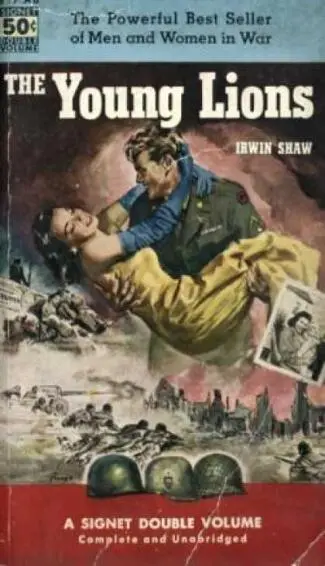
- Название:The Young Lions
- Автор:
- Жанр:
- Год:неизвестен
- ISBN:нет данных
- Рейтинг книги:4 / 5. Голосов: 1
-
Избранное:Добавить в избранное
- Отзывы:
-
Ваша оценка:
The Young Lions: краткое содержание, описание и аннотация
Предлагаем к чтению аннотацию, описание, краткое содержание или предисловие (зависит от того, что написал сам автор книги «The Young Lions»). Если вы не нашли необходимую информацию о книге — напишите в комментариях, мы постараемся отыскать её.
The Young Lions — читать онлайн бесплатно полную книгу (весь текст) целиком
Ниже представлен текст книги, разбитый по страницам. Система сохранения места последней прочитанной страницы, позволяет с удобством читать онлайн бесплатно книгу «The Young Lions», без необходимости каждый раз заново искать на чём Вы остановились. Поставьте закладку, и сможете в любой момент перейти на страницу, на которой закончили чтение.
Интервал:
Закладка:
He stood on top of the cliff, regarding the doubtful, clear coast of Europe. The town of Calais, with its docks and spires and rooftops and bare trees rising into the wartime sky, lay still in its Sunday-morning quietness, just like the town of Dover below him. He wished Roger were here with him today. Roger would have had something to say, some obscure, significant point of information about the two linked towns, twins through history, sending fishing smacks, tourists, ambassadors, soldiers, pirates, high explosive, back and forth at each other across the years. How sad that Roger had been sent to die among the palm trees and jungle moss of the Philippines. How much more fitting, if he had to die, if the bullet had reached him as he stormed the beach of the France he had loved so well, or been struck down riding into a country village near Paris, smiling, looking for the proprietor of the cafe he had drunk with all one summer – or if he had been in Italy when his death had reached him, fighting perhaps in the very fishing village through which he had passed up to Rome on his way from Naples in the autumn of 1936, recognizing the church, the city hall, the face of a girl, as he fell… Death, Noah realized, had its peculiar degrees of justness, and Roger's death had been low on that particular scale.
"You make time and you make love dandy. You make swell molasses candy, But, honey, are you makin' any money? That's all I want to know…"
Later, Noah decided, after the war, he would come back to this place with Hope. I stood here in this exact spot, and it was absolutely quiet, and there was France, looking just the way it looks now. I don't know to this day exactly why I picked Dover for what might have been my last leave. I don't know… curiosity, maybe, a desire to see what it was like. A town at war, really at war, a look at the place where the enemy was… I'd been told so much about them, how they fought, what weapons they used, what horrors they'd committed – I wanted at least to see the place where they were. And, then, sometimes there was shelling, and I'd never heard a gun fired in anger, as they used to say in the Army…
No, Noah decided, we won't talk about the war at all. We'll walk here hand in hand, on a summer's day, and sit down next to each other on the cropped grass, and look out across the Channel and say, "Look, you can almost see the church steeple in France. Isn't it a lovely afternoon?…"
The sound of an explosion shivered the quiet. Noah looked down at the harbour. A slow, lazy puff of smoke, small and toylike in the distance, was rising from the spot where the shell had hit among some warehouses. Then there was another explosion and another. The puffs of smoke blossomed in a random pattern throughout the roofs of the town. A chimney slowly crumbled, too far away to make a sound, collapsing softly like bricks made out of candy. Seven times the explosions sounded. Then there was silence again. The town seemed to go back without effort into its Sabbath sleep.
When he got back to camp, Noah found a cable waiting for him. It had taken seven days to reach him. He opened it clumsily, feeling the blood jumping in his wrists and fingertips. "A boy," he read, "six and a half pounds, I feel magnificent, I love you. Hope."
He walked in a daze out of the orderly room.
After supper he distributed the cigars. He made a careful point of giving cigars to all the men whom he had fought with in the camp in Florida. Brailsford wasn't there, because he had been transferred back in the States, but all the rest of the men took them with a surprised, uneasy shyness, and they shook his hand with dumb, warm congratulations, as though they, too, shared the wonder, so far from home, in the fine English rain, among the assembled instruments of destruction, of the state of fatherhood.
"A boy," said Donnelly, the Golden-Gloves heavyweight, the flame-thrower, shaking Noah's hand numb in his terrible, friendly fist. "A boy. What do you know about that? A boy! I hope the poor little son of a bitch never has to wear a uniform like his old man. Thank you," soberly sniffing the gift. "Thanks a lot. This is a great cigar."
But at the last moment Noah could not bring himself to offer cigars to Sergeant Rickett or Captain Colclough. He gave three to Burnecker, instead. He smoked one himself, the first of his life, and went to sleep slightly dizzy, his head wavering in smoky, thick visions.
CHAPTER TWENTY-THREE
THE door opened and Gretchen Hardenburg stood there in a grey wrap.
"Yes?" she said, opening the door only part way and peering out. "What is it?"
"Hello," Christian said, smiling. "I've just arrived in Berlin."
Gretchen opened the door a little more widely and looked closely at him. After a perceptible moment, during which she looked at his shoulder-straps, a light of recognition crossed her face. "Ah," she said. "The Sergeant. Welcome." She opened the door, but before Christian could kiss her, she extended her hand. They shook hands. Her hand was bony and seemed to be shaken by some slight ague.
"For the moment," she apologized, "the light in the hall… And, you've changed." She stepped back and looked at him critically. "You've lost so much weight. And your colour…"
"I had jaundice," Christian said shortly. He hated his colour himself, and didn't like people to remark about it. This was not how he had imagined the first minute with Gretchen, caught at the door this way, in a sharp discussion of his unpleasant complexion. "Malaria and jaundice. That's how I got to Berlin. Sick leave. I've just got off the train. This is the first place I've been…"
"How flattering," Gretchen said, automatically pushing her hair, which was uncombed, back from her face. "Very nice of you to come."
"Aren't you going to ask me in?" Christian said. Begging again, he thought bitterly, as soon as I lay eyes on her.
"Oh, I'm so sorry." Gretchen laughed shrilly. "I was asleep, and I suppose I'm still dazed. Of course, of course, come in…"
She closed the door behind him and put her hand familiarly on his arm, pressing it firmly. It may still be all right, Christian thought, as he went into the well-remembered room; perhaps she was surprised in the beginning and now she's getting over it.
Once in the living-room he made a move towards her, but she slipped away and lit a cigarette and sat down.
"Sit down, sit down," she said. "My pretty Sergeant. I often wondered what had happened to you."
"I wrote," Christian said, seating himself stiffly. "I wrote again and again. You never answered."
"Letters…" Gretchen made a face and waved her cigarette.
"One simply doesn't have the time. I always mean to… And then, finally, I burn them, it is just impossible. I loved your letters, though, I really did; it was awful what they did to you in the Ukraine, wasn't it?"
"I was not in the Ukraine," Christian said soberly. "I was in Africa and Italy."
"Of course, of course," Gretchen said without embarrassment.
"We're doing very well in Italy, aren't we? very well indeed. It is the one really bright spot."
Christian wondered how Italy could seem bright from any vantage point at all, but he did not speak. He watched Gretchen narrowly as she talked. She looked much older, especially in the untidy grey dressing-gown, and her eyes were yellowed and pouchy, her hair dead, her movements, which before had been youthfully energetic, now neurotic, overcharged, quivering.
"I envy you being in Italy," she was saying. "Berlin is getting impossible. Impossible to keep warm, impossible to sleep at night, raids almost every night, impossible to get from place to place. I tried to get sent to Italy, merely to keep warm…" She laughed, and there was something whining in her laugh. "I really need a holiday," she hurried on. "You have no idea how hard we work and under what conditions. Often I tell the man who is the head of my bureau, if the soldiers had to fight under conditions like this, they would go on strike, I tell him to his face…"
Читать дальшеИнтервал:
Закладка:
Похожие книги на «The Young Lions»
Представляем Вашему вниманию похожие книги на «The Young Lions» списком для выбора. Мы отобрали схожую по названию и смыслу литературу в надежде предоставить читателям больше вариантов отыскать новые, интересные, ещё непрочитанные произведения.








Обсуждение, отзывы о книге «The Young Lions» и просто собственные мнения читателей. Оставьте ваши комментарии, напишите, что Вы думаете о произведении, его смысле или главных героях. Укажите что конкретно понравилось, а что нет, и почему Вы так считаете.