Thea Alexander - 2150 A.D.
Здесь есть возможность читать онлайн «Thea Alexander - 2150 A.D.» весь текст электронной книги совершенно бесплатно (целиком полную версию без сокращений). В некоторых случаях можно слушать аудио, скачать через торрент в формате fb2 и присутствует краткое содержание. Год выпуска: 1971, Издательство: Warner Books; Reissue edition (July 1, 1994), Жанр: Классическая проза, Социально-психологическая фантастика, Философия, на английском языке. Описание произведения, (предисловие) а так же отзывы посетителей доступны на портале библиотеки ЛибКат.
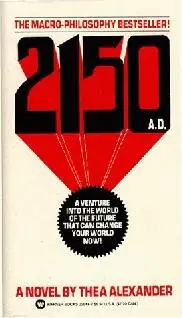
- Название:2150 A.D.
- Автор:
- Издательство:Warner Books; Reissue edition (July 1, 1994)
- Жанр:
- Год:1971
- ISBN:нет данных
- Рейтинг книги:5 / 5. Голосов: 2
-
Избранное:Добавить в избранное
- Отзывы:
-
Ваша оценка:
2150 A.D.: краткое содержание, описание и аннотация
Предлагаем к чтению аннотацию, описание, краткое содержание или предисловие (зависит от того, что написал сам автор книги «2150 A.D.»). Если вы не нашли необходимую информацию о книге — напишите в комментариях, мы постараемся отыскать её.
2150 A.D. — читать онлайн бесплатно полную книгу (весь текст) целиком
Ниже представлен текст книги, разбитый по страницам. Система сохранения места последней прочитанной страницы, позволяет с удобством читать онлайн бесплатно книгу «2150 A.D.», без необходимости каждый раз заново искать на чём Вы остановились. Поставьте закладку, и сможете в любой момент перейти на страницу, на которой закончили чтение.
Интервал:
Закладка:
"I studied the history of micro man," Carol continued. "For thousands of years anyone could have children, and they were treated as possessions. By the 20th century, in your country, they could no longer be put to work at an early age, so the micro family began ignoring them. The drug cults and youth revolts of your time were partially the result of micro man's compulsion to create far more offspring than he/she was at all prepared to guide into effective adulthood."
"And your solution," I said, "is to parentally disenfranchise ninety percent of your population."
"Oh, Jon," Carol, said shaking her head and giving me a wry smile. "You don't understand. Anyone can have a child if they prepare themselves for this purpose. It may take a few lifetimes for some, but we're not imprisoned in one lifetime as micro societies thought they were. Micro man's motto was 'you only live once, so eat, drink, and pollute, for tomorrow you may die.' And, of course, his frantic selfishness not only destroyed him but almost destroyed our whole planet."
I had to admit that by 1976 we had seriously polluted most of our lakes and rivers and were affecting the oceans as well.
I wondered how bad it had gotten between my "time" and Carol's.
Obviously perceiving my thought, she paused for a moment, her eyes saddened as if remembering something very unpleasant. Then she continued, "You polluted your oceans, your air, and your land until almost all animal and fish life was gone. Then you caused geophysical imbalances in the earth which produced-earthquakes, and tidal waves so destructive that when you look at a map of our world today you will not recognize it.",
"Well," I said lightly, not really comprehending. the magnitude of the disaster, "I guess that solved our overpopulation problem. How many people are alive in the world of, 2150?"
"Approximately 303 million," Carol said. "There would have been a lot more, in spite of the physical disasters, if micro man could have at last cooperated and helped each other. Unfortunately, he accentuated all the traditional divisions-nationality, race, religion, language, educational and socioeconomic levels-and fought over the fast-dwindling resources of his ravaged planet."
"Did micro man really become as extinct as the dinosaur and dodo bird?" I asked.
"Almost," Carol responded. "There are only about three million micro beings in existence today, and they
all live on one island, which we call Micro Island. If anyone in our Macro society gets tired of our life, they can move to Micro Island and live selfishly and in fear of their fellow micro neighbors-the way your society lived in the 20th century."
"You mean," I said, "your Macro society keeps three million people on a prison island?"
Carol shook her head. "No one has to live on Micro Island if he is willing to live in the Macro society by our Macro standards. You must understand that every person who lives on Micro Island has chosen to live there."
"Even the children?" I asked.
"Yes," Carol nodded. "We know that every child, prior to his birth, chooses his parents, as well as the environment he will grow up in."
"You mean," I added, "you, too, believe in reincarnation?"
"Yes, I do," Carol responded. "We all do. Just as exploration of the earth proved the theory that the world was round, exploration of the mind proved the theory of reincarnation.
"When we explored the subconscious mind we discovered the soul and its memory of past lives on this planet as well as in other dimensions. We learned that the first human souls to enter this planet inhabited the bodies of various animals and got trapped in animal flesh. Then other human souls decided to help their brothers by preparing a way out of this animal-life trap.
"To achieve this they hovered over the bodies of apes and, working with Macro powers, manipulated the gland centers of the apes to change their evolutionary pattern. This is how the five races of man were produced, black, brown, red, yellow, and white, at approximately the same time in different parts of the world. As these apes developed more human-like bodies, they were used as vehicles for human souls to experience this physical dimension and to provide human bodies for those trapped in animal flesh."
"And are there still human souls inhabiting animal bodies?" I asked. "In my life in 1976... could I have met a fellow human soul trapped behind bars at our local zoo?"
Carol was amused by my question. "No. Not quite. There is an evolution of souls, with some almost human souls still incarnating in other forms of life. Some of these are using mental powers that outreach those of man in specific– areas. But all truly human souls trapped in animal flesh were free to inhabit human bodies long before recorded history began. That does not, however, mean that they were not trapped."
"What do you mean?" I queried.
"I mean that in human bodies most souls could only conceive of pleasure in the limited, scope of physical. existence. Afraid of giving up or losing these pleasures, they became victims of their own desires-their own limited perspective-and kept incarnating again and again. In an attempt to avoid the law of karma they tried to forget their past. They lived in a kind of delusionary amnesia."
"I'm familiar with the concept of karma," I said. "As I understand it, it's the same as the Christian concept of 'what you sow you must reap.' Is that right?"
"Essentially, yes," Carol answered, then went on to clarify. "Karma, you see, reflects the Macro truth that all is one, and, thus, anything we do to others we do to ourselves. Of course, this isn't apparent at the limited micro perspective, so souls take refuge in micro lives in an attempt to avoid the painful consequences of their own past actions and thoughts. This is the delusionary amnesia I spoke of.
"From a purely micro view, karma doesn't exist because it is not perceived as existing.
"From a mid-point of evolution karma is acknowledged as the logical explanation for one's fortunes and misfortunes. It is believed to be real and is, therefore, real as a cause-and-effect element within a continuous time perspective.
"From a more Macro view, however, time is simultaneous, and karma is understood to be a valid element of a limited perspective regarding time. Fortunes and misfortunes are seen, from the broader perspective, not as cause and effect, but as learning opportunities specifically and carefully chosen by each soul for its own development."
"Wait a minute," I interrupted. "Let me go back a bit. You said that some souls try to forget their past in an attempt to avoid the consequences of their actions and thoughts. What's this about thoughts?"
"Thoughts are things, you know, and they are just as important as actions," Carol added. "The way you think makes you what you are and profoundly influences the world around you."
"You mean," I said, "that if I rob or murder someone, or even if I hate someone, that this will eventually come back to me?"
"Exactly," she replied. "But that's only half of it, for you see if you are patient, helpful, or think kindly of others, these, too, will come back to you.
"The great Macro philosopher, Jesus, said that whatever measures you deal out to others shall be dealt back to you in return. That's why the golden rule of treating others as you would like to be treated makes sense from a Macro view, though not from a limited micro view.
"Another expression of the law of karma is Newton's third law: For every action there is an equal and opposite reaction. This law is cumulative throughout all of one's incarnations and there is but one escape from its effect-an applied and practiced Macro perspective."
"I'm not sure I understand." I hesitated.
"What I mean, Jon, is that the same law applies to all experience, but it is seen and interpreted differently according to the size of one's perspective.
Читать дальшеИнтервал:
Закладка:
Похожие книги на «2150 A.D.»
Представляем Вашему вниманию похожие книги на «2150 A.D.» списком для выбора. Мы отобрали схожую по названию и смыслу литературу в надежде предоставить читателям больше вариантов отыскать новые, интересные, ещё непрочитанные произведения.










Обсуждение, отзывы о книге «2150 A.D.» и просто собственные мнения читателей. Оставьте ваши комментарии, напишите, что Вы думаете о произведении, его смысле или главных героях. Укажите что конкретно понравилось, а что нет, и почему Вы так считаете.