Leo Tolstoy - Android Karenina
Здесь есть возможность читать онлайн «Leo Tolstoy - Android Karenina» весь текст электронной книги совершенно бесплатно (целиком полную версию без сокращений). В некоторых случаях можно слушать аудио, скачать через торрент в формате fb2 и присутствует краткое содержание. Жанр: Классическая проза, Фэнтези, на английском языке. Описание произведения, (предисловие) а так же отзывы посетителей доступны на портале библиотеки ЛибКат.
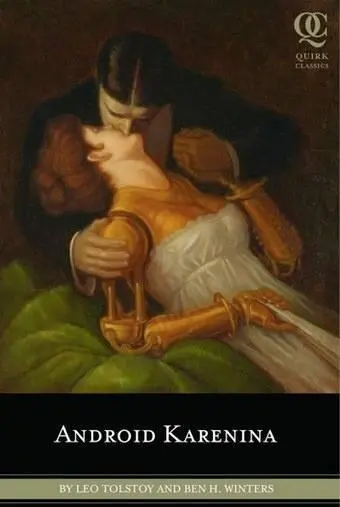
- Название:Android Karenina
- Автор:
- Жанр:
- Год:неизвестен
- ISBN:нет данных
- Рейтинг книги:5 / 5. Голосов: 1
-
Избранное:Добавить в избранное
- Отзывы:
-
Ваша оценка:
Android Karenina: краткое содержание, описание и аннотация
Предлагаем к чтению аннотацию, описание, краткое содержание или предисловие (зависит от того, что написал сам автор книги «Android Karenina»). Если вы не нашли необходимую информацию о книге — напишите в комментариях, мы постараемся отыскать её.
“Anna’s nightmare, one of the most famous passages in Anna Karenina, clearly anticipates the “steampunk‐inspired” atmosphere of Android Karenina… Tolstoy didn’t know about steampunk or cyborgs, but he did know about the nightmarishness of steam power, unruly machines, and the creepy half‐human status of the Russian peasant classes.” -Elif Batuman, author of The Possessed, via The New Yorker
“Whenever a truly pulpy trend reaches its apotheosis like this, I can’t help but wonder if we’ll get a new classic out of it.” -io9
“No word on whether she’ll [Anna] be bionically rebuilt following the ending, though. It’s good that this series is branching out to other authors…” -Entertainment Weekly
***
Android Karenina – Sense and Sensibility and Sea Monsters co-author Ben H. Winters is back with an all-new collaborator, legendary Russian novelist Leo Tolstoy, and the result is Android Karenina-an enhanced edition of the classic love story set in a dystopian world of robots, cyborgs, and interstellar space travel.
As in the original novel, our story follows two relationships: the tragic adulterous romance of Anna Karenina and Count Alexei Vronsky, and the much more hopeful marriage of Konstantin Levin and Kitty Shcherbatskaya.These four, yearning for true love, live in a steampunk-inspired 19th century of mechanical butlers, extraterrestrial-worshiping cults, and airborne debutante balls. Their passions alone would be enough to consume them-but when a secret cabal of radical scientific revolutionaries launches an attack on Russian high society's high-tech lifestyle, our heroes must fight back with all their courage, all their gadgets, and all the power of a sleek new cyborg model like nothing the world has ever seen.
Filled with the same blend of romance, drama, and fantasy that made the first two Quirk Classics New York Times best sellers, Android Karenina brings this celebrated series into the exciting world of science fiction.
Leo Tolstoy wrote two of the greatest novels in world literature: War and Peace and Anna Karenina.
Ben H. Winters is coauthor of Sense and Sensibility and Sea Monsters, which was hailed by The Onion A.V. Club as a "sheer delight" and by Library Journal as "strangely entertaining, like a Weird Al version of an opera aria." Mr. Winters lives in Brooklyn.
Android Karenina — читать онлайн бесплатно полную книгу (весь текст) целиком
Ниже представлен текст книги, разбитый по страницам. Система сохранения места последней прочитанной страницы, позволяет с удобством читать онлайн бесплатно книгу «Android Karenina», без необходимости каждый раз заново искать на чём Вы остановились. Поставьте закладку, и сможете в любой момент перейти на страницу, на которой закончили чтение.
Интервал:
Закладка:
The carriage was flung high into the air, then landed on its side and spun along the roadway until it smashed into the carriage in front of them, which carried the junkered bodies of Exteriors destroyed in the Cull. The shock and terror of that carriage’s passenger, a Ministry engineer, triggered a second blast; the junkered Exteriors flew up and were soon coming down again, a rain of deadly metal shrapnel pelting the tipped-over carriage of Anna and Karenin.
All of this Anna hardly noticed; dropping back into the corner of the upset carriage, she was sobbing, her face hidden in her hands; she did not notice, either, that with each wave of despair, a fresh explosion went off along the roadway, causing more dirt and gravel and bits of fractured metal to explode into the air. Android Karenina spread her arms widely, valiantly laying her metal body over that of her mistress.
Alexei Alexandrovich did not stir, and kept looking straight before him. But the telescopic eye embedded in the left side of his face slowly extended outward, and then upward, and as it did, the burning chunks of metal hurtling down toward the carriage halted in midair and hovered there. Anna raised her head from the crook of her arm and watched confusedly as, responding to minute movements from her husband’s mechanical eye-or so it seemed-the burning hunks of shrapnel crumpled harmlessly, one after the other, in the air above them.
A few minutes later the carriage was once more righted and along its way, its passengers still perfectly silent.
On reaching the house Alexei Alexandrovich turned his head to her, still with the same expression. He only cleared his throat decorously, and responded to her earlier declaration as if nothing had happened. “Very well! But I expect a strict observance of the external forms of propriety till such time-” his voice shook “-as I may take measures to secure my honor and communicate them to you.”
He got out first and helped her to get out. In range of the Class IIs and their senors, he pressed her hand, took his seat in the carriage, and drove back to Petersburg. Immediately afterward a II/Footman/c43 came from Princess Betsy with a communiqué.
“I sent to Alexei to find out how he is, and he writes me he is quite well and unhurt, but in despair.”
So he will be here, she thought. What a good thing I told him all!
Then for a fleeting moment she recalled the hail of shrapnel, and the cold efficiency with which her husband had defused it. She looked in the direction of Petersburg, where Alexei Alexandrovich had gone off to his office at the Ministry, and thought: What in God’s name is he?
CHAPTER 17
ON THE MAJESTIC SPACE VESSEL orbiting the planet Venus, to which the Shcherbatskys had betaken themselves, as in all places indeed where people are gathered together, the usual process of the crystallization of society went on, assigning to each member of that society a definite and unalterable place. Though this vessel was the property of the Russian Ministry of Robotics and State Administration (and operated by the sub-Ministry of Extraterrestrial Trade & Travel), berths were sold to all peoples of the world. And just as the particle of water in frost definitely and unalterably takes the special form of the crystal of snow, so each new person who arrived aboard was at once placed in his special place. The Shcherbatskys, from their name and from the friends they made, were immediately crystallized into a definite place marked out for them.
It was characteristic of Kitty that she always imagined everything in people in the most favorable light possible, especially so in those she did not know. Kitty wandered the long, illuminated halls of the grand old vessel, as it slowly rotated in the ancient blackness of space, arm in arm with her now-beloved Class III, Tatiana, observing and delighting in her fellow passengers. This massive satellite they now inhabited was an Orbiting Purification Retreat, on which the air was carefully recirculated to cleanse it of impurities, in order to maintain maximum recuperative qualities.
Of these people the one who attracted her most was a Russian girl who had blasted off in the company of an invalid Russian lady, Madame Stahl, as everyone called her. Madame Stahl belonged to the highest society, but she was so ill that she could not walk, and was borne about the passageways of the vessel not by a Class III, but dragged in a Class I wheelbarrow piloted by the girl, whom Madame Stahl called Varenka.
The two girls, Kitty and Varenka, met several times a day, and every time they met, Kitty’s eyes said: “Who are you? What are you? Are you really the exquisite creature I imagine you to be? But for goodness’ sake don’t suppose,” her eyes added, “that I would force my acquaintance on you, I simply admire you and like you.”
“I like you too, and you’re very, very sweet. And I should like you better still, if I had time,” answered the eyes of the unknown girl. Kitty saw indeed that she was always busy, either dragging Madame Stahl around on the Class I sledge or resting her arms from a long day of doing so.
Soon after the arrival of the Shcherbatskys there appeared on the morning transport two persons who attracted universal and unfavorable attention. These were a tall man with a stooping figure and huge hands, with black, simple, and yet terrible eyes, and a squat, sputtering Class III; and a pockmarked, kind-looking woman, very badly and tastelessly dressed. Recognizing these persons as Russians, Kitty had already in her imagination begun constructing a delightful and touching romance about them. But her mother, having ascertained from the visitors’ list that this was Nikolai Levin and Marya Nikolaevna, explained to Kitty what a bad man this Levin was, and all her fancies about these two people vanished. Not so much from what the princess told her, as from the fact that it was Konstantin’s brother, this pair suddenly seemed to Kitty intensely unpleasant. This Levin, with his continual twitching of his head, and a cluster of suppurating sores above and around his eyes, aroused in her now an irrepressible feeling of disgust. It seemed to her that his big, terrible eyes, and their dreadful outline of pustules, expressed a feeling of hatred and contempt, and she tried to avoid meeting him.
But Kitty soon found an excuse to make the acquaintance of Varenka, and of Madame Stahl too, and these friendships comforted her in her mental distress. She found this comfort through a completely new world being opened to her by means of this acquaintance, a world having nothing in common with her past, an exalted, noble world, from the height of which she could contemplate her past calmly. It was revealed to her that besides the instinctive life to which Kitty had given herself up hitherto, there was a spiritual life. This life was disclosed in religion, but a religion having nothing in common with that one which Kitty had known from childhood, and which found expression in litanies and all-night services at the Widow’s Home, where one might meet one’s friends, and in learning by heart Slavonic texts with the priest. Madame Stahl’s religion was xenotheologism, the lofty, mysterious faith that Kitty had experienced only slightly, through her friend Countess Nordston: the religion that worshipped mysterious light-beings called the Honored Guests; they who, Madame Stahl explained rapturously, would “come for us in three ways” in days to come, traveling from the farthest reaches of the interplanetary ether to redeem all humankind.
Countess Nordston’s version of this faith, Kitty now understood, had reflected only a limited understanding. When it was presented to her in its full, luminescent complexity by Madame Stahl, xenotheologism brought to Kitty a whole series of noble thoughts and feelings. And Kitty found all this out not from words. Madame Stahl talked to Kitty as to a charming child whom one looks on with pleasure, as on the memory of one’s youth, and only once she said in passing that in all human sorrows nothing gives comfort but love and faith, and that in the knowledge of the Honored Guests’ compassion for us no sorrow is trifling-and immediately talked of other things. But in every gesture of Madame Stahl, in every word, in every heavenly-as Kitty called it-look, and above all in the whole story of her life, which she heard from Varenka, Kitty recognized that “something important,” of which, till then, she had known nothing.
Читать дальшеИнтервал:
Закладка:
Похожие книги на «Android Karenina»
Представляем Вашему вниманию похожие книги на «Android Karenina» списком для выбора. Мы отобрали схожую по названию и смыслу литературу в надежде предоставить читателям больше вариантов отыскать новые, интересные, ещё непрочитанные произведения.








Обсуждение, отзывы о книге «Android Karenina» и просто собственные мнения читателей. Оставьте ваши комментарии, напишите, что Вы думаете о произведении, его смысле или главных героях. Укажите что конкретно понравилось, а что нет, и почему Вы так считаете.