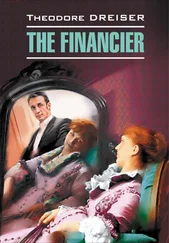
Theodore Dreiser - The Financier
Здесь есть возможность читать онлайн «Theodore Dreiser - The Financier» весь текст электронной книги совершенно бесплатно (целиком полную версию без сокращений). В некоторых случаях можно слушать аудио, скачать через торрент в формате fb2 и присутствует краткое содержание. Жанр: Классическая проза, на английском языке. Описание произведения, (предисловие) а так же отзывы посетителей доступны на портале библиотеки ЛибКат.
- Название:The Financier
- Автор:
- Жанр:
- Год:неизвестен
- ISBN:нет данных
- Рейтинг книги:5 / 5. Голосов: 1
-
Избранное:Добавить в избранное
- Отзывы:
-
Ваша оценка:
The Financier: краткое содержание, описание и аннотация
Предлагаем к чтению аннотацию, описание, краткое содержание или предисловие (зависит от того, что написал сам автор книги «The Financier»). Если вы не нашли необходимую информацию о книге — напишите в комментариях, мы постараемся отыскать её.
The Financier — читать онлайн бесплатно полную книгу (весь текст) целиком
Ниже представлен текст книги, разбитый по страницам. Система сохранения места последней прочитанной страницы, позволяет с удобством читать онлайн бесплатно книгу «The Financier», без необходимости каждый раз заново искать на чём Вы остановились. Поставьте закладку, и сможете в любой момент перейти на страницу, на которой закончили чтение.
Интервал:
Закладка:
Stener’s scheme of loaning him money wherewith to manipulate the North Pennsylvania line deal put this Seventeenth and Nineteenth Street dream in a more favorable light. As it was he was constantly watching the certificates of loan issue, for the city treasury,—buying large quantities when the market was falling to protect it and selling heavily, though cautiously, when he saw it rising and to do this he had to have a great deal of free money to permit him to do it. He was constantly fearful of some break in the market which would affect the value of all his securities and result in the calling of his loans. There was no storm in sight. He did not see that anything could happen in reason; but he did not want to spread himself out too thin. As he saw it now, therefore if he took one hundred and fifty thousand dollars of this city money and went after this Seventeenth and Nineteenth Street matter it would not mean that he was spreading himself out too thin, for because of this new proposition could he not call on Stener for more as a loan in connection with these other ventures? But if anything should happen—well—
“Frank,” said Stener, strolling into his office one afternoon after four o’clock when the main rush of the day’s work was over—the relationship between Cowperwood and Stener had long since reached the “Frank” and “George” period—“Strobik thinks he has that North Pennsylvania deal arranged so that we can take it up if we want to. The principal stockholder, we find, is a man by the name of Coltan—not Ike Colton, but Ferdinand. How’s that for a name?” Stener beamed fatly and genially.
Things had changed considerably for him since the days when he had been fortuitously and almost indifferently made city treasurer. His method of dressing had so much improved since he had been inducted into office, and his manner expressed so much more good feeling, confidence, aplomb, that he would not have recognized himself if he had been permitted to see himself as had those who had known him before. An old, nervous shifting of the eyes had almost ceased, and a feeling of restfulness, which had previously been restlessness, and had sprung from a sense of necessity, had taken its place. His large feet were incased in good, square-toed, soft-leather shoes; his stocky chest and fat legs were made somewhat agreeable to the eye by a well-cut suit of brownish-gray cloth; and his neck was now surrounded by a low, wing-point white collar and brown-silk tie. His ample chest, which spread out a little lower in around and constantly enlarging stomach, was ornamented by a heavy-link gold chain, and his white cuffs had large gold cuff-buttons set with rubies of a very notable size. He was rosy and decidedly well fed. In fact, he was doing very well indeed.
He had moved his family from a shabby two-story frame house in South Ninth Street to a very comfortable brick one three stories in height, and three times as large, on Spring Garden Street. His wife had a few acquaintances—the wives of other politicians. His children were attending the high school, a thing he had hardly hoped for in earlier days. He was now the owner of fourteen or fifteen pieces of cheap real estate in different portions of the city, which might eventually become very valuable, and he was a silent partner in the South Philadelphia Foundry Company and the American Beef and Pork Company, two corporations on paper whose principal business was subletting contracts secured from the city to the humble butchers and foundrymen who would carry out orders as given and not talk too much or ask questions.
“Well, that is an odd name,” said Cowperwood, blandly. “So he has it? I never thought that road would pay, as it was laid out. It’s too short. It ought to run about three miles farther out into the Kensington section.”
“You’re right,” said Stener, dully.
“Did Strobik say what Colton wants for his shares?”
“Sixty-eight, I think.”
“The current market rate. He doesn’t want much, does he? Well, George, at that rate it will take about”—he calculated quickly on the basis of the number of shares Cotton was holding—“one hundred and twenty thousand to get him out alone. That isn’t all. There’s Judge Kitchen and Joseph Zimmerman and Senator Donovan”—he was referring to the State senator of that name. “You’ll be paying a pretty fair price for that stud when you get it. It will cost considerable more to extend the line. It’s too much, I think.”
Cowperwood was thinking how easy it would be to combine this line with his dreamed-of Seventeenth and Nineteenth Street line, and after a time and with this in view he added:
“Say, George, why do you work all your schemes through Strobik and Harmon and Wycroft? Couldn’t you and I manage some of these things for ourselves alone instead of for three or four? It seems to me that plan would be much more profitable to you.”
“It would, it would!” exclaimed Stener, his round eyes fixed on Cowperwood in a rather helpless, appealing way. He liked Cowperwood and had always been hoping that mentally as well as financially he could get close to him. “I’ve thought of that. But these fellows have had more experience in these matters than I have had, Frank. They’ve been longer at the game. I don’t know as much about these things as they do.”
Cowperwood smiled in his soul, though his face remained passive.
“Don’t worry about them, George,” he continued genially and confidentially. “You and I together can know and do as much as they ever could and more. I’m telling you. Take this railroad deal you’re in on now, George; you and I could manipulate that just as well and better than it can be done with Wycroft, Strobik, and Harmon in on it. They’re not adding anything to the wisdom of the situation. They’re not putting up any money. You’re doing that. All they’re doing is agreeing to see it through the legislature and the council, and as far as the legislature is concerned, they can’t do any more with that than any one else could—than I could, for instance. It’s all a question of arranging things with Relihan, anyhow, putting up a certain amount of money for him to work with. Here in town there are other people who can reach the council just as well as Strobik.” He was thinking (once he controlled a road of his own) of conferring with Butler and getting him to use his influence. It would serve to quiet Strobik and his friends. “I’m not asking you to change your plans on this North Pennsylvania deal. You couldn’t do that very well. But there are other things. In the future why not let’s see if you and I can’t work some one thing together? You’ll be much better off, and so will I. We’ve done pretty well on the city-loan proposition so far, haven’t we?”
The truth was, they had done exceedingly well. Aside from what the higher powers had made, Stener’s new house, his lots, his bank-account, his good clothes, and his changed and comfortable sense of life were largely due to Cowperwood’s successful manipulation of these city-loan certificates. Already there had been four issues of two hundred thousand dollars each. Cowperwood had bought and sold nearly three million dollars’ worth of these certificates, acting one time as a “bull” and another as a “bear.” Stener was now worth all of one hundred and fifty thousand dollars.
“There’s a line that I know of here in the city which could be made into a splendidly paying property,” continued Cowperwood, meditatively, “if the right things could be done with it. Just like this North Pennsylvania line, it isn’t long enough. The territory it serves isn’t big enough. It ought to be extended; but if you and I could get it, it might eventually be worked with this North Pennsylvania Company or some other as one company. That would save officers and offices and a lot of things. There is always money to be made out of a larger purchasing power.”
Читать дальшеИнтервал:
Закладка:
Похожие книги на «The Financier»
Представляем Вашему вниманию похожие книги на «The Financier» списком для выбора. Мы отобрали схожую по названию и смыслу литературу в надежде предоставить читателям больше вариантов отыскать новые, интересные, ещё непрочитанные произведения.










Обсуждение, отзывы о книге «The Financier» и просто собственные мнения читателей. Оставьте ваши комментарии, напишите, что Вы думаете о произведении, его смысле или главных героях. Укажите что конкретно понравилось, а что нет, и почему Вы так считаете.