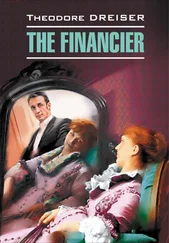
Theodore Dreiser - The Financier
Здесь есть возможность читать онлайн «Theodore Dreiser - The Financier» весь текст электронной книги совершенно бесплатно (целиком полную версию без сокращений). В некоторых случаях можно слушать аудио, скачать через торрент в формате fb2 и присутствует краткое содержание. Жанр: Классическая проза, на английском языке. Описание произведения, (предисловие) а так же отзывы посетителей доступны на портале библиотеки ЛибКат.
- Название:The Financier
- Автор:
- Жанр:
- Год:неизвестен
- ISBN:нет данных
- Рейтинг книги:5 / 5. Голосов: 1
-
Избранное:Добавить в избранное
- Отзывы:
-
Ваша оценка:
The Financier: краткое содержание, описание и аннотация
Предлагаем к чтению аннотацию, описание, краткое содержание или предисловие (зависит от того, что написал сам автор книги «The Financier»). Если вы не нашли необходимую информацию о книге — напишите в комментариях, мы постараемся отыскать её.
The Financier — читать онлайн бесплатно полную книгу (весь текст) целиком
Ниже представлен текст книги, разбитый по страницам. Система сохранения места последней прочитанной страницы, позволяет с удобством читать онлайн бесплатно книгу «The Financier», без необходимости каждый раз заново искать на чём Вы остановились. Поставьте закладку, и сможете в любой момент перейти на страницу, на которой закончили чтение.
Интервал:
Закладка:
“Baby mine,” he said, “do you understand all about this? Do you know exactly what you’re doing when you come with me this way?”
“I think I do.”
She struck her boot and looked at the ground, and then up through the trees at the blue sky.
“Look at me, honey.”
“I don’t want to.”
“But look at me, sweet. I want to ask you something.”
“Don’t make me, Frank, please. I can’t.”
“Oh yes, you can look at me.”
“No.”
She backed away as he took her hands, but came forward again, easily enough.
“Now look in my eyes.”
“I can’t.”
“See here.”
“I can’t. Don’t ask me. I’ll answer you, but don’t make me look at you.”
His hand stole to her cheek and fondled it. He petted her shoulder, and she leaned her head against him.
“Sweet, you’re so beautiful,” he said finally, “I can’t give you up. I know what I ought to do. You know, too, I suppose; but I can’t. I must have you. If this should end in exposure, it would be quite bad for you and me. Do you understand?”
“Yes.”
“I don’t know your brothers very well; but from looking at them I judge they’re pretty determined people. They think a great deal of you.”
“Indeed, they do.” Her vanity prinked slightly at this.
“They would probably want to kill me, and very promptly, for just this much. What do you think they would want to do if—well, if anything should happen, some time?”
He waited, watching her pretty face.
“But nothing need happen. We needn’t go any further.”
“Aileen!”
“I won’t look at you. You needn’t ask. I can’t.”
“Aileen! Do you mean that?”
“I don’t know. Don’t ask me, Frank.”
“You know it can’t stop this way, don’t you? You know it. This isn’t the end. Now, if—” He explained the whole theory of illicit meetings, calmly, dispassionately. “You are perfectly safe, except for one thing, chance exposure. It might just so happen; and then, of course, there would be a great deal to settle for. Mrs. Cowperwood would never give me a divorce; she has no reason to. If I should clean up in the way I hope to—if I should make a million—I wouldn’t mind knocking off now. I don’t expect to work all my days. I have always planned to knock off at thirty-five. I’ll have enough by that time. Then I want to travel. It will only be a few more years now. If you were free—if your father and mother were dead”—curiously she did not wince at this practical reference—“it would be a different matter.”
He paused. She still gazed thoughtfully at the water below, her mind running out to a yacht on the sea with him, a palace somewhere—just they two. Her eyes, half closed, saw this happy world; and, listening to him, she was fascinated.
“Hanged if I see the way out of this, exactly. But I love you!” He caught her to him. “I love you—love you!”
“Oh, yes,” she replied intensely, “I want you to. I’m not afraid.”
“I’ve taken a house in North Tenth Street,” he said finally, as they walked over to the horses and mounted them. “It isn’t furnished yet; but it will be soon. I know a woman who will take charge.”
“Who is she?”
“An interesting widow of nearly fifty. Very intelligent—she is attractive, and knows a good deal of life. I found her through an advertisement. You might call on her some afternoon when things are arranged, and look the place over. You needn’t meet her except in a casual way. Will you?”
She rode on, thinking, making no reply. He was so direct and practical in his calculations.
“Will you? It will be all right. You might know her. She isn’t objectionable in any way. Will you?”
“Let me know when it is ready,” was all she said finally.
Chapter XXI
The vagaries of passion! Subtleties! Risks! What sacrifices are not laid willfully upon its altar! In a little while this more than average residence to which Cowperwood had referred was prepared solely to effect a satisfactory method of concealment. The house was governed by a seemingly recently-bereaved widow, and it was possible for Aileen to call without seeming strangely out of place. In such surroundings, and under such circumstances, it was not difficult to persuade her to give herself wholly to her lover, governed as she was by her wild and unreasoning affection and passion. In a way, there was a saving element of love, for truly, above all others, she wanted this man. She had no thought or feeling toward any other. All her mind ran toward visions of the future, when, somehow, she and he might be together for all time. Mrs. Cowperwood might die, or he might run away with her at thirty-five when he had a million. Some adjustment would be made, somehow. Nature had given her this man. She relied on him implicitly. When he told her that he would take care of her so that nothing evil should befall, she believed him fully. Such sins are the commonplaces of the confessional.
It is a curious fact that by some subtlety of logic in the Christian world, it has come to be believed that there can be no love outside the conventional process of courtship and marriage. One life, one love, is the Christian idea, and into this sluice or mold it has been endeavoring to compress the whole world. Pagan thought held no such belief. A writing of divorce for trivial causes was the theory of the elders; and in the primeval world nature apparently holds no scheme for the unity of two beyond the temporary care of the young. That the modern home is the most beautiful of schemes, when based upon mutual sympathy and understanding between two, need not be questioned. And yet this fact should not necessarily carry with it a condemnation of all love not so fortunate as to find so happy a dénouement. Life cannot be put into any mold, and the attempt might as well be abandoned at once. Those so fortunate as to find harmonious companionship for life should congratulate themselves and strive to be worthy of it. Those not so blessed, though they be written down as pariahs, have yet some justification. And, besides, whether we will or not, theory or no theory, the basic facts of chemistry and physics remain. Like is drawn to like. Changes in temperament bring changes in relationship. Dogma may bind some minds; fear, others. But there are always those in whom the chemistry and physics of life are large, and in whom neither dogma nor fear is operative. Society lifts its hands in horror; but from age to age the Helens, the Messalinas, the Du Barrys, the Pompadours, the Maintenons, and the Nell Gwyns flourish and point a freer basis of relationship than we have yet been able to square with our lives.
These two felt unutterably bound to each other. Cowperwood, once he came to understand her, fancied that he had found the one person with whom he could live happily the rest of his life. She was so young, so confident, so hopeful, so undismayed. All these months since they had first begun to reach out to each other he had been hourly contrasting her with his wife. As a matter of fact, his dissatisfaction, though it may be said to have been faint up to this time, was now surely tending to become real enough. Still, his children were pleasing to him; his home beautiful. Lillian, phlegmatic and now thin, was still not homely. All these years he had found her satisfactory enough; but now his dissatisfaction with her began to increase. She was not like Aileen—not young, not vivid, not as unschooled in the commonplaces of life. And while ordinarily, he was not one who was inclined to be querulous, still now on occasion, he could be. He began by asking questions concerning his wife’s appearance—irritating little whys which are so trivial and yet so exasperating and discouraging to a woman. Why didn’t she get a mauve hat nearer the shade of her dress? Why didn’t she go out more? Exercise would do her good. Why didn’t she do this, and why didn’t she do that? He scarcely noticed that he was doing this; but she did, and she felt the undertone—the real significance—and took umbrage.
Читать дальшеИнтервал:
Закладка:
Похожие книги на «The Financier»
Представляем Вашему вниманию похожие книги на «The Financier» списком для выбора. Мы отобрали схожую по названию и смыслу литературу в надежде предоставить читателям больше вариантов отыскать новые, интересные, ещё непрочитанные произведения.








Обсуждение, отзывы о книге «The Financier» и просто собственные мнения читателей. Оставьте ваши комментарии, напишите, что Вы думаете о произведении, его смысле или главных героях. Укажите что конкретно понравилось, а что нет, и почему Вы так считаете.