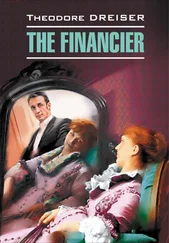
Theodore Dreiser - The Financier
Здесь есть возможность читать онлайн «Theodore Dreiser - The Financier» весь текст электронной книги совершенно бесплатно (целиком полную версию без сокращений). В некоторых случаях можно слушать аудио, скачать через торрент в формате fb2 и присутствует краткое содержание. Жанр: Классическая проза, на английском языке. Описание произведения, (предисловие) а так же отзывы посетителей доступны на портале библиотеки ЛибКат.
- Название:The Financier
- Автор:
- Жанр:
- Год:неизвестен
- ISBN:нет данных
- Рейтинг книги:5 / 5. Голосов: 1
-
Избранное:Добавить в избранное
- Отзывы:
-
Ваша оценка:
The Financier: краткое содержание, описание и аннотация
Предлагаем к чтению аннотацию, описание, краткое содержание или предисловие (зависит от того, что написал сам автор книги «The Financier»). Если вы не нашли необходимую информацию о книге — напишите в комментариях, мы постараемся отыскать её.
The Financier — читать онлайн бесплатно полную книгу (весь текст) целиком
Ниже представлен текст книги, разбитый по страницам. Система сохранения места последней прочитанной страницы, позволяет с удобством читать онлайн бесплатно книгу «The Financier», без необходимости каждый раз заново искать на чём Вы остановились. Поставьте закладку, и сможете в любой момент перейти на страницу, на которой закончили чтение.
Интервал:
Закладка:
“Oh, why—why?” she retorted, one day, curtly. “Why do you ask so many questions? You don’t care so much for me any more; that’s why. I can tell.”
He leaned back startled by the thrust. It had not been based on any evidence of anything save his recent remarks; but he was not absolutely sure. He was just the least bit sorry that he had irritated her, and he said so.
“Oh, it’s all right,” she replied. “I don’t care. But I notice that you don’t pay as much attention to me as you used to. It’s your business now, first, last, and all the time. You can’t get your mind off of that.”
He breathed a sigh of relief. She didn’t suspect, then.
But after a little time, as he grew more and more in sympathy with Aileen, he was not so disturbed as to whether his wife might suspect or not. He began to think on occasion, as his mind followed the various ramifications of the situation, that it would be better if she did. She was really not of the contentious fighting sort. He now decided because of various calculations in regard to her character that she might not offer as much resistance to some ultimate rearrangement, as he had originally imagined. She might even divorce him. Desire, dreams, even in him were evoking calculations not as sound as those which ordinarily generated in his brain.
No, as he now said to himself, the rub was not nearly so much in his own home, as it was in the Butler family. His relations with Edward Malia Butler had become very intimate. He was now advising with him constantly in regard to the handling of his securities, which were numerous. Butler held stocks in such things as the Pennsylvania Coal Company, the Delaware and Hudson Canal, the Morris and Essex Canal, the Reading Railroad. As the old gentleman’s mind had broadened to the significance of the local street-railway problem in Philadelphia, he had decided to close out his other securities at such advantageous terms as he could, and reinvest the money in local lines. He knew that Mollenhauer and Simpson were doing this, and they were excellent judges of the significance of local affairs. Like Cowperwood, he had the idea that if he controlled sufficient of the local situation in this field, he could at last effect a joint relationship with Mollenhauer and Simpson. Political legislation, advantageous to the combined lines, could then be so easily secured. Franchises and necessary extensions to existing franchises could be added. This conversion of his outstanding stock in other fields, and the picking up of odd lots in the local street-railway, was the business of Cowperwood. Butler, through his sons, Owen and Callum, was also busy planning a new line and obtaining a franchise, sacrificing, of course, great blocks of stock and actual cash to others, in order to obtain sufficient influence to have the necessary legislation passed. Yet it was no easy matter, seeing that others knew what the general advantages of the situation were, and because of this Cowperwood, who saw the great source of profit here, was able, betimes, to serve himself—buying blocks, a part of which only went to Butler, Mollenhauer or others. In short he was not as eager to serve Butler, or any one else, as he was to serve himself if he could.
In this connection, the scheme which George W. Stener had brought forward, representing actually in the background Strobik, Wycroft, and Harmon, was an opening wedge for himself. Stener’s plan was to loan him money out of the city treasury at two per cent., or, if he would waive all commissions, for nothing (an agent for self-protective purposes was absolutely necessary), and with it take over the North Pennsylvania Company’s line on Front Street, which, because of the shortness of its length, one mile and a half, and the brevity of the duration of its franchise, was neither doing very well nor being rated very high. Cowperwood in return for his manipulative skill was to have a fair proportion of the stock—twenty per cent. Strobik and Wycroft knew the parties from whom the bulk of the stock could be secured if engineered properly. Their plan was then, with this borrowed treasury money, to extend its franchise and then the line itself, and then later again, by issuing a great block of stock and hypothecating it with a favored bank, be able to return the principal to the city treasury and pocket their profits from the line as earned. There was no trouble in this, in so far as Cowperwood was concerned, except that it divided the stock very badly among these various individuals, and left him but a comparatively small share—for his thought and pains.
But Cowperwood was an opportunist. And by this time his financial morality had become special and local in its character. He did not think it was wise for any one to steal anything from anybody where the act of taking or profiting was directly and plainly considered stealing. That was unwise—dangerous—hence wrong. There were so many situations wherein what one might do in the way of taking or profiting was open to discussion and doubt. Morality varied, in his mind at least, with conditions, if not climates. Here, in Philadelphia, the tradition (politically, mind you—not generally) was that the city treasurer might use the money of the city without interest so long as he returned the principal intact. The city treasury and the city treasurer were like a honey-laden hive and a queen bee around which the drones—the politicians—swarmed in the hope of profit. The one disagreeable thing in connection with this transaction with Stener was that neither Butler, Mollenhauer nor Simpson, who were the actual superiors of Stener and Strobik, knew anything about it. Stener and those behind him were, through him, acting for themselves. If the larger powers heard of this, it might alienate them. He had to think of this. Still, if he refused to make advantageous deals with Stener or any other man influential in local affairs, he was cutting off his nose to spite his face, for other bankers and brokers would, and gladly. And besides it was not at all certain that Butler, Mollenhauer, and Simpson would ever hear.
In this connection, there was another line, which he rode on occasionally, the Seventeenth and Nineteenth Street line, which he felt was a much more interesting thing for him to think about, if he could raise the money. It had been originally capitalized for five hundred thousand dollars; but there had been a series of bonds to the value of two hundred and fifty thousand dollars added for improvements, and the company was finding great difficulty in meeting the interest. The bulk of the stock was scattered about among small investors, and it would require all of two hundred and fifty thousand dollars to collect it and have himself elected president or chairman of the board of directors. Once in, however, he could vote this stock as he pleased, hypothecating it meanwhile at his father’s bank for as much as he could get, and issuing more stocks with which to bribe legislators in the matter of extending the line, and in taking up other opportunities to either add to it by purchase or supplement it by working agreements. The word “bribe” is used here in this matter-of-fact American way, because bribery was what was in every one’s mind in connection with the State legislature. Terrence Relihan—the small, dark-faced Irishman, a dandy in dress and manners—who represented the financial interests at Harrisburg, and who had come to Cowperwood after the five million bond deal had been printed, had told him that nothing could be done at the capital without money, or its equivalent, negotiable securities. Each significant legislator, if he yielded his vote or his influence, must be looked after. If he, Cowperwood, had any scheme which he wanted handled at any time, Relihan had intimated to him that he would be glad to talk with him. Cowperwood had figured on this Seventeenth and Nineteenth Street line scheme more than once, but he had never felt quite sure that he was willing to undertake it. His obligations in other directions were so large. But the lure was there, and he pondered and pondered.
Читать дальшеИнтервал:
Закладка:
Похожие книги на «The Financier»
Представляем Вашему вниманию похожие книги на «The Financier» списком для выбора. Мы отобрали схожую по названию и смыслу литературу в надежде предоставить читателям больше вариантов отыскать новые, интересные, ещё непрочитанные произведения.










Обсуждение, отзывы о книге «The Financier» и просто собственные мнения читателей. Оставьте ваши комментарии, напишите, что Вы думаете о произведении, его смысле или главных героях. Укажите что конкретно понравилось, а что нет, и почему Вы так считаете.