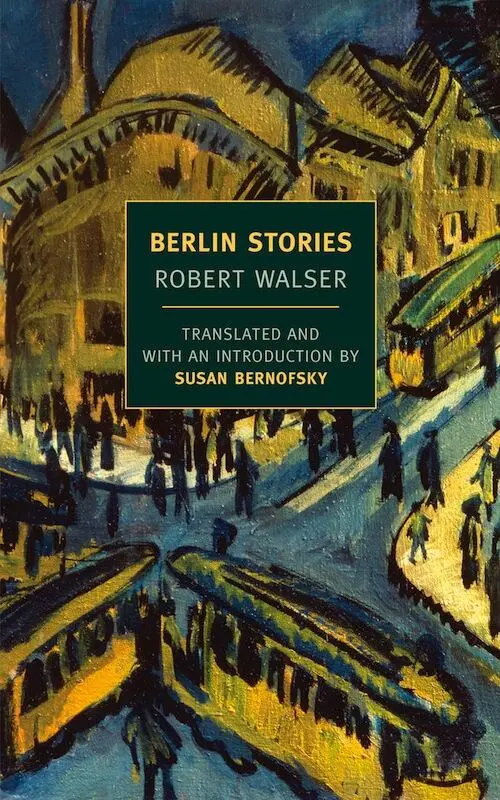
Robert Walser - Berlin Stories
Здесь есть возможность читать онлайн «Robert Walser - Berlin Stories» весь текст электронной книги совершенно бесплатно (целиком полную версию без сокращений). В некоторых случаях можно слушать аудио, скачать через торрент в формате fb2 и присутствует краткое содержание. Год выпуска: 2012, ISBN: 2012, Издательство: NYRB Classics, Жанр: Классическая проза, на английском языке. Описание произведения, (предисловие) а так же отзывы посетителей доступны на портале библиотеки ЛибКат.
- Название:Berlin Stories
- Автор:
- Издательство:NYRB Classics
- Жанр:
- Год:2012
- ISBN:978-1590174548
- Рейтинг книги:4 / 5. Голосов: 1
-
Избранное:Добавить в избранное
- Отзывы:
-
Ваша оценка:
Berlin Stories: краткое содержание, описание и аннотация
Предлагаем к чтению аннотацию, описание, краткое содержание или предисловие (зависит от того, что написал сам автор книги «Berlin Stories»). Если вы не нашли необходимую информацию о книге — напишите в комментариях, мы постараемся отыскать её.
collects his alternately celebratory, droll, and satirical observations on every aspect of the bustling German capital, from its theaters, cabarets, painters’ galleries, and literary salons, to the metropolitan street, markets, the Tiergarten, rapid-service restaurants, and the electric tram. Originally appearing in literary magazines as well as the feuilleton sections of newspapers, the early stories are characterized by a joyous urgency and the generosity of an unconventional guide. Later pieces take the form of more personal reflections on the writing process, memories, and character studies. All are full of counter-intuitive images and vignettes of startling clarity, showcasing a unique talent for whom no detail was trivial, at grips with a city diving headlong into modernity.
Berlin Stories — читать онлайн бесплатно полную книгу (весь текст) целиком
Ниже представлен текст книги, разбитый по страницам. Система сохранения места последней прочитанной страницы, позволяет с удобством читать онлайн бесплатно книгу «Berlin Stories», без необходимости каждый раз заново искать на чём Вы остановились. Поставьте закладку, и сможете в любой момент перейти на страницу, на которой закончили чтение.
Интервал:
Закладка:
I’d seen a poor, sick, unhappy day laborer forgotten by all the world, lying in her squalid bed of sufferings; I heard her sighs.
Forests, hills, plains silent and wordless in the dull hush of the gleaming winter sun. Here and there a solitary person, an insignificant little word, an isolated sound.
One day I left all this remoteness and all this silence behind and set off for the seductive gleam of the capital, where soon thereafter I saw The Tales of Hoffmann at the Komische Oper.
I felt like an astonished hayseed amid all that gleaming intoxication, the graceful, sense-beguiling tumultuousness and the blindingly elegant society gathered there.
But when the interior of the grand edifice became as silent as a tiny chamber filled with reveries and fancies of the soul, as the might and art of sound opened their divine mouths and began to sing, ring out, and resound, beginning with the overture that wheedled its way into all our souls with its bright and dark, gay and earnest melodies, only to entwine them — now constricting, now liberating from constriction — with heavenly bliss, and then soft warm song burst from the lips of the singers and songstresses, images brimming with delicate, noble, magical colors and magical figures lightly and gaily emerged to delight the eye and taste, music and painting most beautifully took possession of every heart, eye, and ear, and everything became suddenly quiet as a mouse, only to resound once more as if it wished never to stop so beautifully resounding and conquering its listeners with its desired, delightful force: pain and sounds of joy mirroring the adventure of existence, exemplifying the meaning of life, and soaring up and down the scales like angelic figures ascending and descending Jacob’s ladder …
Oh, everything was so regally beautiful and luxurious all about our tear-filled, feverish eyes and in our hearts. All of life could now cease outright or else begin utterly anew.
What a presence to partake of! Thousands of hours flowed together to form this one single hour. Yes, what a beautiful, good, meaningful evening this was.
1916
The Tanners
The intoxicating gleam of the dark, metropolitan streets, the lights, the people, my brother. I myself, living in my brother’s apartment. I shall never forget this simple two-bedroom dwelling. It always seemed to me as if this apartment contained a sky complete with stars, moon, and clouds. Marvelous romanticism, dulcet forebodings! My brother would spend half the night at the theater, where he was making the stage sets. At three or four in the morning he would come home, and I would still be sitting there, enchanted by all the thoughts, all the lovely images wafting through my head; it was as if I no longer required sleep, as if thinking, writing, and waking were my lovely, restorative sleep, as if writing for hours and hours at my desk comprised my world, my pleasure, relaxation and peace. The dark-colored desk, so antiquated it might have been an old magician. When I pulled open its delicately worked small drawers, I imagined that sentences, words, and maxims would come leaping out. The snow-white curtains, the singing gaslight, the elongated dark room, the cat and all the becalmed waves of the long nights filled with thoughts. From time to time I would go visit the merry maids down at the girls’ tavern, that was also part of it. To speak of the cat once more: she always sat on the pages filled with writing that I had laid to one side and would blink at me with her unfathomable golden eyes so strangely, with such a questioning look. Her presence was like the presence of an odd, silent fairy. Perhaps I owe this dear, silent animal a great deal. How can one know? The further I progressed in my writing, the more I felt as if I were being watched over and protected by a kindly entity. A soft, delicate large veil floated about me. But at this juncture I should also mention the liqueur that stood upon the sideboard. I partook of it as freely as I was permitted and able. Everything all around me had a soothing, invigorating influence. Certain states, circumstances, and circles are there only once, never again to appear, or else only when one is least expecting it. Are not expectations and presuppositions unholy, impertinent, and indelicate? The poet must ramble and rove, he must courageously lose himself, must always venture everything he owns, and he has to hope, or rather he is permitted: permitted to hope. — I recall that I began writing the book with a hopeless flutter of words, with all sorts of mindless sketchings and scribblings. — I never dreamed I might be capable of completing something serious, beautiful, and good. — Better ideas and, along with them, the courage to create arrived only gradually, but also all the more mysteriously, rising out of chasms of self-contempt and flippant disbelief. — It was like the morning sun rising up in the sky. Evening and morning, past and future and the so delightful present seemed to lie at my feet; before me the countryside quickened with life, and I felt as though I could grasp human activity, all of human life in my hands, that’s how vividly I saw it. — One image gave way to another, and the thoughts that occurred to me played with one another like happy, graceful, well-mannered children. Filled with rapture, I clung to my joyful main idea, and as I industriously went on writing more and more, its context came into view.
1914
The Secretary
I had the audacity to write a book that caused quite a stir. As a consequence I was permitted to interact in a casual manner with people of substance. The doors of serious, elegant households were flung wide open to admit me, which was most certainly to my advantage. All I had to do was stroll right in and take care to behave in an agreeable manner as consistently as possible. Once I set foot in a gathering of at least forty full-blooded celebrities. Just imagine how glorious that was!
The commercial head of an association for practitioners of the fine arts one day invited me, after appropriate deliberation, to become his secretary. “I hope,” he said, “that you will prove just as capable of selling pictures as you are of publishing books!” The offer was too kind to be dismissed out of hand. Accepting this proposal, I resolved that from this moment on I would consider myself fairly remarkable. I felt obliged to remind myself that a person who, upon receiving support, neither feels gratified nor shows his pleasure and gives voice to his satisfaction insults the world at large.
It’s plain to see: a keen mind, superior intelligence, a high or the highest level of education and culture should, if this is somehow conceivable, be expected of all secretaries. Even their external appearance must, it goes without saying, be proper and distinguished. One assumes them to be pliant and at the same time clever, suave, gallant and at the same time in every way resolved to achieve commercial success. Elegant manners and glossy social savoir faire number decisively among their inborn qualities.
I don’t know whether I did in fact display all the above-mentioned traits, but I do know that half the city came traipsing through my office. Persons of all dispositions, of every rank and station came barging more or less vigorously into the ministry, I mean headquarters: the cream of society, elegant agents, poor journeymen, sly Gypsies, unruly poets, alarmingly refined ladies, dour princes, strikingly handsome young officers, authors, actresses, sculptors, diplomats, politicians, critics, journalists, theater directors, virtuosos, celebrated scholars, publishers, and wizards in the field of finance. In and out went some who had long since arrived at the top, some who were still groping about the bottom, and others hoping to ascend — both radiantly luminous and somber, gloomy individuals. As in an odd masquerade there entered: young and old, poor and wealthy, healthy and frail, lofty and lowly, merry and morose, happy and unhappy, saucy and shy, cheerful and sad, attractive and hideous, polite and impolite, glorious and shabby, respected and despondent, the proud and the imploring, the famous and the unknown, along with faces, gestures, and figures of all genres.
Читать дальшеИнтервал:
Закладка:
Похожие книги на «Berlin Stories»
Представляем Вашему вниманию похожие книги на «Berlin Stories» списком для выбора. Мы отобрали схожую по названию и смыслу литературу в надежде предоставить читателям больше вариантов отыскать новые, интересные, ещё непрочитанные произведения.












Обсуждение, отзывы о книге «Berlin Stories» и просто собственные мнения читателей. Оставьте ваши комментарии, напишите, что Вы думаете о произведении, его смысле или главных героях. Укажите что конкретно понравилось, а что нет, и почему Вы так считаете.