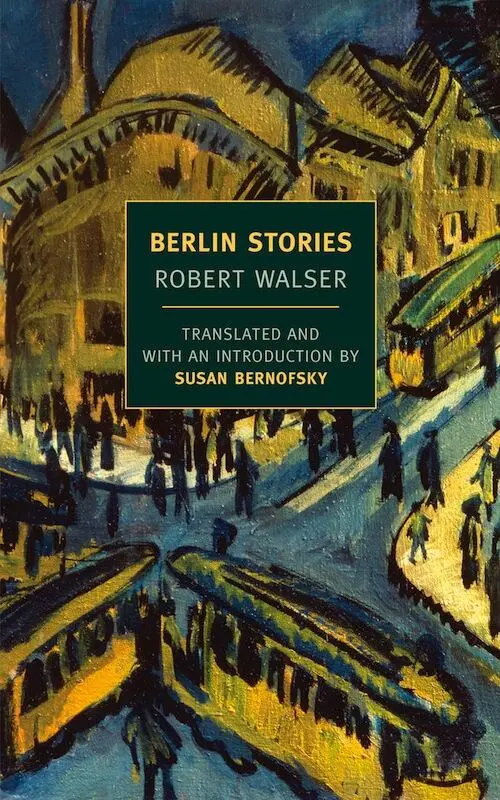
Robert Walser - Berlin Stories
Здесь есть возможность читать онлайн «Robert Walser - Berlin Stories» весь текст электронной книги совершенно бесплатно (целиком полную версию без сокращений). В некоторых случаях можно слушать аудио, скачать через торрент в формате fb2 и присутствует краткое содержание. Год выпуска: 2012, ISBN: 2012, Издательство: NYRB Classics, Жанр: Классическая проза, на английском языке. Описание произведения, (предисловие) а так же отзывы посетителей доступны на портале библиотеки ЛибКат.
- Название:Berlin Stories
- Автор:
- Издательство:NYRB Classics
- Жанр:
- Год:2012
- ISBN:978-1590174548
- Рейтинг книги:4 / 5. Голосов: 1
-
Избранное:Добавить в избранное
- Отзывы:
-
Ваша оценка:
Berlin Stories: краткое содержание, описание и аннотация
Предлагаем к чтению аннотацию, описание, краткое содержание или предисловие (зависит от того, что написал сам автор книги «Berlin Stories»). Если вы не нашли необходимую информацию о книге — напишите в комментариях, мы постараемся отыскать её.
collects his alternately celebratory, droll, and satirical observations on every aspect of the bustling German capital, from its theaters, cabarets, painters’ galleries, and literary salons, to the metropolitan street, markets, the Tiergarten, rapid-service restaurants, and the electric tram. Originally appearing in literary magazines as well as the feuilleton sections of newspapers, the early stories are characterized by a joyous urgency and the generosity of an unconventional guide. Later pieces take the form of more personal reflections on the writing process, memories, and character studies. All are full of counter-intuitive images and vignettes of startling clarity, showcasing a unique talent for whom no detail was trivial, at grips with a city diving headlong into modernity.
Berlin Stories — читать онлайн бесплатно полную книгу (весь текст) целиком
Ниже представлен текст книги, разбитый по страницам. Система сохранения места последней прочитанной страницы, позволяет с удобством читать онлайн бесплатно книгу «Berlin Stories», без необходимости каждый раз заново искать на чём Вы остановились. Поставьте закладку, и сможете в любой момент перейти на страницу, на которой закончили чтение.
Интервал:
Закладка:
But for the moment begone with this loitering observer, whose experiences in the end are after all rather one-sided. All at once we really are sitting in one of the many trains as an actual and not just imaginary traveler, experiencing journeys that last entire days and nights. Landscapes fly past the window like movable stage sets at the theater being spun around on the revolving stage. If agreeable company is present, conversation ensues, and if not, one feels a bit vexed and proceeds to light a cigar — to the annoyance of an all too sensitive fellow traveler — and produces great quantities of smoke. Or else one has a book and would like to read a bit of it, but one cannot quite, until in the end one can. The rectangle of window keeps displaying fresh new images. You watch vineyard-covered hillsides slowly falling away, houses sinking down, trees suddenly shooting up out of the earth. Clouds and meadows alternate amicably, meaningfully. “Might you give me a light from your fire there?” someone accosts you, but given your good breeding you willingly tolerate this interruption and reply “Why, of course!” and with pleasure distribute some of the superfluous embers. What a flying, rattling, rustling. Entire towns and villages are left behind on both sides as though they were lifeless images, and yet in these places human beings respire, horses whinny, a metalworker hammers away, a factory spins its wheel, a steer bellows, a child is crying, a person is consumed by bitter despair, two lovers secretly rejoice, boys are heading off to school, a midday meal is cooked in someone’s kitchen, a pair of unfortunate invalids lie in bed, or two men exchange blows in some wretched altercation. But the railway keeps on flying down its precisely predetermined, prearranged path and lets all the rest of human life and activity be human life and activity. At each tidy station, people get out and in, those getting out are generally received by a mother, father, brother, son, or daughter, or else by acquaintances, and those who get in nicely say “Good day” or “Good evening,” depending on where, for example, the hour hand has gotten to. And then the journey continues, crossing plains, passing by thick fir forests and splendid little garden-encircled huts for the level-crossing attendants, then passing a woodcutter on the shore of a brightly glittering lake. What lake is that, people are asking in the car. Onward. Many sit silently in their seats, surrendering to a melancholy thought or memory, a few laugh and jest, most are now eating something they have extracted from paper wrappers and boxes, and one or the other takes railway-car friendliness to the point of offering his neighbor something to eat with the calmest demeanor in the world. Thank you! But no one is even expecting to be thanked. Traveling inspires camaraderie. And how marvelous it is to ride the train in winter! Snow everywhere, snow-covered rooftops, villages, people, fields, and forests; on rainy days: dampness everywhere, fog and darkly veiled views; in the sunny springtime: blue, green, and yellow everywhere, and white blossoms. The meadows are yellow and green, sweet sunlight shimmers through the beech forest, high up in the blue sky float the gayest, whitest clouds, and in the gardens and fields there is such a blossoming, humming, and splendor that one is tempted at every station to get out and lose oneself in all this warmth, color, and beauty. And in the fall, and in the middle of summery, languid, humid high season, and again in the frosty clear winter — no, one shouldn’t be so cocky as to try to cram all of this into the brief space of a newspaper article.
Nowadays anywhere there is nature, trains are also found. Soon there will no longer be a single colossus of a mountain that people have not yet begun to pierce for the sake of transport, civilization, and pleasure. There is no shortage of cable cars, and all of this is good, for it sets hands and minds in beneficial motion. To be sure, traveling by train for pleasure or business can also be quite perilous, as recent accidents have taught us; bridges can collapse, tracks can suddenly jut up in a fury and fling the train about, two trains can, owing perhaps to an oversight on the part of a single responsible official in the middle of a forest where no human habitations can be found far and wide, crash into each other — what horrific things! Or a fire can suddenly break out within a flying train, or else the train can — in holy Russia for example — be attacked by bandits. These are things that, it appears to me, display a blanched, solemn visage, but at least occurrences of this sort are met with only very rarely. Mankind cannot, after all, abandon something so advantageous just because of certain dangers, and the steam locomotive with all the cars hanging on behind does represent an unmistakable advantage. Many a person has already been liberated from torments, worries, and annoyances by his peaceful journey in a quiet compartment, using the railway to put his pressing plans and thoughts more or less in order in the course of long, possibly nocturnal journeys. Here the foolishnesses and pettinesses of quotidian life fall silent, triumph as they may in their usual milieu. Today one can rest while completing a journey. But one can also easily experience the most tender adventures , above all on express trains. How? This is something every person must discover on his own. I now come to a close, looking forward to the train trip I shall soon be making. To be honest, I don’t travel much, and this is why the thought of travel fills me with such longing.
1907
What Became of Me
I am, by birth, a child of my country, by trade I am poor, my social status is that of human being, my character that of a young man, and by profession I am the author of the present autobiographical sketch. My upbringing went like this: From time to time my beloved Papa sent me out to Ridau. Ridau is a charming, ancient little town with only a single street — though a nice wide one to be sure — and a towering Gothic castle.
Ridau is home to Herr Baumgartner. I would go running off to Ridau so as swiftly to pass on to Herr Baumgartner Papa’s greetings and best regards. Such was my upbringing.
My schooling and education took the form of attending a Progymnasium or junior high school. The Progymnasium is a classical seat of learning, for it was established under Napoleon the Great and First, or at least under his influence. After this, harsh Life flung me upon the path of a practicing feuilletonist. Oh, if only I had never written a feuilleton.
But Fate, which remains perpetually inscrutable, willed it thus, and would appear to have made of me a perfumed and mincing know-it-all and write-it-all, and all the oh so precious innermost cores of my being that pluck at the heartstrings of my patriotic sentiment have had — as I lament with weeping eyes and deep within my hollowed-out soul — to go by the wayside. What a cruel fate I am bound to!
And yet everything can take a turn for the better, and naïve rusticality will perhaps, who knows, return to me someday, and then I shall once more be allowed to wring my hands in isolation. For the time being, however, I appear to be sunk deep in the Gomorrah of simpering, capering correspondenthood, and very little hope persists — possibly none at all — that I shall ever again in all my days be capable of emitting a yodel such as, for example, the literarily so enterprising and worldly Ernst Zahn lets rip in so splendid and earthy a manner. Ernst Zahn and other equally shrewd individuals are champions at underscoring that they love their homeland.
Such manufacture has always eluded me. The world is wide, and human beings are a mystery, and Napoleon was a great man, and Ridau is a delightful little town, and the core of a human being never goes entirely by the wayside. What silly bigotry, these Old Auntie gossipings from the South. Berlin is such a lovely city, and its inhabitants are such hardworking, upright, and courteous human beings.
Читать дальшеИнтервал:
Закладка:
Похожие книги на «Berlin Stories»
Представляем Вашему вниманию похожие книги на «Berlin Stories» списком для выбора. Мы отобрали схожую по названию и смыслу литературу в надежде предоставить читателям больше вариантов отыскать новые, интересные, ещё непрочитанные произведения.











Обсуждение, отзывы о книге «Berlin Stories» и просто собственные мнения читателей. Оставьте ваши комментарии, напишите, что Вы думаете о произведении, его смысле или главных героях. Укажите что конкретно понравилось, а что нет, и почему Вы так считаете.