Gyula Krudy - Sunflower
Здесь есть возможность читать онлайн «Gyula Krudy - Sunflower» весь текст электронной книги совершенно бесплатно (целиком полную версию без сокращений). В некоторых случаях можно слушать аудио, скачать через торрент в формате fb2 и присутствует краткое содержание. Город: New York, Год выпуска: 2007, Издательство: New York Review Books, Жанр: Классическая проза, на английском языке. Описание произведения, (предисловие) а так же отзывы посетителей доступны на портале библиотеки ЛибКат.
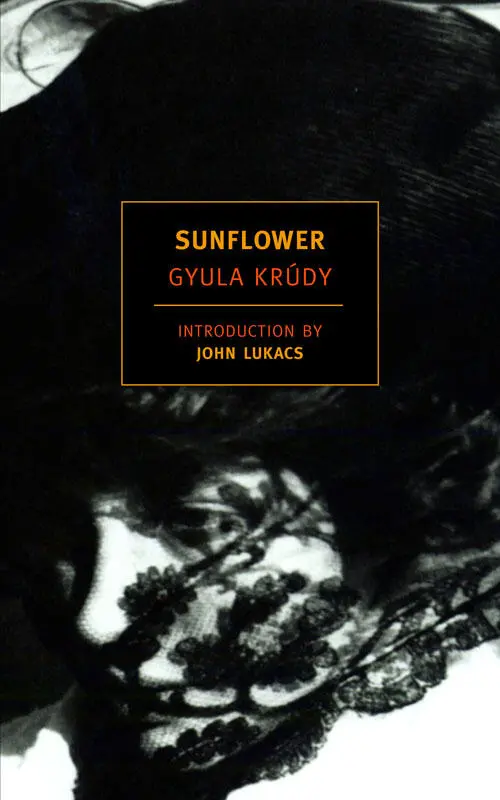
- Название:Sunflower
- Автор:
- Издательство:New York Review Books
- Жанр:
- Год:2007
- Город:New York
- ISBN:нет данных
- Рейтинг книги:4 / 5. Голосов: 1
-
Избранное:Добавить в избранное
- Отзывы:
-
Ваша оценка:
Sunflower: краткое содержание, описание и аннотация
Предлагаем к чтению аннотацию, описание, краткое содержание или предисловие (зависит от того, что написал сам автор книги «Sunflower»). Если вы не нашли необходимую информацию о книге — напишите в комментариях, мы постараемся отыскать её.
In
young Eveline leaves the city and returns to her country estate to escape the memory of her desperate love for the unscrupulous charmer Kálmán. There she encounters the melancholy Álmos-Dreamer, who is languishing for love of her, and is visited by the bizarre and beautiful Miss Maszkerádi, a woman who is a force of nature. The plot twists and turns; elemental myth mingles with sheer farce: Krúdy brilliantly illuminates the shifting contours and acid colors of the landscape of desire.
John Bátki’s outstanding translation of
is the perfect introduction to the world of Gyula Krúdy, a genius as singular as Robert Walser, Bruno Schulz, or Joseph Roth.
Sunflower — читать онлайн бесплатно полную книгу (весь текст) целиком
Ниже представлен текст книги, разбитый по страницам. Система сохранения места последней прочитанной страницы, позволяет с удобством читать онлайн бесплатно книгу «Sunflower», без необходимости каждый раз заново искать на чём Вы остановились. Поставьте закладку, и сможете в любой момент перейти на страницу, на которой закончили чтение.
Интервал:
Закладка:
There, where the lime trees huddle together like revolutionary generals before their execution, awaiting the crash of lightning with arms uplinked, there stood a memorable little garden bench, a secret spot on the grounds surrounding this red house, as private as the purity of a youth and the nobility of a heart. Formerly, when women had still travelled on clouds over this land, and a female foot was worth a kingdom, Pistoli spent hours seated there next to his soul mate, uttering never-to-be-recalled fine words; or else brooding alone like some knight whose unbalanced bride jumped from the castle ramparts the night before;—but he was never bored.
In later years, whenever Pistoli approached this small bench, he envisioned women who would quietly rise as he neared and vanish into the birches like a delicate mist withdrawing under fallen leaves beneath a frigid moon. Women he had yearned to meet sat there, and women he had tired of, but later wanted back with all the pain of a middle-aged man missing the joys of his youth. And since a real man holds no grudge against the women who robbed him of his youth, merely to pin his wings on their hats, Pistoli thought he saw seated on that bench mostly those ladies who had drawn blood.
And now, once more, a dearly beloved took her place on the little bench. The hat decorated with a pheasant feather shaded the face averted in surrender, like a bird being taught to sing. It was Eveline, sitting where Pistoli’s former loves had sat, and she was listening to what Kálmán Ossuary had to say.
“Just look at him jabber!” reflected Mr. Pistoli bitterly, as he hid to eavesdrop behind the hedge, pricking up his ears like a horse.
Alas, Mr. Pistoli was too far away, though he would have gladly given a fine fur coat to overhear the lovers’ conversation. But it was enough just to look at them: the eyes said it all, it was so obvious. A glove pulled off the hand might feel the way Mr. Pistoli felt. The russet brown cloak’s undone buttons might have sensed his keen disappointment. Those soft curls lurking about her ear quivered like young maids when they find out the whys and wherefores of their coming into this world. The swan neck, the adorable mouth, the long lashes: they were all unaware of the hourglass and time’s flight. The finely-shod foot, the liquescently smooth stockings, and the amulet heaving above the panting heart all imagined this was the first instance of love on earth, wherefore their sudden all-importance. The tender curves of the shoulder, the phenomenal lines of the arm, the miraculous shape of the hips: no way did they foresee lying someday in the grave pit’s damp depth and infinite solitude, with no one to praise them. And the splendid cheek might be leprous after a few years — while this moment, this heartthrobbing hour, imagined by bird-bodied, bird-brained love to be eternal, would have become a matter of indifference.
All Pistoli could do was wriggle his big toe, as if it were a gopher, inside his boot. He regretted that not once did Ossuary kneel, during his endless warblings. Then the moment of farewell arrived. The exchange of abiding looks. The arm gliding off like foam down Niagara Falls. The departing lady’s subdued, lingering, pensive footfall, as if she were leaving for good, for the infinite beyond.
Soon afterward came the clatter of a carriage, stealing off past the garden’s far end, like a Gypsy kidnapper’s cart.
“Tomorrow I’ll sacrifice a pig to celebrate that it wasn’t Maszkerádi with that joker,” resolved Mr. Pistoli, and made an effort to sneak back to his house without being seen by Ossuary.
By nightfall he had remembered all kinds of old songs he believed he had long forgotten. The ditties descended like a spider from the roof beam, and he snapped at them like a dog at a fly. Of some songs he recalled only a single line, but he still hummed through the entire melody. He laid his head on the tabletop, absorbed in woolgathering. From time to time he flung a ditty, as one would a bone, at Kakuk crouching in a corner. But he had little patience for another’s singing. It didn’t take long before he shouted: “Ah, nonsense!”
And whinnying, he struck up a new song, only to get stuck halfway through, like a rickety cart full of drunken wedding guests.
Ossuary was loitering in the moonlight like some terminally bored ghost.
Suddenly Mr. Pistoli stood in front of him with raised forefinger and declared triumphantly:
“I was a tougher kid than you…And I’m still the better man. The girls were weeping and wailing when they left me. For I am Pistoli, that’s who I am.”
The moonlight over The Birches advanced hugger-mugger in the sky like a shepherd hiding a lamb under his coat.
And, wrapped in black veils, night crept away, like a woman’s once undying love.
Kakuk spent all day lolling in a ditch, for the grass was growing in; he chewed grasses like a hound healing some ailment. And, anyway, he had been dropped into this world to lie about in ditches, while the flouncy-skirted, flowery-embroidered, rowdy marketing women pressed ahead to pass each other on the highway. Life does have its do-nothings who welcome as a matter of course each successive morn. They trudge, slothful and passive, into eternal darkness, for they never imagined that dawn would ever displace the night. All those daytimes must have been a misunderstanding, as was the aimless wind, rustling rainfall, wall-clawing torment, and bitter dementia. The truth lies in the great night that stretches from one end of the sky to the other in motionless eternity, where rockets devised by humans will never penetrate.
Kakuk clambered forth from the ditch, tiptoed up to Mr. Pistoli, whose wide-open eyes stared at a demijohn of Bull’s Blood while his left hand inscribed all kinds of sigils in the air to his familiar spirits. He was dour and woebegone, a wax figure at the waxworks. His mustache was curled to point up. His worn lacquered dress boots proclaimed to the visitor their superiority to everyday footwear: these boots would never trudge in the dust of the highway.
“The equestrienne,” Kakuk announced, as if he had been hanging out around a theatrical troupe, and had picked up the actors’ accents.
Pistoli slowly shifted his weight to his feet, shoved himself and his chair away from the table, tore his eyes away from the wine bottle and gave a deep sigh like a prisoner on death row. The half-blind pier glass on the wall had long forgotten what womenfolk looked like, how they would once upon a time stop for a quick peek at themselves or to pin up their hair in a topknot. Nowadays the mirror always reflected Novemberish faces. Pistoli looked into the mirror, and twirled his mustache like a gray rodent.
“Ah yes, the equestrienne,” he murmured. He opened his mouth and spat at the mirror, practically reeling with bitterness. “The trollop!”
Had he a weapon on hand, surely he would have grabbed it. But firearms and even sharp knives had long ago been banished from his house. Pistoli feared suicidal schemes and death- craving moments. He wore only the flimsiest belt that was guaranteed to snap under his two hundred pounds. Many a dawn found the droll, carefree boon companion, the life of last night’s party, ardently yearning for death, sprawled across the worn rug that served as a coverlet on his bed. He sank his teeth into the pillow, for that’s how it was in a novel he once read. Suicide approached barefoot in the snow, and lurked around his property like some pushy beggar. He could never enjoy love unless it was totally hopeless.
And so, hands in pockets, it was with an impassive face that he noted the saddle horse tied to a sapling in the birch grove. He knew that yellow mare from Eveline’s stables. Kati was her name. She flicked her short-clipped tail like a lady her fan, and trotted as obediently with a lady’s saddle as if she were in collusion with her rider. Pistoli squatted down next to the saddle horse. In a fevered flush of humiliation he repeatedly resolved to take refuge in the shrubbery if and when Miss Maszkerádi returned from the garden cottage, but her visit was still very much in progress.
Читать дальшеИнтервал:
Закладка:
Похожие книги на «Sunflower»
Представляем Вашему вниманию похожие книги на «Sunflower» списком для выбора. Мы отобрали схожую по названию и смыслу литературу в надежде предоставить читателям больше вариантов отыскать новые, интересные, ещё непрочитанные произведения.









Обсуждение, отзывы о книге «Sunflower» и просто собственные мнения читателей. Оставьте ваши комментарии, напишите, что Вы думаете о произведении, его смысле или главных героях. Укажите что конкретно понравилось, а что нет, и почему Вы так считаете.