Nescio - Amsterdam Stories
Здесь есть возможность читать онлайн «Nescio - Amsterdam Stories» весь текст электронной книги совершенно бесплатно (целиком полную версию без сокращений). В некоторых случаях можно слушать аудио, скачать через торрент в формате fb2 и присутствует краткое содержание. Год выпуска: 2012, Издательство: NYRB Classics, Жанр: Классическая проза, на английском языке. Описание произведения, (предисловие) а так же отзывы посетителей доступны на портале библиотеки ЛибКат.
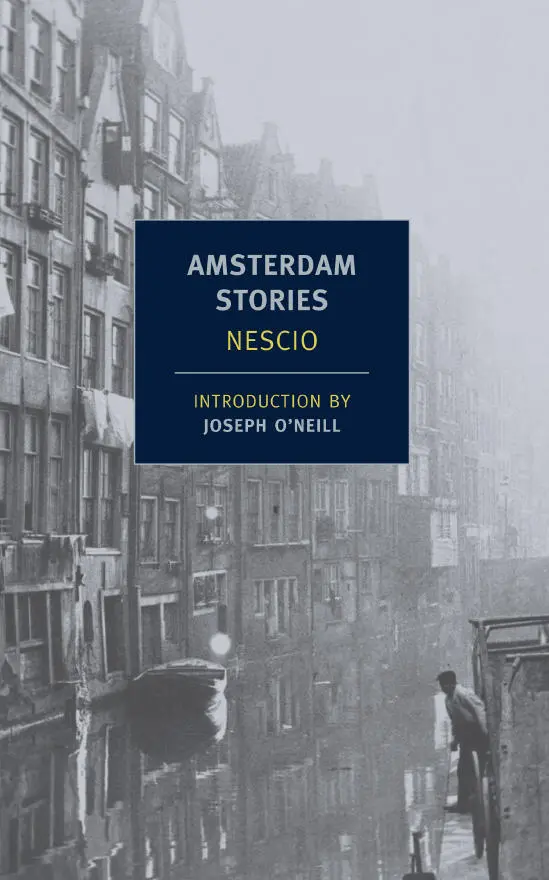
- Название:Amsterdam Stories
- Автор:
- Издательство:NYRB Classics
- Жанр:
- Год:2012
- ISBN:нет данных
- Рейтинг книги:5 / 5. Голосов: 1
-
Избранное:Добавить в избранное
- Отзывы:
-
Ваша оценка:
Amsterdam Stories: краткое содержание, описание и аннотация
Предлагаем к чтению аннотацию, описание, краткое содержание или предисловие (зависит от того, что написал сам автор книги «Amsterdam Stories»). Если вы не нашли необходимую информацию о книге — напишите в комментариях, мы постараемся отыскать её.
Who was Nescio? Nescio — Latin for “I don’t know”—was the pen name of J.H.F. Grönloh, the highly successful director of the Holland — Bombay Trading Company and a father of four — someone who knew more than enough about respectable maturity. Only in his spare time and under the cover of a pseudonym, as if commemorating a lost self, did he let himself go, producing over the course of his lifetime a handful of utterly original stories that contain some of the most luminous pages in modern literature.
This is the first English translation of Nescio’s stories.
Amsterdam Stories — читать онлайн бесплатно полную книгу (весь текст) целиком
Ниже представлен текст книги, разбитый по страницам. Система сохранения места последней прочитанной страницы, позволяет с удобством читать онлайн бесплатно книгу «Amsterdam Stories», без необходимости каждый раз заново искать на чём Вы остановились. Поставьте закладку, и сможете в любой момент перейти на страницу, на которой закончили чтение.
Интервал:
Закладка:
To be a great poet and then to fall. In the fullness of time.
It was certainly a day to forget about 36" white shirts and colored satin for a while.
There was no one there to pick them up. The friend couldn’t leave the house since her mother was bedridden and they didn’t have a maid. A maid is a sister, not yours or mine but a typesetter’s or a mailman’s, who crawls around rooms on her hands and knees wiping the floor and takes out the trash and breaks the teacups.
So Dora and the little poet had a cup of coffee in Lent, overlooking the river and with a view of the city and the hills. It had turned into a still, sunny autumn afternoon. The chestnut trees were already bare, their yellow five-fingered leaves with thick gummy stems lay on the ground and dry golden leaves lay everywhere. There was a smell of decaying leaves, which always made the little poet’s heart flutter as if he was about to die and awaken, immortal, in just such a still blue and gold autumn day that would never end. He wiped a thread of gossamer from his forehead. The sky was so blue and cloudless and it looked down at itself in the water and the sun shone golden.
The city rose up out of the water into the blue sky, quay and houses and then more houses farther up, half visible or all visible above the houses lower down, with red roofs everywhere and over there an enormous church like a sign by which God could recognize his city. It had two sharp spires, tall and powerless, reaching up even higher. The way a little poet reaches up, powerful and powerless, from the raging river of his poethood toward God, who never does come out from behind the blue sky and show himself. The little poet had to laugh at the miracle before his eyes, the eyes that saw a monument to God’s majesty where actually there was nothing but shacks full of measly small-town life, not even in civilized Holland but out east.
They looked straight down a street that ran steeply uphill from the quay. Shadows were starting to appear on the right side. And up on the hill was a terrace with an iron fence around the edge and over there, on another terrace, a washtub, and someone more than halfway from the river to God opened a window that fiercely reflected the bright sun for an instant.
To the left of the city was a low ridge of green hills in a straight line “ ins grosse Vaterland. ”*
A golden alley cut gently up across the slope. The golden letters of the French boarding school, “Notre Dame aux anges,” shone far above in the distance, on a tall building at the foot of the hills, where the grassy plain ended. “Notre Dame aux anges,” innocent naked little angels and innocent fully clothed students. The God of the Netherlands is right after all, you can never tell with poets. Are they respectable or disrespectable, decent or indecent?
Then the little poet recaptured the wan romance of the whole situation. God didn’t mean anything by it. He was only playing around, only getting everything ready for a new production of The Sorrows of Young Werther if the little poet was up for it.
So they chatted and played with words and thoughts and flights of fancy and looked at the sparkling in each other’s eyes whenever a new flash of inspiration struck. Then they stood up and crossed the river. She wanted him to have a nice present to take home to Coba that night, so they went to go buy it together. She hung on his arm, her left arm through his right and her little hands clasping each other tight in their black kid gloves.
A light-purple silk shawl with a knotted fringe — that’s what he should buy, oh yes, Coba would be so happy with that. Come on, be a nice brother-in-law. She looked into his eyes and pressed his arm, for her sister. There was no duplicity in her head, there was blood rushing in her head but no duplicity. “Look, it’s so pretty.” They were standing in the valley and looking up at the hill, and the arch of the bridge up there that led to the Belvédère framed a little picture: a stretch of gravel road, deserted, climbing gently, with the blue ribbon of a footpath on either side, and trees with blazing orange-yellow crowns, the branches clearly visible through the leaves, and a pair of streetlamps far apart with frosted glass globes, bright white— like a tinted engraving just waiting for someone to write “October 5” underneath.
There was no duplicity in her thoughts when she suddenly fell silent, the engraving having derailed their conversation. Even though she felt it herself. But she didn’t understand it, just as Adam and Eve didn’t understand their nakedness, or the “ anges ” of Notre Dame their angelic state, or the boarding-school students their fully-clothedness. My God, what is a woman who understands herself.
But he understood himself all right, it was horribly clear to him, and that is why nothing happened. He looked at her and the poet in him worshipped her and raised her up to the throne alongside the God of heaven and earth and he didn’t dare touch her.
And at the same time, deep inside the little poet, the wild animal crouched, ready to pounce and devour all the things that taunted him, everything that stood around him and walked past him and didn’t notice him. First of all, her — the beautiful, the beloved, first — so that there would be no reason not to devour everything else. To lift her up as high as the stars in the winter night and do his worst with her and then let her fall down into the unfathomable deeps. To avenge upon her, in his pleasure, the whole world’s taunting indifference. And besides, what would a little poetess want more than to fall like that?
Those were his thoughts while a little sparrow flew from a piece of horse dung on the gravel road up into one of the orange trees. But he said, “Do you know a nice shop around here?”
They bought a very beautiful shawl, elegant and fine. Too bad she was wearing black. She tried the same shawl on herself, but in black, to see how it looked, and her upper body bent the tiniest bit back as she tried it on. But the purple one, that was gorgeous. Coba would definitely squeal with pleasure.
And so on that day she was simultaneously and alternately sister and wife and little poetess and courtesan and she did not know her divided nature and did not understand any of it.
But what a day to end all days it was.
She sang out loud on the road to Beek, which was also deserted, and she skipped as she went, she couldn’t help it, she could move mountains around for fun and snatch the sun from the sky with one hand and toss it over her shoulder into the Waal just to hear it hiss.
The electric tram gathered them up and trailed a long stream of dry yellow leaves whirling and shuffling and rustling behind it, a little joke of God’s, one he could easily permit himself on a day like this.
From Beek they climbed to Berg en Dal, winding through the hills. And the hills were not nearly high or steep enough, how could you tire yourself out on those? And she had to tire herself out or else she would burst apart with power, shatter into fragments of little poetess and wife and sister and courtesan. At the summit they looked down into a little valley with black and yellow and green rectangular fields sloping up and down the hills, stands of pine and copses of oak between them. And past that, down on the plains, hours and hours away with no distinguishing features except a straight stretch of wide river that ran off until losing itself in a bend. There, very small, the red roofs of a brickyard and its chimneys, tall but still lost in the distance.
There they stood, and then they realized that there was nothing to do now except go back.
But that night in bed she couldn’t sleep, the brilliant clarity in her head just would not go away. She relived the whole day over and over again and saw everything again, perfectly clear. And all at once it was like the sun itself was inside her skull: “I love him. I can’t help it. I want to. God be with me.” She got out of bed and drank down her whole carafe of water.
Читать дальшеИнтервал:
Закладка:
Похожие книги на «Amsterdam Stories»
Представляем Вашему вниманию похожие книги на «Amsterdam Stories» списком для выбора. Мы отобрали схожую по названию и смыслу литературу в надежде предоставить читателям больше вариантов отыскать новые, интересные, ещё непрочитанные произведения.

![Олеся Проглядова - Nomen nescio. Имя неизвестно [litres]](/books/391740/olesya-proglyadova-nomen-nescio-imya-neizvestno-lit-thumb.webp)








Обсуждение, отзывы о книге «Amsterdam Stories» и просто собственные мнения читателей. Оставьте ваши комментарии, напишите, что Вы думаете о произведении, его смысле или главных героях. Укажите что конкретно понравилось, а что нет, и почему Вы так считаете.