Henry Roth - Call It Sleep
Здесь есть возможность читать онлайн «Henry Roth - Call It Sleep» весь текст электронной книги совершенно бесплатно (целиком полную версию без сокращений). В некоторых случаях можно слушать аудио, скачать через торрент в формате fb2 и присутствует краткое содержание. Год выпуска: 1992, Издательство: Farrar, Straus and Giroux, Жанр: Классическая проза, на английском языке. Описание произведения, (предисловие) а так же отзывы посетителей доступны на портале библиотеки ЛибКат.
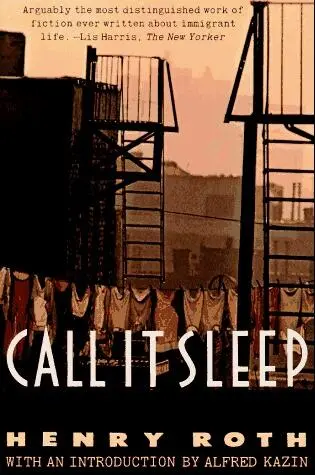
- Название:Call It Sleep
- Автор:
- Издательство:Farrar, Straus and Giroux
- Жанр:
- Год:1992
- ISBN:нет данных
- Рейтинг книги:4 / 5. Голосов: 1
-
Избранное:Добавить в избранное
- Отзывы:
-
Ваша оценка:
Call It Sleep: краткое содержание, описание и аннотация
Предлагаем к чтению аннотацию, описание, краткое содержание или предисловие (зависит от того, что написал сам автор книги «Call It Sleep»). Если вы не нашли необходимую информацию о книге — напишите в комментариях, мы постараемся отыскать её.
, his first novel, in 1934, it was greeted with critical acclaim. But in that dark Depression year, books were hard to sell, and the novel quickly dropped out of sight, as did its twenty-eight-year-old author. Only with its paperback publication in 1964 did the novel receive the recognition it deserves.
was the first paperback ever to be reviewed on the front page of
, and it proceeded to sell millions of copies both in the United States and around the world.
Call It Sleep
Call It Sleep — читать онлайн бесплатно полную книгу (весь текст) целиком
Ниже представлен текст книги, разбитый по страницам. Система сохранения места последней прочитанной страницы, позволяет с удобством читать онлайн бесплатно книгу «Call It Sleep», без необходимости каждый раз заново искать на чём Вы остановились. Поставьте закладку, и сможете в любой момент перейти на страницу, на которой закончили чтение.
Интервал:
Закладка:
“It— it’s my fault you’d say. Is that it?”
She shook her head wearily. “What use is there to talk about faults, Albert? None foresaw this. No one alone brought it on. And if it’s faults we must talk about it’s mine as well. I never told you. I let him listen to me months and months ago. I even drove him downstairs to — to—”
“To protect him — from me?”
“Yes.”
His teeth clicked. His chest rose. The expulsion of his breath seemed to rock him slightly. “I’ll go get it.” He turned heavily out of the doorway.
David listened to his father’s dull, unresilient footfall cross the kitchen floor. The door was opened, closed. A vague, remote pity stirred within his breast like a wreathing, raveling smoke, tenuously dispersed within his being, a kind of torpid heart-break he had felt sometimes in winter awakened deep in the night and hearing that dull tread descend the stairs.
“Perhaps you’ll be hungry in a little while,” his mother said persuasively. “After you’ve rested a bit and we’ve put the medicine on your foot. And then some milk and a boiled egg. You’d like that?” Her question was sufficiently shored by statement to require no answer. “And then you’ll go to sleep and forget it all.” She paused. Her dark, unswerving eyes sought his. “Sleepy, beloved?”
“Yes, Mama.”
He might as well call it sleep. It was only toward sleep that every wink of the eyelids could strike a spark into the cloudy tinder of the dark, kindle out of shadowy corners of the bedroom such myriad and such vivid jets of images — of the glint on tilted beards, of the uneven shine on roller skates, of the dry light on grey stone stoops, of the tapering glitter of rails, of the oily sheen on the night-smooth rivers, of the glow on thin blonde hair, red faces, of the glow on the outstretched, open palms of legions upon legions of hands hurtling toward him. He might as well call it sleep. It was only toward sleep that ears had power to cull again and reassemble the shrill cry, the hoarse voice, the scream of fear, the bells, the thick-breathing, the roar of crowds and all sounds that lay fermenting in the vats of silence and the past. It was only toward sleep one knew himself still lying on the cobbles, felt the cobbles under him, and over him and scudding ever toward him like a black foam, the perpetual blur of shod and running feet, the broken shoes, new shoes, stubby, pointed, caked, polished, buniony, pavement-beveled, lumpish, under skirts, under trousers, shoes, over one and through one, and feel them all and feel, not pain, not terror, but strangest triumph, strangest acquiescence. One might as well call it sleep. He shut his eyes.
AFTERWORD
Between Mother Tongue and Native Language in Call It Sleep
HENRY ROTH’S Call It Sleep is a multilingual book, although it is accessible to the American reader who knows none of its languages other than English. In order to portray a world that was both multilingual and multicultural, Roth used a variety of narrative strategies, some designed to simulate the experience of his immigrant child protagonist and others designed to translate these experiences for his general American reader. Call It Sleep is a classic example of a work in which several cultures interact linguistically, thematically, and symbolically, and it is also an interesting case of ethnic literature, the Jewish-American novel.
Henry Roth offers a classic example as well of the author of a brilliant first novel who keeps the critics speculating as to whether his second work will live up to the first. In his case, the silence that followed that first dazzling performance could be interpreted as a larger cultural phenomenon than a mere individual writer’s block. Occasionally what appears to be one artist’s dilemma can also be a symptom of a cultural cul-de-sac. Such was the case of Thomas Hardy’s last novel, Jude the Obscure, which carried the bleakness of the Victorian age and the Victorian novel to its limits, and such was the case of Henry Roth’s Call It Sleep, which embodies the paralyzing ambivalence of the Jewish immigrant writer in America, although not every writer’s response to this conflict has been silence. Throughout Jewish literary history, writers have developed different narrative strategies for representing the multilingual and multicultural world which they inhabited.
As early as 1918, the Yiddish literary critic Baal Makhshoves argued that the mark of Jewish literature is its bilingualism. Although he was taking this position within the cultural context of the Czernowitz conference and the antagonism between Hebrew and Yiddish, he made claims for the status of Jewish literature from biblical times to the present. In every text that is part of the Jewish tradition, Baal Makhshoves wrote, there existed explicitly or implicitly another language, whether it be Chaldean in the Book of Daniel, Aramaic in the Pentateuch and the prayer book, Arabic in medieval Jewish philosophical writings, and, in his own day, Yiddish. “Bilingualism accompanied the Jews even in ancient times, even when they had their own land, and they were not as yet wanderers as they are now,” he wrote.1 “We have two languages and a dozen echoes from other foreign languages, but we have only one literature.”2 When Baal Makhshoves refers to bilingualism, he means not only the literal presence of two languages but also the echoes of another language and culture detected in the prose of the one language of which the text is composed. “Don’t our finer critics carry within them the spirit of the German language? And among our younger writers, who were educated in the Russian language, isn’t it possible to discern the spirit of Russian?”3
Bilingualism and diglossia, in their strict linguistic sense and in their broader culture meanings, have always been distinguishing features of Jewish culture and one major aspect of that enigmatic concept, Jewish literature. By bilingualism, I mean the alternate use of two or more languages by the same individual, which presupposes two different language communities, but does not presuppose the existence of a bilingual community itself.4 Diglossia, on the other hand, is the existence of complementary varieties of language for intragroup purposes, and therefore it does not necessitate bilingualism, as the linguistic repertoires are limited owing to role specialization.5 In short, as Fishman has pointed out, bilingualism is essentially a characterization of individual linguistic versatility whereas diglossia is a characterization of the societal allocation of functions to different languages. Diglossia is obviously not unique to Jewish civilization. In European culture, for example, the idea that certain languages were specially proper for specific purposes lasted into the sixteenth century, with one of its literary products being macaronic verse.6 But both bilingualism and diglossia are central concepts in any discussion of Jewish literature, for they presuppose that a truly competent reader of the text must be in command of more than one language, and consequently of more than one culture. When Henry Roth used Hebrew, Yiddish, and Aramaic for specific purposes in his novel, he was employing a device used widely within Jewish literature, and within what has come more generally to be called ethnic literature.7
The centrality of both bilingualism and diglossia in Jewish culture has been explored extensively by scholars and literary critics, among them Max Weinreich, Uriel Weinreich, Joshua Fishman, Itamar Even-Zohar, Benjamin Harshav, and Dan Miron.8 The extent to which bilingualism is rooted in European Jewish life is expressed by Max Weinreich in his History of the Yiddish Language: “a Jew of some scholarly attainment, born around 1870, certainly did not express only his personal opinion when he declared that the Yiddish translation of the Pentateuch had been given to Moses on Mt. Sinai.”9
Читать дальшеИнтервал:
Закладка:
Похожие книги на «Call It Sleep»
Представляем Вашему вниманию похожие книги на «Call It Sleep» списком для выбора. Мы отобрали схожую по названию и смыслу литературу в надежде предоставить читателям больше вариантов отыскать новые, интересные, ещё непрочитанные произведения.




Обсуждение, отзывы о книге «Call It Sleep» и просто собственные мнения читателей. Оставьте ваши комментарии, напишите, что Вы думаете о произведении, его смысле или главных героях. Укажите что конкретно понравилось, а что нет, и почему Вы так считаете.