Pearl Buck - Bridge for Passing
Здесь есть возможность читать онлайн «Pearl Buck - Bridge for Passing» весь текст электронной книги совершенно бесплатно (целиком полную версию без сокращений). В некоторых случаях можно слушать аудио, скачать через торрент в формате fb2 и присутствует краткое содержание. Год выпуска: 2013, Издательство: Open Road Media, Жанр: Классическая проза, Биографии и Мемуары, на английском языке. Описание произведения, (предисловие) а так же отзывы посетителей доступны на портале библиотеки ЛибКат.
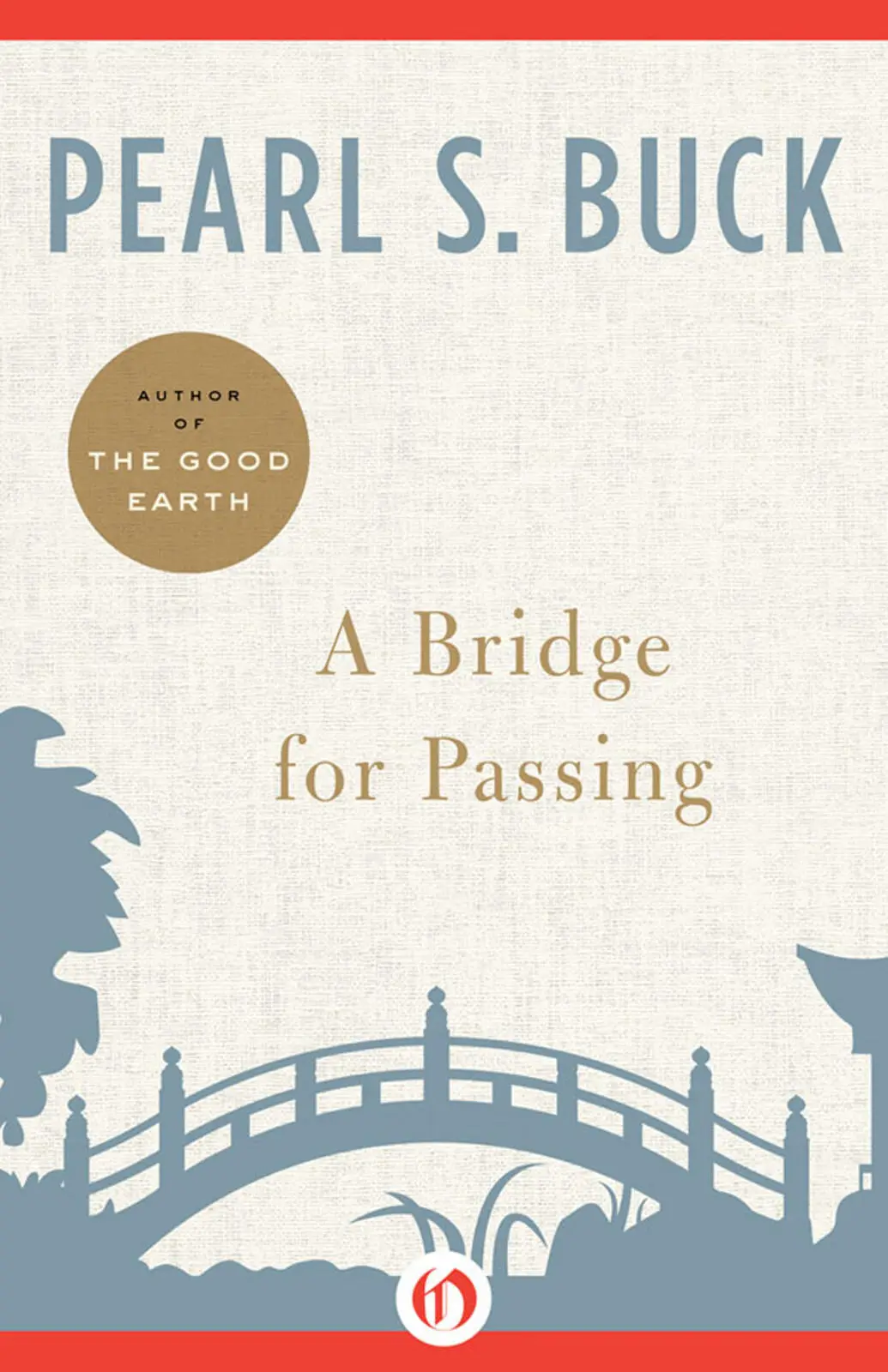
- Название:Bridge for Passing
- Автор:
- Издательство:Open Road Media
- Жанр:
- Год:2013
- ISBN:нет данных
- Рейтинг книги:3 / 5. Голосов: 1
-
Избранное:Добавить в избранное
- Отзывы:
-
Ваша оценка:
Bridge for Passing: краткое содержание, описание и аннотация
Предлагаем к чтению аннотацию, описание, краткое содержание или предисловие (зависит от того, что написал сам автор книги «Bridge for Passing»). Если вы не нашли необходимую информацию о книге — напишите в комментариях, мы постараемся отыскать её.
Bridge for Passing — читать онлайн бесплатно полную книгу (весь текст) целиком
Ниже представлен текст книги, разбитый по страницам. Система сохранения места последней прочитанной страницы, позволяет с удобством читать онлайн бесплатно книгу «Bridge for Passing», без необходимости каждый раз заново искать на чём Вы остановились. Поставьте закладку, и сможете в любой момент перейти на страницу, на которой закончили чтение.
Интервал:
Закладка:
Now there remained the farmhouse and the empty beach to be seen. The beach could wait, for the day was darkening, but the farmhouse we must see. We drove past a village and between fields and road I recognized it. The farmhouse stood among terraces, itself built on a wide terrace, the road in front of it twenty feet above the rice paddy below. A wall of ancient brick ran across the front, but the wide wooden gate stood open and I walked into the world of my story book. Yes, this was the house, simple but spacious, wooden walls, rooms divided by shoji, a thatched roof so old that grass and flowers grew on it. Chickens, a goat, a little vegetable garden, some ornamental shrubbery, a few decorative rocks, a fine old-fashioned kitchen, a narrow veranda, a small pool for washing rice and vegetables, the farmer himself, a cheerful widower with a married daughter looking after him — it was exactly right. And, best of all, the farm family was friendly and eager to be helpful. When were we coming? Tomorrow? Good — good — the house was ours. Yes, they had electricity — and a pump in the kitchen, modern farm, the farmer said proudly. And he would be glad to have Americans see how he managed everything. Tea, please, before we left! It was night before he would let us go, and work began at seven o’clock the next day. Every hour of light is precious when a film is made on location.
The chickens, I noticed as I left, were of the most articulate variety. Only the darkness silenced them. Their dissonant cackling, their exclamations of excitement and outrage when we moved in the next day, were to be the background music of every scene we filmed at the farmhouse.
We were delayed, alas, and by rain — rain — rain. By the time we reached our hotel that night, the rain was falling. I had feared rain, always the hazard of filming on location, especially in the climate of southern Japan, where sea and mountain are close neighbors. If the wind blows from the sea the sky will clear; if from the land, it will rain. This I remembered from days long past, and while I lay in my Japanese bed listening to the rain and waiting for sleep, I pondered on the strange divisions of my life.
How incredible, above all, that for the whole first half of my life, I did not know he existed! When I was here before, where was he? And now when I am here again, where now is he? Between these two eras were twenty-five good years of life together, a gem set into eternity before and after. And the old question beset me again, as it besets every human being who has known death come too near. I set my teeth against the inexorability of death.
Is there life beyond?
I remembered the courage of his atheism. How often we argued of the future in which one of us must live alone! For it would have been too good to be possible that we should die at the same moment and hand in hand cross the invincible barrier. I had known for years that it would be I who would be left, I with the heritage of long-living ancestors on both sides of my family. The question was should I remind myself of the possibility of life beyond or thrust it aside and live as though eternity were now — which it is, in one sense, there being no beginning or end in the endlessness of all things. So what then is the present solitude in which I am living? Is it an end to what once was, or is it a beginning to something I do not yet comprehend?
Did he know I was here in Japan? Was he still hovering about the house at home, the essence of himself, and were I there would I perceive his presence? Lying there on my Japanese bed, the sound of the rising sea mingling with the rain on the tiled roof, I fought off the mighty yearning to go in search of him, wherever he was. For surely he was looking for me, too. We were ill at ease, always, when apart. But what are the pathways?
I remembered an evening at Sardi’s, in New York. I was with a friend from Hollywood, and for the first time I met his wife. While her husband talked shop with other guests, this woman talked to me rather shyly, a pleasant Midwestern woman, not at all of Hollywood. She was timid at first and then upon some impulse she lowered her voice to tell me that she wanted some “real talk” with me. She had had, it seemed, a strange personal development in recent months. Her father, to whom she was very close, had lived with her for many years after her mother died, but had himself recently died. She worried about him, wondering if he were still himself somewhere, and if so, if he were happy, and in such worry she became depressed and was joyless.
One evening, she said, when her husband was delayed at work, she was sitting alone at her crocheting, a pastime to which she was addicted, and as usual, grieving over her father. Suddenly she heard him call her name, and looking up she saw him quite clearly across the room.
“You must stop this worrying about me,” he had said in his usual practical voice. “I am all right — happy, in fact.”
“Were you afraid?” I asked her.
“Afraid of my father? No!”
“But was he the same?”
“Exactly the same,” she said, and then added, half puzzled, “Except I knew that, though he was there, his body wasn’t.
“And have you seen him again?”
“Yes,” she said, “several times, though I don’t worry any more. Sometimes when Jack and I are just sitting at home quietly of an evening, he reading and I crocheting, I’ll feel somebody else is there and I’ll see my father smiling at us.”
“Does Jack see him?” I asked.
“I asked him once, ‘Jack, do you see Dad over there?’ He said no, he didn’t see him, but he believed I did, because in the old country where he came from there were people like me who could see beyond.”
Yes, and remembering, I thought of what my fourteen-year-old daughter told me the day after the funeral. She had wanted his room after it was empty because it was next to mine and she slept there quite peacefully the first night, I remember, for I had asked her if she really wanted to sleep there so soon.
“I don’t want the room to be empty,” she said.
The next morning she said entirely naturally at breakfast, “Daddy came in last night. He looked wonderful — all well again and so cheerful. He just came back to see that everything was all right.”
I restrained incredibility. “Did he speak to you?”
“No, just smiled.”
“And what was he wearing?” I asked.
“I think it was his red velvet smoking jacket,” she said.
But the red smoking jacket, though his favorite, had been laid away five years ago when he forgot about smoking.
Do I believe? If I do it is only because I believe that some day we shall know as we are known, and communications will be clear, the laws of science revealing to us the laws that govern the creating universe. Religion calls the creative force by a name, God for whom we wait. En attendant Godot!
There in the darkness of the night by the Japanese sea, I besought him to let me know by some true sign that he lived somewhere, only to tell me that he was. He made no sign. Yet silence is not finality. It may be only definition. He is there, I am here. We do not have the same wave length yet. Is that faith? I dare not call it so. I am trained in science. There are two schools in the approach. One is to believe the impossible an absolute unless and until it is proved the possible. The other is to believe the possible an absolute unless and until it is proved the impossible. I belong to the latter school. Therefore all things are possible until they are proved impossible — and even the impossible may only be so, as of now.
In this way my life continued to be lived on two separate levels, one by day, the other by night; one upon Earth, the other in search of a habitation not made with hands.
Читать дальшеИнтервал:
Закладка:
Похожие книги на «Bridge for Passing»
Представляем Вашему вниманию похожие книги на «Bridge for Passing» списком для выбора. Мы отобрали схожую по названию и смыслу литературу в надежде предоставить читателям больше вариантов отыскать новые, интересные, ещё непрочитанные произведения.



Обсуждение, отзывы о книге «Bridge for Passing» и просто собственные мнения читателей. Оставьте ваши комментарии, напишите, что Вы думаете о произведении, его смысле или главных героях. Укажите что конкретно понравилось, а что нет, и почему Вы так считаете.