Pearl Buck - Kinfolk
Здесь есть возможность читать онлайн «Pearl Buck - Kinfolk» весь текст электронной книги совершенно бесплатно (целиком полную версию без сокращений). В некоторых случаях можно слушать аудио, скачать через торрент в формате fb2 и присутствует краткое содержание. Год выпуска: 2012, Издательство: Open Road Media, Жанр: Классическая проза, на английском языке. Описание произведения, (предисловие) а так же отзывы посетителей доступны на портале библиотеки ЛибКат.
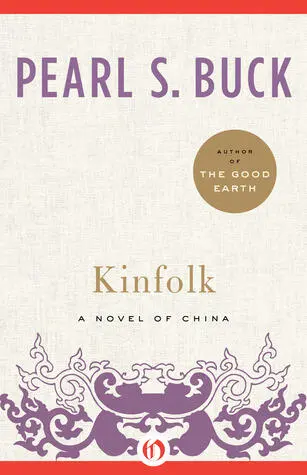
- Название:Kinfolk
- Автор:
- Издательство:Open Road Media
- Жанр:
- Год:2012
- ISBN:нет данных
- Рейтинг книги:4 / 5. Голосов: 1
-
Избранное:Добавить в избранное
- Отзывы:
-
Ваша оценка:
Kinfolk: краткое содержание, описание и аннотация
Предлагаем к чтению аннотацию, описание, краткое содержание или предисловие (зависит от того, что написал сам автор книги «Kinfolk»). Если вы не нашли необходимую информацию о книге — напишите в комментариях, мы постараемся отыскать её.
, a sharp dissection of the expatriate experience, Pearl S. Buck unfurls the story of a Chinese family living in New York. Dr. Liang is a comfortably well-off professor of Confucian philosophy, who spreads the notion of a pure and unchanging homeland. Under his influence, his four grown children decide to move to China, despite having spent their whole lives in America. As the siblings try in various ways to adjust to a new place and culture, they learn that the definition of home is far different from what they expected.
Kinfolk — читать онлайн бесплатно полную книгу (весь текст) целиком
Ниже представлен текст книги, разбитый по страницам. Система сохранения места последней прочитанной страницы, позволяет с удобством читать онлайн бесплатно книгу «Kinfolk», без необходимости каждый раз заново искать на чём Вы остановились. Поставьте закладку, и сможете в любой момент перейти на страницу, на которой закончили чтение.
Интервал:
Закладка:
Chen was alarmed. “True — I had better go to bed now.” He turned in haste and made off to his own room.
James lay awake long enough that night himself. This then was why Chen had been so well content here in the village. His love was here. A man could live and work if he had his love. His mind stole back to Lili — foolishly, he told himself, for she was married now and perhaps even the mother of a child. But he had known her for a little while as she was, and this fragment of memory was all that he had. There had been American girls in love with him, he knew well enough, but he had never loved them. When he had felt them grow warm toward him he had grown cold and had withdrawn into his work. Their flesh was alien to his. And yet was he to live solitary all his life? No, heart and body cried. Yet how could he find here a woman to love? He belonged neither to old nor to new. He wanted a wife who would be a companion to him as well as the mother of his children. He wanted love as well as mating.
He could not find an easy place that night upon his bed and it was nearly dawn before he slept.
But Mary lay quietly, in her bed. She lay on her back and she gazed up into the canopy above her. The moon shone outside and the room was not quite dark. The night was cold and still. It was midwinter. They had been here in the village a year. She had known Chen for more than a year. She had never thought of being in love, because being in love brought so much trouble. Louise was always in love, and Jim had been in love. She and Peter never fell in love, and Peter was dead. What was being in love? She had always thought of Chen and Jim together, but now she remembered she always put Chen first — that is, she always said it so—“Chen and Jim.”
Once Peter had reproached her. “Why do you say Chen’s name before your brother’s?” he had demanded.
She had stared back at him. “I don’t know,” she had said honestly.
She shut her eyes and thought of all the people she knew. Chen’s face came first against the dark curtain of her eyelids. When she wanted the schoolroom made she had gone to Chen, not James. They had worked hard but it had seemed like play. Chen made her laugh. Sometimes he made her angry, but then it felt good to be angry with him. He did not mind. She could be as angry as she wanted with him and he did not mind. She felt comfortable with him. She could be herself with him. Was this being in love? “I will ask him tomorrow,” she thought.
It was not easy for a man and a woman to be alone in the ancestral village. Tongues wagged quickly, and it was taken for granted that man and woman were interested only in their differing sex. It was necessary for a new Liang to work while she talked with a man. So Mary the next day in the afternoon cleaned James’s room while she talked to Chen. Children came by and a servant or two and a new tenant farmer looking for Uncle Tao and two women who wanted to send their children to school and some of the cousins and daughters-in-law passed through the court. All they saw was Mary working hard to clean her brother’s room and Chen reading a book on the threshold of his own room which opened upon the same court. When no one passed, Chen and Mary paused. They talked in English for safety.
“Is this being in love?” she asked, when she had told him how she felt.
“If you are content to be with me, it is enough to begin with,” Chen said joyously. “I cannot expect a good girl like you, Mary, to behave like a wild Western woman.”
“But you must promise to let me go on teaching.”
“I promise,” Chen said instantly. “More than that, I insist upon it.”
“I might want to stop,” Mary said suddenly.
“I shall forbid it!” Chen exclaimed. His eyes were twinkling. Then he laughed. “You shall do exactly what you want to do, now and forever,” he said tenderly.
She stood looking at him doubtfully and so adorable was her face, the eyes so big and black, her mouth so full and red, that he felt distracted with happiness. He looked hastily about and saw no one in sight. Overcome with himself he stepped forward impetuously and took her in his arms, broom and all, and kissed her exactly as he had seen such things in American movies. He had never dreamed it possible, nor had she. Both were astounded at the success they both made of it. Chen stepped back. “Do you mind?” he asked humbly.
She stood transfixed, gazing at him and clutching her broom in both hands. She shook her head at his question and her eyes were entranced.
19
DR. LIANG FELT RELIEF at the news about Mary. There was pride in his relief, also, for until his daughters are married a father has an uneasy sense of duty not yet done. Unwed daughters still belong to the parents, and like fruit clinging too long to the tree, there is something unnatural about it. Surely, Dr. Liang had often told himself, it was very difficult to be a father in these post-Confucian days. In the old days, the golden days, the father chose a suitable husband for his daughter, the wedding took place, and the father could think of other matters. Nowadays, however, all the old harmonies being gone and discord having taken their place, fathers could only make objections. They could object if their daughters married unsuitable men, or they could object if their daughters did not marry at all. Dr. Liang had done both. He had never wholly reconciled himself to his American son-in-law and he professed to his wife not to understand how Louise could sleep with an American.
“I suppose a man is a man,” Mrs. Liang had said briskly.
Dr. Liang had been offended at this. “You are too coarse,” he replied. “I do not think that I, for example, can be confused with this one whom Louise has married. Consider his appearance! His bones are large. He is crudely educated. When I mention some subject of literature or philosophy he does not know what I am talking about.”
“In bed even you do not talk about literature and philosophy,” Mrs. Liang told him in her too literal fashion.
Dr. Liang had not replied to this. He had formulated in his mind several good paragraphs which he would use in his conversation with Violet Sung. Then he remembered that she, too, was in some unmentionable and strange fashion connected with the Englishman. He supposed that this was still going on. It troubled him with a growing disgust. Violet never mentioned the name of Ranald Grahame and Dr. Liang never allowed himself to think of that part of her life with which he had nothing to do. Their relationship, which was now infinitely deeper than mere friendship, continued on a purely spiritual level.
This level had remained undisturbed until Louise came back to New York married to Alec Wetherston. Dr. Liang found the Wetherston family uncongenial and after one dinner party at which he had been extremely uncomfortable he had refused any further meeting. Alec was, he told Mrs. Liang, an empty young man. He would never understand what Louise saw in him. The child they had brought back from China he considered worthy of no notice from himself, and Louise’s child, who had been born in July, was a girl and therefore still unworthy of notice. A girl of mixed blood was the child of misfortune. He could not imagine who would marry her.
He had remembered Violet Sung at that moment and that she too was of mixed blood. But the French, he believed, were the nearest of all Western peoples to the Chinese. Then, too, it was Violet’s father who had been Chinese, and the Chinese male strength always dominated. His feelings, however, Dr. Liang kept to himself and his wife. He spoke to Louise when she came home and he was kind enough to smile at the plump little creature to whom she had given such mongrel birth. Fortunately the child had dark eyes and hair. Still, it was a Wetherston child, and he had very little part in it. The Wetherstons, he persisted in thinking, were not connections in which to take pride. Mr. Wetherston was undoubtedly honest but he was the ordinary commercial American, thickset, jovial, bald-headed, and given to back-slapping, which made Dr. Liang shiver, and in conversation he was dull and even stupid. Apparently he read no books. Mrs. Wetherston was the sort of woman found in any country, a female who is no more than a mother to children. After she had produced these children little was left in her except residue of flesh. That both the elder Wetherstons and indeed the whole Wetherston family seemed fond of Louise, that they heaped her with gifts and concern, seemed to him no more than just. They acknowledged thus the superiority of the Liang family and indeed of the Chinese.
Читать дальшеИнтервал:
Закладка:
Похожие книги на «Kinfolk»
Представляем Вашему вниманию похожие книги на «Kinfolk» списком для выбора. Мы отобрали схожую по названию и смыслу литературу в надежде предоставить читателям больше вариантов отыскать новые, интересные, ещё непрочитанные произведения.


Обсуждение, отзывы о книге «Kinfolk» и просто собственные мнения читателей. Оставьте ваши комментарии, напишите, что Вы думаете о произведении, его смысле или главных героях. Укажите что конкретно понравилось, а что нет, и почему Вы так считаете.