Pearl Buck - Kinfolk
Здесь есть возможность читать онлайн «Pearl Buck - Kinfolk» весь текст электронной книги совершенно бесплатно (целиком полную версию без сокращений). В некоторых случаях можно слушать аудио, скачать через торрент в формате fb2 и присутствует краткое содержание. Год выпуска: 2012, Издательство: Open Road Media, Жанр: Классическая проза, на английском языке. Описание произведения, (предисловие) а так же отзывы посетителей доступны на портале библиотеки ЛибКат.
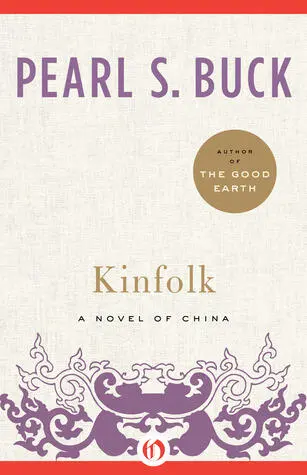
- Название:Kinfolk
- Автор:
- Издательство:Open Road Media
- Жанр:
- Год:2012
- ISBN:нет данных
- Рейтинг книги:4 / 5. Голосов: 1
-
Избранное:Добавить в избранное
- Отзывы:
-
Ваша оценка:
Kinfolk: краткое содержание, описание и аннотация
Предлагаем к чтению аннотацию, описание, краткое содержание или предисловие (зависит от того, что написал сам автор книги «Kinfolk»). Если вы не нашли необходимую информацию о книге — напишите в комментариях, мы постараемся отыскать её.
, a sharp dissection of the expatriate experience, Pearl S. Buck unfurls the story of a Chinese family living in New York. Dr. Liang is a comfortably well-off professor of Confucian philosophy, who spreads the notion of a pure and unchanging homeland. Under his influence, his four grown children decide to move to China, despite having spent their whole lives in America. As the siblings try in various ways to adjust to a new place and culture, they learn that the definition of home is far different from what they expected.
Kinfolk — читать онлайн бесплатно полную книгу (весь текст) целиком
Ниже представлен текст книги, разбитый по страницам. Система сохранения места последней прочитанной страницы, позволяет с удобством читать онлайн бесплатно книгу «Kinfolk», без необходимости каждый раз заново искать на чём Вы остановились. Поставьте закладку, и сможете в любой момент перейти на страницу, на которой закончили чтение.
Интервал:
Закладка:
Thus, he had nothing with which to understand his own melancholy as the summer ripened in the ancient city. That he was not happy he knew. That he was lonely he knew very well. He tried to believe that this was because of Lili but his too honest heart told him that it was not. He came to putting it in words only in the few brief letters which he wrote to his sister Mary, among the dutiful ones he wrote his father and mother.
“I may as well tell you that there is too much here that is rotten,” he wrote to Mary. “I suppose this is partly because we are an old people and much dead wood has not been cut away. There is decay here — I cannot find out just where, but I see it in Su and Kang and Peng and others. It is even in the nurses. But also it is in the cooks and the orderlies. Money sticks to every hand. Well, it sticks to many hands in America, too, but here there is no pretense about it. Maybe pretense is not good. Anyway, I somehow feel I have no home in the world.”
In this letter he said nothing about Lili, and reading it in the solitude of her own room Mary rejoiced. Then she read the letter again slowly. It had come to her at a moment when she herself was restless. The summer in the Vermont mountains had filled her with health and energy which as yet had no purpose. She had no lover. She had rejected with some disgust a young Chinese journalist who had pursued her. To accept an American would have been to violate the profound love of her country which was the true passion of her heart. She had quarreled all summer with Louise when she found that this younger sister moped when the mail was delayed. It had not taken too long to discover that Louise read a letter from Estelle almost as eagerly as she read the less frequent ones from Philip.
Mary had taken Louise for a walk when she discovered this, and upon a path fragrant with pine trees in the sun she had faced her sister. “Louise, don’t be a fool.” Thus their talk had begun.
Louise had blushed. Both girls stood still, and by chance it was Louise who stood in the sunshine. Mary looked at her intently and severely. “So you blush!” she cried.
Louise tossed her curled hair. “No, I don’t blush.”
“Your face is red,” Mary said. “I can see something in your eyes. Do you think Philip will marry a Chinese girl? You are silly, Louise. His father and mother will not allow it.”
“Who talked about marriage?” Louise asked. She began to walk on quickly. Mary had waited a moment, watching the slender figure of her sister in its pale yellow dress. Then she had followed with impetuous steps.
“I hope you are not thinking of anything else, Louise,” she said. She seized her sister’s hand. “Louise, do not forget — we are not American. Although we have never seen our own country, yet we are Chinese. We cannot behave like American girls.”
Louise pulled her hand away. “Let me alone,” she cried, and suddenly she began to run down the path and Mary had not pursued her. She sat down on a log and sitting alone she had tried to think what she should do, whether she should tell her parents, whether even she should write to James.
In the end after the family had come back to the city she had talked to Peter, but he had been scornful. “It doesn’t matter what Louise does,” he had said in his young and lordly fashion. “I tell you Louise is already spoiled.”
Mary’s heart had stopped. “Peter, what do you mean?” she had demanded.
Peter had laughed at her look. “Perhaps they have not slept together, if that is what scares you. Mary, you are very old-fashioned. No, but if Philip wanted Louise she would go to him.”
“Doesn’t Philip want her?”
Peter shook his head.
“You mean you have talked with him about Louise?” Mary cried.
Peter looked unwilling. Mary and he breakfasted early and usually alone, and they were talking in the dining room before their parents had come down. “I saw him kiss her one day,” he said at last.
“No!” Mary whispered. “Did Louise let him?”
Peter grinned. “She helped.”
Mary was silent for a moment. As plainly as though she had been in Peter’s place she saw the tall young American with Louise in his arms. “I shall tell Pa,” she said.
Peter shrugged his shoulders. “You have always had too much courage,” he said. He had risen from the table at that, and had gone away to his own affairs. He had only two weeks left him before college and nothing else was important to him.
When Dr. Liang came down ten minutes later he found his elder daughter looking very pretty but preoccupied. He wondered if she were thinking about some young man. Her marriage was the subject of frequent conversation between him and Mrs. Liang and he intended as soon as he saw a suitable young man to make the proper preliminary approaches. Now, observing his daughter’s pretty face and figure, it occurred to him that he ought not to delay too long.
“Good morning, Pa,” Mary said.
“Good morning,” he replied. He sat down and sipped the glass of orange juice at his plate.
“Pa!” Mary said suddenly.
He liked to be calm in the mornings and he heard with some distaste the hint of determination in her voice.
“Yes?” he replied mildly. They spoke in English.
“Pa, I don’t want to tell you this at breakfast because I know you like quiet, but I must tell you before Ma comes down. Louise is in love with Philip.”
Dr. Liang looked surprised. Nellie came in and set his oatmeal before him and he spread sugar on it in a thin even coat. When she had gone out he asked, “Who is Philip?”
“You know, Pa — he is Estelle’s brother — Estelle Morgan.”
Dr. Liang looked shocked. “An American!”
“Yes, Pa. Don’t pretend you don’t know, please, Pa! She has let him kiss her.”
Dr. Liang suddenly had no appetite. He pushed the dish of oatmeal away. “Mary, do you know of what you accuse your sister?”
“That’s why I thought you ought to know. Shall we tell Ma?”
“Tell me what?” Mrs. Liang demanded briskly. She came into the room at this moment, her full eyelids still a little swollen with sleep. “Eh, Liang — what is the matter? Is the oatmeal burned again?”
“No — it is something even worse,” he said angrily.
Mary looked at one parent and then the other. The matter was now in her father’s hands.
“Who has done something?” Mrs. Liang demanded. She sat down, yawned, and poured herself some tea from the pot on the table.
“Your youngest daughter,” he said severely.
“Louise is also your daughter,” Mrs. Liang put in.
“She. has allowed an American man to become — familiar.”
“Oh, Pa, I didn’t say that,” Mary cried.
“It is the same thing,” he said in a lofty voice. He looked at his wife. “I always said that you allowed that girl too much of her own way,” he said solemnly. “She comes and goes as if she were not Chinese. She has no breeding. She is not respectful. Now she insults even our ancestors.”
“Oh, Pa,” Mary said softly. Whenever her father became very Chinese she knew he was really angry.
“Do not interrupt me,” he replied. “And leave the room, if you please. This is for your mother and me to discuss alone.”
He waited until Mary had closed the door and then he began to speak in Chinese. His voice, usually mellifluous and deep, was now high and harsh. He pointed his long forefinger at his wife. “You,” he said, “you! I told you, when we first came here, to watch the girls.”
Mrs. Liang turned pale and began to cry. “How can I watch them?” she asked.
“You have not taught them respect,” he retorted. “They do not obey you. You should tell them what they must do and what they must not do. I have said to you many times we are Chinese. Therefore we must behave as Chinese. What is not suitable for us in China is not suitable here.”
Читать дальшеИнтервал:
Закладка:
Похожие книги на «Kinfolk»
Представляем Вашему вниманию похожие книги на «Kinfolk» списком для выбора. Мы отобрали схожую по названию и смыслу литературу в надежде предоставить читателям больше вариантов отыскать новые, интересные, ещё непрочитанные произведения.



Обсуждение, отзывы о книге «Kinfolk» и просто собственные мнения читателей. Оставьте ваши комментарии, напишите, что Вы думаете о произведении, его смысле или главных героях. Укажите что конкретно понравилось, а что нет, и почему Вы так считаете.