Sait Abasiyanik - A Useless Man
Здесь есть возможность читать онлайн «Sait Abasiyanik - A Useless Man» весь текст электронной книги совершенно бесплатно (целиком полную версию без сокращений). В некоторых случаях можно слушать аудио, скачать через торрент в формате fb2 и присутствует краткое содержание. Год выпуска: 2015, Издательство: Archipelago, Жанр: Классическая проза, на английском языке. Описание произведения, (предисловие) а так же отзывы посетителей доступны на портале библиотеки ЛибКат.
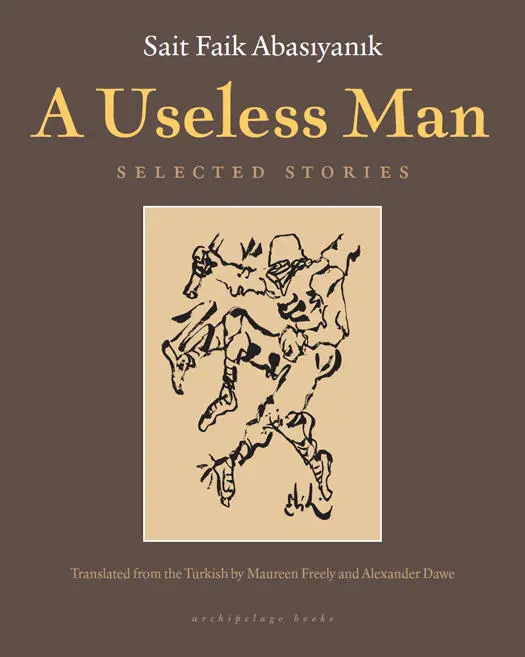
- Название:A Useless Man
- Автор:
- Издательство:Archipelago
- Жанр:
- Год:2015
- ISBN:нет данных
- Рейтинг книги:3 / 5. Голосов: 1
-
Избранное:Добавить в избранное
- Отзывы:
-
Ваша оценка:
A Useless Man: краткое содержание, описание и аннотация
Предлагаем к чтению аннотацию, описание, краткое содержание или предисловие (зависит от того, что написал сам автор книги «A Useless Man»). Если вы не нашли необходимую информацию о книге — напишите в комментариях, мы постараемся отыскать её.
Sait Faik donated his estate to the Daruşafaka foundation for orphans, and this foundation has since been committed to promoting his work. His former family home on Burgazada was recently restored, and now functions as a museum honoring his life and work. He is still greatly revered: Turkey's most prestigious short story award carries his name and nearly every Turk knows by heart a line or a story by Sait Faik.
A Useless Man — читать онлайн бесплатно полную книгу (весь текст) целиком
Ниже представлен текст книги, разбитый по страницам. Система сохранения места последней прочитанной страницы, позволяет с удобством читать онлайн бесплатно книгу «A Useless Man», без необходимости каждый раз заново искать на чём Вы остановились. Поставьте закладку, и сможете в любой момент перейти на страницу, на которой закончили чтение.
Интервал:
Закладка:
I’d hung the cage on a nail I’d hammered into the wall and set off. There were no birds in the sky, but there was green grass along the side of the road … I looked down: chunks of the grass had been torn away. A little further on I noticed four boys walking ahead. Stopping at one of the loveliest patches of green, they shoveled out a clump the size of a paving stone and tossed it into a sack.
“What are you boys doing?” I asked.
“What’s it to you?” they replied.
They were just poor children, dressed in tattered clothes.
“But friends, why are you pulling up the grass?”
“Ahmet, the engineer. We’re working for him.”
“What are they going to do with these?”
“You know the Dutch leather merchant up there? They’re landscaping his garden …”
“He should buy English grass and plant it, that guy’s a rich bastard …”
“Isn’t this the same as English grass?”
“Is it any better?”
“Of course, can you really find grass better than this? That’s what the Dutchman says.”
I ran to the police station and informed them. They supposedly took action. But the boys continued to pull up the grass here and there on the sly, and the police never did a thing about Ahmet the engineer. Even though the city council has penalties for people who pull grass out from the roadside.
They strangled the birds. They ripped up the grass. They left the roads filled with mud.
The world is changing, my friends. One day soon, there won’t be a single dark-brown fleck left in the autumn sky. One day soon, there won’t be a blade of mother earth’s green hair left on the roadside. And children, this bodes ill for you. We older ones won’t suffer. We’ve already known the pleasure of birds and green spaces. You’re the ones who will suffer. But this story is on me.
Barba Antimos

On the wall is a picture of an English aristocrat at the Imperial Court, asking for the Queen’s forgiveness. But more remarkable than that is the advertisement for “The Optimus,” a modern oil lamp.
The lamp hangs from a rope on the deck of a motorboat. It sways in the wind, while fishermen underneath it heave in a net full of fish.
The canary chirps inside its cage. Restless titmice hop from one perch down to the next. The air above the stove is shimmering. Fisherman Kanari steps inside with snow on his graying blond moustache. The canary chirps again.
“Do you know Barba Antimos?”
He is a stonemason who at the age of eighty finds himself all alone on an island, far from his wife and children, as old as the pictures on the walls, and just as alive. He no longer has a boat or a fishing net, and his heart harbors no desires. His only belongings are the Priyol watch in his pocket, the red scarf around his neck, the woolen socks on his feet, and the smoke rising from his thick Maxim Gorki moustache. As for his memories — choose any year, and he’ll have little to tell you. He might tell you about a wall he mended, and that would be it. It’s not that he’s reticent. It’s just that he prefers peace and quiet. He would, I’m sure, love to spend another eighty years on this earth, building and mending and plastering walls. And dozing by the stove in the Kornil coffeehouse, while in his dreams he was already escaping through the heather to his one-room house with a loaf of bread under his arm and fresh tobacco in his case. But time is as fickle as the wind: the lodos gives way to the poyraz and then it is the turn of the karayel . As we drag ourselves through life, it’s the rhythm of our days that seem to offer constancy. But this, too, will change. One day Barba Antimos will die.
“Barba Antimos built that wall over there,” we’ll say. “He used to sit there by that stove in the Kornil coffeehouse. At eighty, his eyes were still sharp and his hands still nimble enough to tuck a cigarette inside that moustache. And when he blew out the smoke, he’d puff out his cheeks.” That’s how we shall remember him, unless we descend into oblivion first.
Today the canary is singing, while our feet turn to ice, but one day the canary will stop singing. Apostol the Greengrocer will stop feeding rakı to Marco the Donkey. Pandeli Efendi the Milkman will no longer sit beneath that magnificent image of the British Queen with Puços, the Kornil’s resident cat, in his lap. And never again will he tell us how he was sentenced to the tombs when he’d already paid his taxes or how much effort it took to change the court’s decision. Knowing all this, I leave the coffeehouse. I leave behind the fragrant stink of rubber, fish, tobacco, and ink. I wend my way home. The moment I’m there, I’ll get started. I shall put down on paper every year of Barba Antimos’s on this earth.
The folk remedies they’d suggested for his ulcer didn’t always work. There were times when he would almost complain. The lines on his face would deepen, as if to bemoan his eighty years of stoic, noble sacrifice. Blurred by sadness, his blue eyes would seem to question human company and the rule it enforced. And perhaps these were the times when the ulcer was giving him the most pain. When he spoke directly about the ulcer, the pain was probably less severe. He had been at home for days, alone with his pain. And maybe that was why he’d come out — so that he could grumble about the pain on his way down the hill, or even before he started.
“How goes it, Barba Antimos?”
“Not so good. It’s quite troubling, sir. I can’t sleep, can’t eat. I had a little soup yesterday. But that made me …”
“It’ll pass, Barba Antimos.”
He pursed his lips. He had beautiful lips. The lips of a five-year-old child.
“The doctor at the Bulgarian hospital gave me some medicine, but it doesn’t always work. You just never know.”
Lean on any wall on this island. Sit on it. Climb over it or pelt it with stones. Whatever you do, you will find in it his mortar, sweat, and toil. You will find no mosaics in them, no ersatz wood or stone. He makes his walls the same way they made them two thousand years ago, and they hide secrets just as old. Greek gods, epic lovers, heroes railing against injustice. Touch a wall that Barba Antimos has made, and you touch antiquity. Pull a bag of Byzantine gold out of one of his cisterns — just three years old — and you’d be hard pressed to find an archaeologist to challenge its authenticity. Grow a boxwood vine over an arbor outside one of his cottages and it won’t be long before you’re expecting Socrates himself to greet you the moment you step inside. And then, one summer night, when you’re sitting at your table drinking wine, you’ll see Alcibiades draw his blade on Socrates and say: “Fine then, have it your way. But tell me this. How can a man live as long as you have without becoming an immortal? Why, after eighty years of gathering wisdom and unearthing secrets, and finally discovering true happiness, must he leave this world behind?”
Should you lack the confidence to guess how Socrates might have answered such a question, you hold your tongue. Instead you gaze up at the stars through the dangling grapes and then down at your glass of wine. Then, with Homer at your side, you follow a path that winds among the walls and houses and hollowed cisterns that grace the island with nothing but good taste; you find the true path that runs from Byzantium to the simplicity and poetry of the ancient Greek world, and away from the monstrous villas of the modern age.
Barba Antimos never falters in the face of adversity. He makes just enough to get by. As long as his arms are strong, he brings beauty to everything he touches. But when his ulcer flares up, not even 250 grams of Halvah wedged in bread can bring him comfort. His gnarled and knotted muscles go limp. And all that’s left of him is the light in his clear blue eyes and the smoke in his blond, Maxim Gorki moustache and his long, mortar-white hair. No one remembers what he did anymore — the houses he embellished, the walls he strengthened, the lime he covered with mortar and made beautiful with his hands.
Читать дальшеИнтервал:
Закладка:
Похожие книги на «A Useless Man»
Представляем Вашему вниманию похожие книги на «A Useless Man» списком для выбора. Мы отобрали схожую по названию и смыслу литературу в надежде предоставить читателям больше вариантов отыскать новые, интересные, ещё непрочитанные произведения.








Обсуждение, отзывы о книге «A Useless Man» и просто собственные мнения читателей. Оставьте ваши комментарии, напишите, что Вы думаете о произведении, его смысле или главных героях. Укажите что конкретно понравилось, а что нет, и почему Вы так считаете.