Sait Abasiyanik - A Useless Man
Здесь есть возможность читать онлайн «Sait Abasiyanik - A Useless Man» весь текст электронной книги совершенно бесплатно (целиком полную версию без сокращений). В некоторых случаях можно слушать аудио, скачать через торрент в формате fb2 и присутствует краткое содержание. Год выпуска: 2015, Издательство: Archipelago, Жанр: Классическая проза, на английском языке. Описание произведения, (предисловие) а так же отзывы посетителей доступны на портале библиотеки ЛибКат.
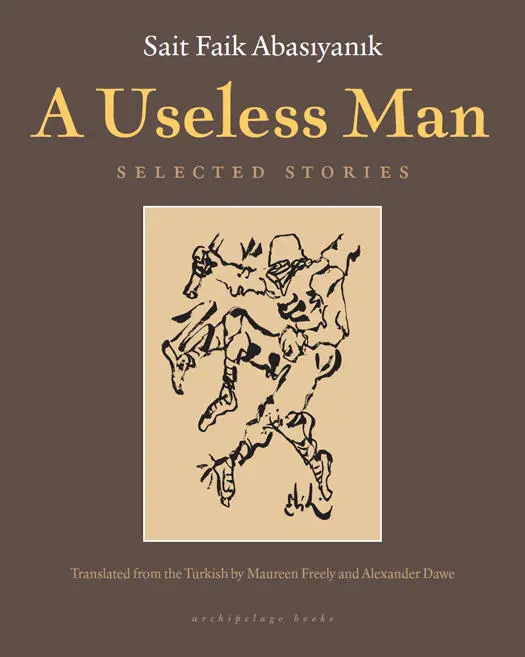
- Название:A Useless Man
- Автор:
- Издательство:Archipelago
- Жанр:
- Год:2015
- ISBN:нет данных
- Рейтинг книги:3 / 5. Голосов: 1
-
Избранное:Добавить в избранное
- Отзывы:
-
Ваша оценка:
A Useless Man: краткое содержание, описание и аннотация
Предлагаем к чтению аннотацию, описание, краткое содержание или предисловие (зависит от того, что написал сам автор книги «A Useless Man»). Если вы не нашли необходимую информацию о книге — напишите в комментариях, мы постараемся отыскать её.
Sait Faik donated his estate to the Daruşafaka foundation for orphans, and this foundation has since been committed to promoting his work. His former family home on Burgazada was recently restored, and now functions as a museum honoring his life and work. He is still greatly revered: Turkey's most prestigious short story award carries his name and nearly every Turk knows by heart a line or a story by Sait Faik.
A Useless Man — читать онлайн бесплатно полную книгу (весь текст) целиком
Ниже представлен текст книги, разбитый по страницам. Система сохранения места последней прочитанной страницы, позволяет с удобством читать онлайн бесплатно книгу «A Useless Man», без необходимости каждый раз заново искать на чём Вы остановились. Поставьте закладку, и сможете в любой момент перейти на страницу, на которой закончили чтение.
Интервал:
Закладка:
And off he went up the hill.
The Last Birds

Winter came with the winds — the poyraz and the yıldız poyraz , the maestro , and the dramaduna , the gündoğusu , the karayel , and the batı karayel . It took up residence on one side of the island while summer lingered on the other, a wistful nomad who had yet to gather up her things. I have no wish to sing my own praises, but I do believe I am the only man on the island who fully appreciates this fresh-faced beauty as she wavers (passport in one hand, a pouch of gold pieces in the other) between staying and going.
All around me, they were making their preparations for six or seven months of cold. But I, in my idleness, was playing hide and seek with my nomad. Whenever I caught up with her, I held her in my arms. Sometimes she hid in the shade of a pine. Sometimes I would find her in the grass, next to a bush — as radiant as if she had never left.
On this side of the island, where summer is so slow to close her tattered bundles, the only structure standing is a little coffeehouse.
It is no larger than a small balcony, just five or ten meters above a quiet bay. Ants still wander over its wooden tables. Flies perch on the edges of coffee cups. There isn’t a sound. Then from somewhere in the sky comes the humming of a plane. I only imagine the passengers as I write these lines now. There were other planes, earlier on. But this is the first time I’ve stopped to think about the passengers who are soon to disembark at Yeşilköy, who may already have done so by the time I finish these two lines.
The proprietor is a surly man, more like a cantankerous civil servant than the proprietor of a coffeehouse. It’s the last job in the world he would have chosen, but he was in poor health and his doctors told him to take it easy. I have very different reasons: I stayed away from the job because I couldn’t find the right coffeehouse. What I had in mind was a coffeehouse in the country, or a village. With only three or four regulars … I can’t think of a more beautiful life. What could be more beautiful than a life spanning fifty or sixty years, if it began and ended in such a place?
The underwear strung up between two trees will never dry in this warm weather. It’s overcast and still. A cat is up on the tabletop. Will it keep grumbling at my dog? Those holey socks draped over the chairs are as dark as cherry stones … The vine leaves are greener than ever. The ones in our garden are already dry.
The sea is racing off to the Bozburun Peninsula. What part of Istanbul is that, hovering in the distance? Why is there no sound?
Another plane flies overhead. Our island must be underneath a flight path — they are always going right over us, or just to the left. The cat’s stopped grumbling. My dog’s eyes are closed. Now I can hear the crows. Time was when birds would flock to the island at this time of year. They’d fill the air with their chirping. They’d swarm in flocks from tree to tree.
For two years now, we haven’t seen them.
Or have they come and gone without my knowing?
Toward autumn I’d see families — all sorts — heading toward the highest hill on the island with cages in their hands. I’d shudder at the sight.
The older ones carried strange, shit-colored clubs.
When they reached the edge of a green meadow, they’d set down their cage. Inside was a decoy bird. Placing the cage beneath a little tree, they’d smear birdlime all over its branches. The wild birds would hear the decoy’s lonely cry — for friendship, for company — and swoop down to help, while that bunch of bruisers kept watch from the shade of a neighboring tree. Then slowly they’d come back out into the open to walk toward the cage, the decoy, and the swarms of wild birds. Four or five would manage to break free of the birdlime and while they were flying off to be caught on yet another patch of lime, these men would gather up their quarry. Each bird a miracle of nature. Each yielding no more than a drop of flesh. Then and there, they’d break their necks with their teeth. And then pluck them alive.
There was one in particular, I’ll always remember him. This one brought boys with him to do the job. He’d prepare the birdlime on Saturday night … The bastard’s name was Konstantin. He had an office in Galata. A grain store. He was a broad-chested man, with thick, hairy wrists; his smile was oily and unctuous; his nose was covered with moles and his nostrils flared. A shock of unruly hair, and mincing footsteps.
If only you could see him, wrapping his fingers around those golden brown feathers, and sinking his glittering chrome teeth into the bird’s neck. Already tasting the pilaf he would sprinkle with its drop of flesh.
He was a calm and humble man. He didn’t flaunt his wealth. His neighbors liked him and all that. He never meddled in their affairs. Never gossiped. If you saw him pitter-pattering off to work of a morning, or stepping off the ferryboat of an evening, swinging his heavy string bag, you’d find nothing amiss in his massive frame, his casual air, his Karaman accent. His simple, if calculated, way of thinking. The simple, if endearing, jokes he told after throwing back a few glasses. In his natural state he could be any one of a thousand other people, measuring their lives on their way to work.
But in the fall he became a monster. In the space of an instant, a monster. Seated on a bench on the back deck of the 5:35 ferryboat, he would let his contented eyes travel over the surface of the sea. He would lift them to the wondrous late September sky. Then suddenly his eyes would light up. His entire face.
A swarm of dark brown specks would appear, in the sky and on the green-blue sea. They would dance to the right and left, these dark brown specks, before setting course to vanish as fast as they had come.
Konstantin Efendi would squint as he gazed in their wake. He would see where the brown specks were heading. Yes. It was the island. Looking around him, he would seek out someone he knew. Then he’d wink and point up to the sky and say:
“Our pilaf has arrived!”
If the birds passed close enough, he’d whistle through his teeth. With his thick lips, he would imitate their song. Once I saw a whole flock of them deceived. They circled around the boat before they left, detained by what they thought had been a friendly cry.
Then the weather changed. The lodos and the poyraz went to war over us, but on one warm, sweet hyacinth day in late autumn, when the wind had died down, when strips of cloud still hovered in the sky, he managed to locate an excellent decoy for his cage. He called in all the neighborhood boys. One by one they plucked the finches from the sky, and the titmice, the floryas and the odd sparrow. A thousand birds, yielding no more than 250 grams of flesh.
The birds haven’t come for years now. Or maybe I just don’t see them. Once I glimpsed one of those beautiful autumn days through my window. I set out wondering just where along the hillside I might find Konstantin Efendi. My blood froze when I heard the chirping of a bird. My heart stopped. But how could that be? Flying amidst the arbutus berries, the white and olive-colored clouds, the soft sunlight, and this peaceful wash of blue, a bird call can only conjure up a world of peace and poetry. Literature, art, music. Happy, understanding souls that never heed the call of greed. However far afield we travel, wherever we are in the world, a calling bird speaks one language. Konstantin Efendi is a mere hindrance. But what are we to do? The birds no longer come here. Maybe in a few years they’ll be gone forever. Who knows how many Konstantin Efendis there are in the world? First it was the birds. Now it’s our green spaces. The other day I stepped out onto the road as I couldn’t bear to crush the grass along the sidewalk. It was one of those Konstantin Efendi days. There wasn’t a bird in the sky. Before leaving home, I’d pressed a fig up against my titmouse’s cage. Cracking a fig seed, he looked up at me fondly through one eye.
Читать дальшеИнтервал:
Закладка:
Похожие книги на «A Useless Man»
Представляем Вашему вниманию похожие книги на «A Useless Man» списком для выбора. Мы отобрали схожую по названию и смыслу литературу в надежде предоставить читателям больше вариантов отыскать новые, интересные, ещё непрочитанные произведения.








Обсуждение, отзывы о книге «A Useless Man» и просто собственные мнения читателей. Оставьте ваши комментарии, напишите, что Вы думаете о произведении, его смысле или главных героях. Укажите что конкретно понравилось, а что нет, и почему Вы так считаете.