Sergei Lebedev - Oblivion
Здесь есть возможность читать онлайн «Sergei Lebedev - Oblivion» весь текст электронной книги совершенно бесплатно (целиком полную версию без сокращений). В некоторых случаях можно слушать аудио, скачать через торрент в формате fb2 и присутствует краткое содержание. Город: New York, Год выпуска: 2016, ISBN: 2016, Издательство: New Vessel Press, Жанр: Историческая проза, Современная проза, на английском языке. Описание произведения, (предисловие) а так же отзывы посетителей доступны на портале библиотеки ЛибКат.
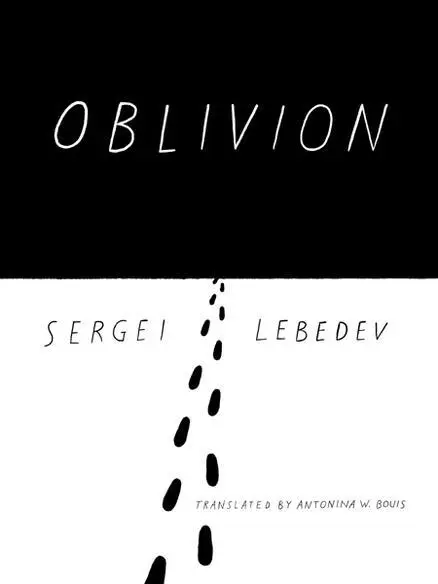
- Название:Oblivion
- Автор:
- Издательство:New Vessel Press
- Жанр:
- Год:2016
- Город:New York
- ISBN:978-1-939931-25-2
- Рейтинг книги:4 / 5. Голосов: 1
-
Избранное:Добавить в избранное
- Отзывы:
-
Ваша оценка:
Oblivion: краткое содержание, описание и аннотация
Предлагаем к чтению аннотацию, описание, краткое содержание или предисловие (зависит от того, что написал сам автор книги «Oblivion»). Если вы не нашли необходимую информацию о книге — напишите в комментариях, мы постараемся отыскать её.
Sergei Lebedev
Oblivion
Oblivion — читать онлайн бесплатно полную книгу (весь текст) целиком
Ниже представлен текст книги, разбитый по страницам. Система сохранения места последней прочитанной страницы, позволяет с удобством читать онлайн бесплатно книгу «Oblivion», без необходимости каждый раз заново искать на чём Вы остановились. Поставьте закладку, и сможете в любой момент перейти на страницу, на которой закончили чтение.
Интервал:
Закладка:
The prisoners of the 1930s and 1940s lived in foxholes before they built barracks; the fishermen and hunters of the Neolithic period who left drawings and petroglyphs in the nearby mountains, hunters of the sun and pilots of the moon—they were related by the dark of the cave, where the first rational feeling was pain; and I thought of an old acquaintance, a professor of archaeology who studied Neanderthal culture and was then arrested and sent to the camps.
We met in the region where he had been exiled and later remained; there he studied the history of local tribes inhabiting the long and narrow sandbars in the thousands of kilometers of swamps. In times closer to our own, an epic was being created by people’s lives, and big events, wars and revolutions were woven into its pattern and reinterpreted as a mythological scene; Nicholas II, Lenin, and Stalin were turned into heroes of the middle world, Bolsheviks were born out of the ground; battles and clashes reached them like a wave striking a distant shore, the receptive myth reworked them without destroying its own wholeness; the GOERLO plan for national electrification was turned into combat over the sun, collectivization into a clash between the spirits of the land and the spirits of war who destroyed all the fruits of the earth for the work of death.
The professor studied these tribes without scientific detachment, rather, he did not separate his perceptions from those of the people whose minds created the myths; the professor said that he tested the effectiveness and saving power of a mythical perception of reality, turning it into a battle of the ancient polymorphic forces of good and evil, a struggle without distinction of warring sides. In this consciousness, good is not yet separated from evil, they grow out of the same life root and easily flow into each other, they are close and fraternal; for instance, what is really evil is presented as good and what is seen as a victory of good is actually the triumph of evil. This is how the mind protects itself, the professor thought, extending the spectral presence of good through mythology, when facing the totality of evil without the distorting lens of myth would destroy you.
Yet the professor did not forget his prior scientific interests and liked to tell me that since he had been in the few caves with Neanderthal remains and had studied their skeletons in order to establish what the creatures looked like, in the camps he had the feeling he was surrounded by those he thought had become extinct tens of thousands of years ago.
The discovery, in the final years of the professor’s life, that Neanderthals were not ancestors of man, but were an independent subspecies and warred with humans, confirmed his unscientific hypothesis, which was nevertheless exact in a different way: the ancient anthropoid races did not vanish, they learned to coexist with humans, grew to look like them, but their cannibalistic nature remained the same; when the human qualities in humans are abused, that nature is revealed and manifests itself: the cannibals openly practice their cannibalism. However, the professor used this hypothesis metaphorically as well: “It’s easier this way than accepting that everything I have seen belongs to human nature.”
The town also had a geological museum; the main exhibits were the local ores used to make fertilizer and the minerals with rare earth metals.
All were ugly, here was one homely stone and oddly, a whole city, tens of thousands of people, arose just to mine that stone, so ordinary looking; when you look at the minerals cerium or scandium, you understand that they have an admixture of metals that are extremely expensive, but their value is profoundly conceptual.
Of course, you are judging like an ordinary person expecting an obvious depiction of value that would justify the massive expenditures—processing plants, quarries, mines—but at the same time there is something very true in the ordinary view; it was telling you that labor here has a specific meaning and there is no point in judging it by its fruits.
Even coal extracted from a mine is a compressed form of the fierce sun of the Jurassic period, the sun of gigantic creatures and vegetation, it remembers the shimmer of scaly skin, the heat of the sun that was younger by hundreds of millions of years, coal—and there is a reason why heat and food is calculated in calories—seems to be the food of fire, and the ancient respect for fire makes coal the bread of flames, a significant presence in the business of life. The rocks and minerals in the museum did not speak to the heart, they could become valuable only in a chain of chemical transformations, traveling along several conveyor belts, and it seemed that a miner who cut out a rock like that with his jackhammer should ask himself why he’s done so and should have to persuade himself that his work has meaning and is useful—for the distance is too great between a piece of gray dull rock and the extraction of a useful substance.
After the library and museums I decided after all to visit the street where the man who wrote to Grandfather II lived; not drop in on him, not ask about him, just walk down the street, as if by chance; bring the future a little closer, but not enter it; see what that man sees—or saw—every day, his store, his tobacco kiosk, his bus stop, his front door; take a good look—for now as a casual stroller—at the street that would irreversibly become that street, look at it freely as one of many streets, and maybe it would tell me something, warn me.
I wanted to ask for a map at the newspaper counter, but realized that the town did not need to see itself from the outside; they would hardly publish a map here, it was all known, all the corners, intersections, alleys, and courtyards; people don’t look at maps here, they ask the way; and so did I.
No one knew the street indicated in the letter; people tried to remember, stopped others, one even called home—there was no such street; of course, it wasn’t hard to get mixed up: it was called Red Kolkhoz Street, and the town had many other streets with red in the name: Red Army, Red Partisans, Red Lighthouse, Red Dawn; none of them had anything to do—by name—with the locale, creating a parallel system of ideological cosmogony in which Red Dawns rose above the country and the Red Lighthouse lit the way for the Red Partisans for some reason; people were trapped in this net of non-reality, and they lived in it, pronouncing the names and extending the existence of this hassle. I remembered a village outside Moscow where I was visiting friends in their dacha and I awoke in the morning with the horrible realization that I was in a place called Lenin’s Precepts, and the very possibility of living there, of saying “We live in the Precepts” or “The population of the Precepts,”—it was detrimental to sanity to live in something that was doubly fictitious because Lenin never left any precepts. Now I was dealing with the topography of an entire town that was deprived of its own voice, drawn on a grid, and the streets intersected like footnotes in articles of the latest mythological dictionary.
At last someone recalled that Red Kolkhoz Street had existed but then the old buildings were razed, they were some of the first built in the town, and the Rainbow neighborhood was created, and the street was now called First Rainbow.
Hoping that maybe Grandfather II’s correspondent had been given an apartment in one of the new buildings, I went to First Rainbow. They were multistoried houses painted in bright colors copying one of the big northern cities; orange, pink, and violet nine-story buildings. They were no longer new—it was fifteen or twenty years later, but the cheerful colors denied the possibility of a man from the past choosing to live here; there were no old people in the courtyards, they apparently did not manage to live here among walls the color of fruit-flavored gum.
Читать дальшеИнтервал:
Закладка:
Похожие книги на «Oblivion»
Представляем Вашему вниманию похожие книги на «Oblivion» списком для выбора. Мы отобрали схожую по названию и смыслу литературу в надежде предоставить читателям больше вариантов отыскать новые, интересные, ещё непрочитанные произведения.





Обсуждение, отзывы о книге «Oblivion» и просто собственные мнения читателей. Оставьте ваши комментарии, напишите, что Вы думаете о произведении, его смысле или главных героях. Укажите что конкретно понравилось, а что нет, и почему Вы так считаете.