Jonathan Foer - Here I Am
Здесь есть возможность читать онлайн «Jonathan Foer - Here I Am» весь текст электронной книги совершенно бесплатно (целиком полную версию без сокращений). В некоторых случаях можно слушать аудио, скачать через торрент в формате fb2 и присутствует краткое содержание. Год выпуска: 2016, Издательство: Hamish Hamilton, Жанр: Историческая проза, на английском языке. Описание произведения, (предисловие) а так же отзывы посетителей доступны на портале библиотеки ЛибКат.
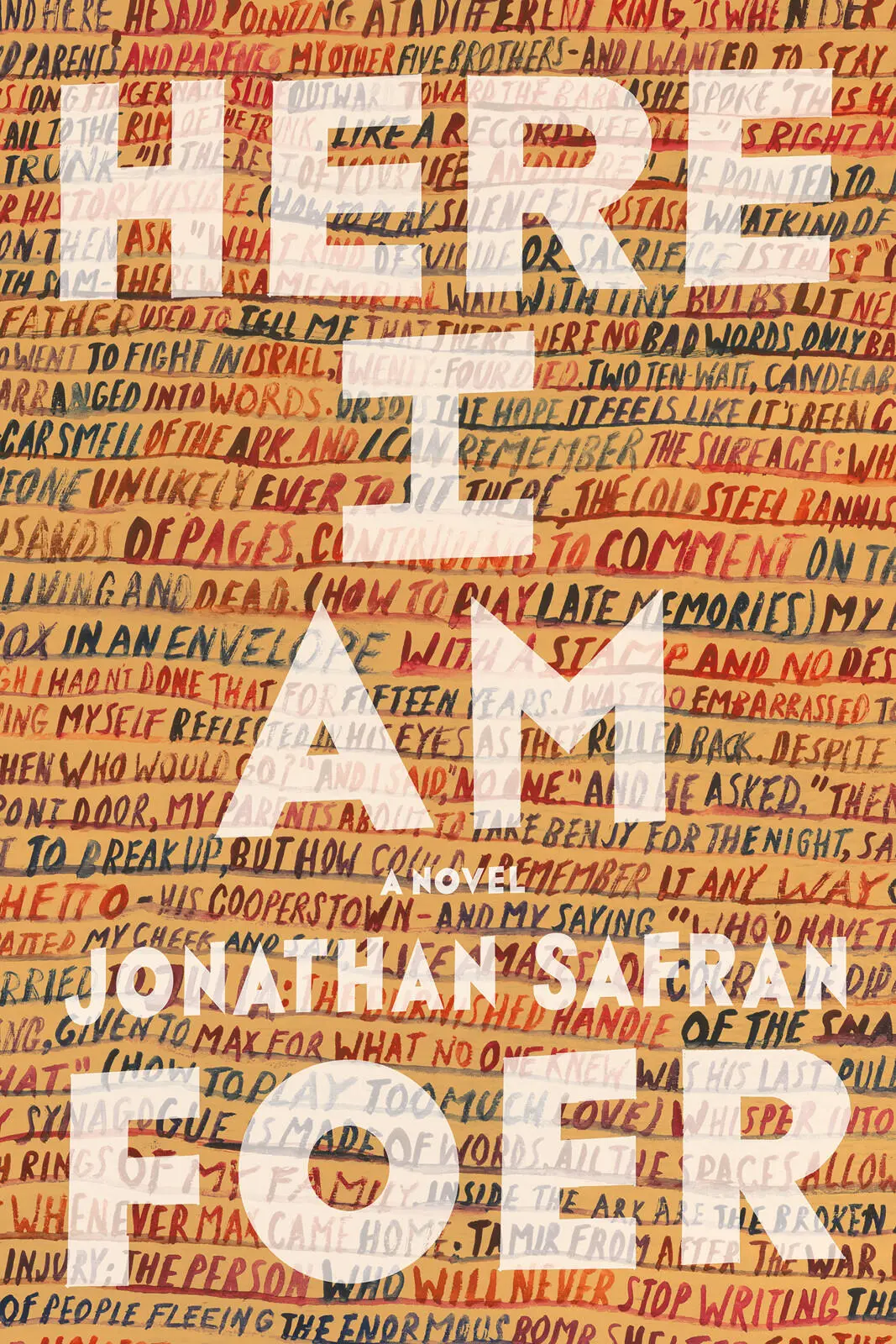
- Название:Here I Am
- Автор:
- Издательство:Hamish Hamilton
- Жанр:
- Год:2016
- ISBN:нет данных
- Рейтинг книги:5 / 5. Голосов: 1
-
Избранное:Добавить в избранное
- Отзывы:
-
Ваша оценка:
Here I Am: краткое содержание, описание и аннотация
Предлагаем к чтению аннотацию, описание, краткое содержание или предисловие (зависит от того, что написал сам автор книги «Here I Am»). Если вы не нашли необходимую информацию о книге — напишите в комментариях, мы постараемся отыскать её.
How do we fulfill our conflicting duties as father, husband, and son; wife and mother; child and adult? Jew and American? How can we claim our own identities when our lives are linked so closely to others’? These are the questions at the heart of Jonathan Safran Foer’s first novel in eleven years-a work of extraordinary scope and heartbreaking intimacy.
Unfolding over four tumultuous weeks in present-day Washington D.C.,
is the story of a fracturing family in a moment of crisis. As Jacob and Julia and their three sons are forced to confront the distances between the lives they think they want and the lives they are living, a catastrophic earthquake sets in motion a spiraling conflict in the Middle East. At stake is the very meaning of home — and the fundamental question of how much life one can bear.
Showcasing the same high-energy inventiveness, hilarious irreverence, and emotional urgency that readers and critics loved in his earlier work,
is Foer’s most searching, hard-hitting, and grandly entertaining novel yet. It not only confirms Foer’s stature as a dazzling literary talent but reveals a mature novelist who has fully come into his own as one of the most important writers of his generation.
Here I Am — читать онлайн бесплатно полную книгу (весь текст) целиком
Ниже представлен текст книги, разбитый по страницам. Система сохранения места последней прочитанной страницы, позволяет с удобством читать онлайн бесплатно книгу «Here I Am», без необходимости каждый раз заново искать на чём Вы остановились. Поставьте закладку, и сможете в любой момент перейти на страницу, на которой закончили чтение.
Интервал:
Закладка:
The camera held.
The prime minister inhaled, and gathered into the ram’s horn the molecules of every Jew who had ever lived: the breath of warrior kings and fishmongers; tailors, matchmakers, and executive producers; kosher butchers, radical publishers, kibbutzniks, management consultants, orthopedic surgeons, tanners, and judges; the grateful laugh of someone with more than forty grandchildren gathered in his hospital room; the false moan of a prostitute who hid children under the bed on which she kissed Nazis on the mouth; the sigh of an ancient philosopher at a moment of understanding; the cry of a new orphan alone in a forest; the final air bubble to rise from the Seine and burst as Paul Celan sank, his pockets full of stones; the word clear from the lips of the first Jewish astronaut, strapped into a chair facing infinity. And the breath of those who never lived, but whose existence Jewish existence depended on: the patriarchs, matriarchs, and prophets; Abel’s last plea; Sarah’s laughter at the prospect of the miracle; Abraham offering his God and his son what could not be offered to both: “Here I am.”
The prime minister aimed the shofar forty-five degrees, sixty degrees, and in New York, and in Los Angeles, and in Miami, Chicago, and Paris, in London, Buenos Aires, Moscow, and Melbourne, television screens trembled, they shook.
TODAY I AM NOT A MAN
“The hardest thing to say is the hardest thing to hear: forced to choose between my parents, I would be able to.
“And I’ve talked about it with Max and Benjy, and if forced to choose, each of them could choose as well. Two of us would have chosen one, and one of us the other, but we agreed that if forced to choose, we would all choose the same one, so that we could stay together.
“When I did Model UN a couple of weeks ago, the country we were representing, Micronesia, suddenly came into possession of a nuclear weapon. We didn’t ask for a nuclear weapon, and didn’t want a nuclear weapon, and nuclear weapons are, in pretty much every way, horrible. But there’s a reason people have them, and it’s to never have to use them.
“That’s it. I’m finished.”
He didn’t bow, they didn’t clap. No one moved or spoke.
As always, Sam didn’t know what to do with his body. But the organism that was the roomful of family and friends seemed to depend on his movement. If he started to cry, someone would comfort him. If he ran out, someone would follow. If he’d just go talk to Max, everyone would schmooze. But if he continued to stand there, fists balled, they would continue to stand there.
Jacob thought maybe he could clap his hands, smile, and say something lame, like “Dig in!”
Julia thought maybe she could go to Sam, put her arm around him, and touch her head to his head.
Even Benjy, who, by virtue of never giving it any thought, always knew what to do, was motionless.
Irv longed to assume the authority of the family’s new patriarch, but he didn’t know how. Was there a five-dollar bill in his pocket?
From the middle of the room, Billie said, “Yet.”
Everyone turned to her.
“What?” Sam asked.
There was no sound to overcome, but she screamed: “Yet!”
O JEWS, YOUR TIME HAS COME!
The cheering would continue long after the Ayatollah lowered his final raised arm of solidarity. Long after he made his way behind the temporary stage, surrounded by a dozen plainclothes bodyguards. The cheering — the applauding, the chanting, the hollering, the singing — would continue after he was greeted by a line of his closest advisers, each kissing him, blessing him. After he was put into a car with two-inch-thick windows and no door handles and driven away. The cheering continued, and intensified, but without a gravitational center, the crowd moved outward in every direction.
Wolf Blitzer and his panel started discussing the speech — without the time to digest the translation, they just pulled quote after quote until they’d reassembled it out of order — but the camera stayed on the crowd. The mass of people couldn’t be contained by Azadi Square, which pumped them through the connecting streets like blood, and it couldn’t be contained by the camera’s frame.
Jacob imagined every street in Tehran packed with people throwing fists in the air, beating their chests. He imagined every park and gathering space overflowing like Azadi Square. The camera closed on a woman slapping the back of one hand into the palm of the other, over and over; a boy screaming from his father’s shoulders, four arms in the air. There were people on balconies, on rooftops, on the branches of trees. People atop cars and corrugated metal awnings too hot to be touched with bare skin.
The Ayatollah’s words had dripped into more than a billion open ears, and there had been two hundred thousand pairs of fixed eyes in the square, and 0.2 percent of the world was Jewish, but watching the replays of the speech — the Ayatollah’s gesticulating fists, the crowd’s undulations — Jacob thought only of his family.
Before they were allowed to take Sam home from the hospital when he was born, Jacob had to sit through a fifteen-minute course covering the Ten Commandments of Caring for a Newborn — the absolute rudiments of new parenting: YOU SHALL NOT SHAKE YOUR BABY; YOU SHALL CARE FOR THE UMBILICAL STUMP WITH A COTTON SWAB SOAKED IN WARM WATER AND SOAP, AT LEAST ONCE A DAY; YOU SHALL BE AWARE OF THE FONTANEL; YOU SHALL FEED YOUR BABY ONLY BREAST MILK OR FORMULA, BETWEEN ONE AND THREE OUNCES, EVERY TWO TO THREE HOURS, AND YOU SHALL NOT BE OBLIGATED TO BURP YOUR BABY IF HE FALLS ASLEEP AFTER A FEEDING; and so on. All things that anyone who had gone to a parenting class, or had ever spent time in the presence of a baby, or had simply been born Jewish, would already know. But the Tenth Commandment rattled Jacob. YOU SHALL REMEMBER: IT WILL NOT LAST.
COME HOME
After the guests went home, after Uber came for the Torah, after Tamir took all the kids to the Nats game (where, thanks to Max’s thoughtful ingenuity, Sam’s bar mitzvah was announced on the scoreboard during the seventh-inning stretch), after a bit of unnecessary e-mailing, after a walk to the corner with Argus, Jacob and Julia were left to clean up. Before they had kids, if asked to conjure images of parenthood they would have said things like “Reading in bed,” and “Giving a bath,” and “Running while holding the seat of a bicycle.” Parenthood contains such moments of warmth and intimacy, but isn’t them. It’s cleaning up. The great bulk of family life involves no exchange of love, and no meaning, only fulfillment. Not the fulfillment of feeling fulfilled, but of fulfilling that which now falls to you.
Julia couldn’t bring herself to accept paper plates in the end, so there were a few loads of dishes to do. Jacob filled the machine to the brim and then hand-washed the rest, he and Julia taking turns with the soaping-up and the drying-off.
“You were right not to believe him,” Jacob said.
“Apparently. But you were right that we should have believed him.”
“Did we mishandle it?”
“I don’t know,” Julia said. “Is that even the question? Everything with kids is some kind of mishandling. So we try to learn, and mishandle it less badly in the future. But in the meantime, they’ve changed, so the lesson doesn’t apply.”
“It’s a lose-lose.”
They both laughed.
“A love-love.”
The sponge was already well on its way to mush, the only clean dish towel was damp, and the dish soap had to be diluted with water for there to be enough, but they made it work.
“Listen,” Jacob said. “Not fatalistically, but responsibly, I arranged a whole bunch of things with the accountant and lawyer, and—”
Читать дальшеИнтервал:
Закладка:
Похожие книги на «Here I Am»
Представляем Вашему вниманию похожие книги на «Here I Am» списком для выбора. Мы отобрали схожую по названию и смыслу литературу в надежде предоставить читателям больше вариантов отыскать новые, интересные, ещё непрочитанные произведения.









Обсуждение, отзывы о книге «Here I Am» и просто собственные мнения читателей. Оставьте ваши комментарии, напишите, что Вы думаете о произведении, его смысле или главных героях. Укажите что конкретно понравилось, а что нет, и почему Вы так считаете.