Jonathan Foer - Here I Am
Здесь есть возможность читать онлайн «Jonathan Foer - Here I Am» весь текст электронной книги совершенно бесплатно (целиком полную версию без сокращений). В некоторых случаях можно слушать аудио, скачать через торрент в формате fb2 и присутствует краткое содержание. Год выпуска: 2016, Издательство: Hamish Hamilton, Жанр: Историческая проза, на английском языке. Описание произведения, (предисловие) а так же отзывы посетителей доступны на портале библиотеки ЛибКат.
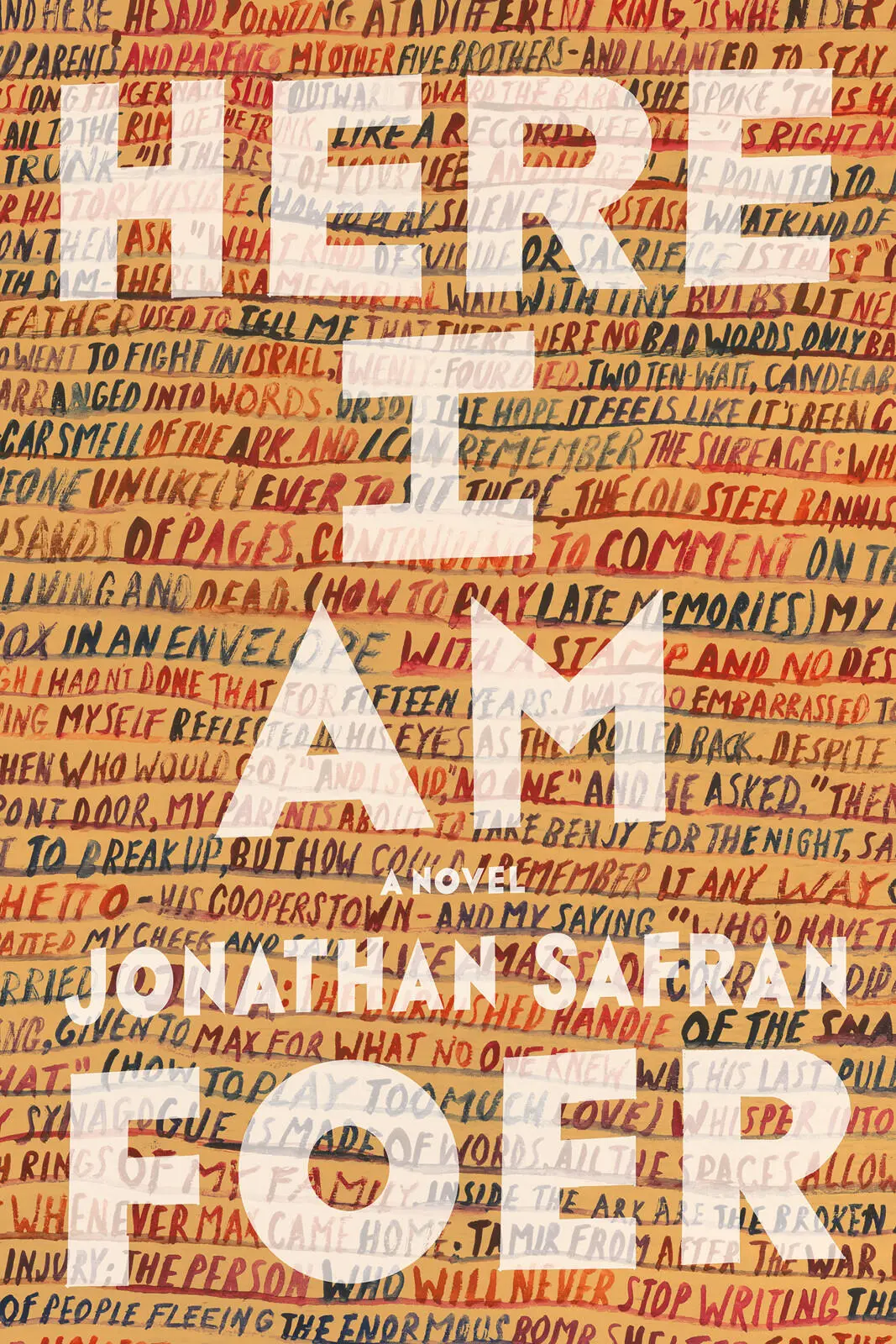
- Название:Here I Am
- Автор:
- Издательство:Hamish Hamilton
- Жанр:
- Год:2016
- ISBN:нет данных
- Рейтинг книги:5 / 5. Голосов: 1
-
Избранное:Добавить в избранное
- Отзывы:
-
Ваша оценка:
Here I Am: краткое содержание, описание и аннотация
Предлагаем к чтению аннотацию, описание, краткое содержание или предисловие (зависит от того, что написал сам автор книги «Here I Am»). Если вы не нашли необходимую информацию о книге — напишите в комментариях, мы постараемся отыскать её.
How do we fulfill our conflicting duties as father, husband, and son; wife and mother; child and adult? Jew and American? How can we claim our own identities when our lives are linked so closely to others’? These are the questions at the heart of Jonathan Safran Foer’s first novel in eleven years-a work of extraordinary scope and heartbreaking intimacy.
Unfolding over four tumultuous weeks in present-day Washington D.C.,
is the story of a fracturing family in a moment of crisis. As Jacob and Julia and their three sons are forced to confront the distances between the lives they think they want and the lives they are living, a catastrophic earthquake sets in motion a spiraling conflict in the Middle East. At stake is the very meaning of home — and the fundamental question of how much life one can bear.
Showcasing the same high-energy inventiveness, hilarious irreverence, and emotional urgency that readers and critics loved in his earlier work,
is Foer’s most searching, hard-hitting, and grandly entertaining novel yet. It not only confirms Foer’s stature as a dazzling literary talent but reveals a mature novelist who has fully come into his own as one of the most important writers of his generation.
Here I Am — читать онлайн бесплатно полную книгу (весь текст) целиком
Ниже представлен текст книги, разбитый по страницам. Система сохранения места последней прочитанной страницы, позволяет с удобством читать онлайн бесплатно книгу «Here I Am», без необходимости каждый раз заново искать на чём Вы остановились. Поставьте закладку, и сможете в любой момент перейти на страницу, на которой закончили чтение.
Интервал:
Закладка:
Almost convulsing with restraint, Benjy asked, “Did she have an egg?”
“He.”
“He!”
“And no, he didn’t.”
“What an asshole.”
“And I accidentally blinded him.”
“Injury to the insult.”
“No, wait. Wait. Do it again. Ask me if she had an egg.”
“I have a question.”
“Let me try to answer it.”
“Did she have an egg?”
“Your mom? She did.”
“Wonder of wonders!”
“And I accidentally fertilized it.”
The laughter we’d been containing never came. We sighed, smiled, sat back, and nodded for no reason. Benjy said, “It must be a relief.”
“What must?”
“Finally looking like yourself.”
I looked at “You will travel to many places” and said, “I am not a ghost.”
Benjy was five when we started Tales from the Odyssey . I’d read it to Sam and Max, and both times, the further we got in, the slower we read, until we were making it through only a page a night. Benjy and I got all the way through the Cyclops that first bedtime. I had a rare instance of recognizing what was happening as it happened — he was my final child, and this was my final reading of the passage. It would not last. “‘Why?’” I read. “‘Why do you break the stillness of the night with your cries?’” I gave space to each pause, opening the sentences as far as they would go. “‘Who harms you?’ ‘NO ONE!’ Polyphemus shouted, writhing on the floor of his cave. ‘No One tried to kill me! No One blinded me!’”
HOW TO PLAY NO ONE
I told Julia I didn’t want her to go with us to the airport. I would tuck in the children, like any other night, no overly dramatic goodbyes, let them know I’d FaceTime as often as possible and be back in a week or two with a suitcase of tchotchkes. And then I’d leave while they slept.
“You can do it however you want,” she said. “But can I ask you — or can you ask yourself — what it is you’re waiting for?”
“What do you mean?”
“Everything is no big deal. You’ve raised your voice once in your entire life, to tell me I was your enemy.”
“I didn’t mean that.”
“I know. But you don’t mean the silence, either. If this isn’t a big deal — saying goodbye to your children before going to war — what is? What is the big deal you’re waiting for?”
My father drove us to MacArthur Airport in Islip, Long Island. I sat in the passenger seat, and Barak moved in and out of sleep against Tamir’s chest in the back. Five hours. On the radio, there was coverage of the first day of Operation Arms of Moses. Reporters were stationed at the designated airfields around the world, but as it was still early, most of the reporting was just speculation about how many would heed the call. It was the opposite of the ride we’d made only a few weeks earlier, from Washington National to the house.
What conversations there were in the car were segregated front and back; I could hear little of what passed between Tamir and Barak, and my father, who lacked an indoor voice, found his whisper.
“Gabe Perelman will be there,” he said. “I spoke to Hersch last night. We’re going to see a lot of people we know.”
“Probably.”
“Glenn Mechling. Larry Moverman.”
“Mom’s OK, right? She was worryingly nonchalant this morning.”
“She’s a mother. But she’ll be fine.”
“And you?”
“What can I say? The price of speaking unpopular truths. I turned the ringer off on the home phone. And D.C.’s finest put a car on the corner. I told them not to. They insisted, told me it wasn’t my choice. It’ll pass.”
“Not that. I mean with me going.”
“You read what I wrote. Every part of me wishes you didn’t have to go, but I know you do.”
“I can’t believe this is happening.”
“That’s because you haven’t been listening to me for the past twenty years.”
“Longer than that.”
Eyes on the road, he rested his right hand on my thigh and said, “I can’t believe it, either.”
We stopped curbside. The airport was closed, save for flights to Israel. There were about two dozen cars unloading men, and no one waving a stumpy lightsaber and saying, “Keep it moving, keep it moving,” but there were two men in army green with machine guns pressed to their chests.
We took our duffels from the trunk and stood by the car.
“Barak’s not going to get out?” I asked.
“He’s asleep,” Tamir said. “We said goodbye in the car. It’s better this way.”
My father put his hand on Tamir’s shoulder and told him, “You’re brave.”
Tamir said, “This doesn’t count as bravery.”
“I loved your father.”
“He loved you.”
My father nodded. He put his other hand on Tamir’s other shoulder and said, “Since he’s no longer here—” and that was all that was needed. As if the knowledge of what to do at that moment had been coiled into him at birth, Tamir put down his duffel, let his arms rest at his sides, and bowed slightly. My father placed his hands atop Tamir’s head and said, “ Y’varech’cha Adonai v’yishm’recha. May God bless you and guard you. Ya’ar Adonai panav ay’lecha viy’hunecha. May God make His face shine upon you and be gracious unto you. Yisa Adonai panav ay’lecha v’yasaym l’cha shalom. May God turn His face unto you and grant you peace.”
Tamir thanked my father and told me he’d go for a walk, then meet me inside.
Once it was just the two of us, my father laughed.
“What?”
He said, “You know what Lou Gehrig’s final words were, right?”
“‘I don’t want to die’?”
“‘Damn, Lou Gehrig’s disease, I should have seen that coming.’”
“Funny.”
“We should have seen this coming,” he said.
“You did.”
“No, I just said I did.”
Barak rose from his sleep, calmly looked around, and then, perhaps assuming he was in a dream, closed his eyes and rested his forehead against the window.
“You’ll go to the house every day, right?”
“Of course,” my father said.
“And take the kids out. Give Julia a break every now and then.”
“Of course, Jacob.”
“Make sure Mom eats.”
“You’ve traded places.”
“A friend at the Times said it’s nowhere near as bad as it sounds. Israel is intentionally making the situation appear worse than it is with the hopes of getting more American support. He said they’re drawing it out to achieve the most propitious peace.”
“The Times is an anti-Semitic pap smear.”
“I’m just saying don’t be scared.”
As if the knowledge of what to do at that moment had been coiled into me at birth, I bowed. My father put his hands atop my head. I waited. As if the knowledge of what to do at that moment had been coiled into him at my birth, his palms began to close, taking my hair into the grip of his fingers, holding me in place. I waited for a blessing that would never come.
HOW TO PLAY SILENCE
First ask, “What kind of silence is this?” EMBARRASSED SILENCE is not ASHAMED SILENCE. WORDLESS SILENCE is not SPEECHLESS SILENCE, is not SILENCE OF SUBTLE WITHHOLDING. And so on. And on and on.
Then ask, “What kind of suicide or sacrifice is this?”
HOW TO PLAY RAISED VOICES
I’ve raised my voice to a human only twice in my entire life. The first time was when Julia confronted me with the texts and, pushed beyond my self-control, into my self, I shouted: “You are my enemy!” She didn’t remember that she had given me that line. When she was in labor with Sam — her only natural childbirth — she traced a forty-hour spiral into deeper and more isolating pain, until, surrounded by the same four walls, we were in different rooms. The doula said something absurd (something that, at any other moment, Julia would have dismissed with a roll of her eyes), and I said something loving (something that, at any other moment, Julia would have teared up about and thanked me for), and Julia moaned like a nonfemale nonhuman, grabbed the bed rail like it was a roller-coaster safety bar, looked at me with eyes more satanic than in any red-pupilled photograph, and snarled, “You are my enemy!” I hadn’t meant to quote her thirteen years later, and it didn’t even occur to me that I’d done so until I wrote about it after. Like so much that happened during labor, Julia seemed to have no memory of it.
Читать дальшеИнтервал:
Закладка:
Похожие книги на «Here I Am»
Представляем Вашему вниманию похожие книги на «Here I Am» списком для выбора. Мы отобрали схожую по названию и смыслу литературу в надежде предоставить читателям больше вариантов отыскать новые, интересные, ещё непрочитанные произведения.









Обсуждение, отзывы о книге «Here I Am» и просто собственные мнения читателей. Оставьте ваши комментарии, напишите, что Вы думаете о произведении, его смысле или главных героях. Укажите что конкретно понравилось, а что нет, и почему Вы так считаете.