Jonathan Foer - Here I Am
Здесь есть возможность читать онлайн «Jonathan Foer - Here I Am» весь текст электронной книги совершенно бесплатно (целиком полную версию без сокращений). В некоторых случаях можно слушать аудио, скачать через торрент в формате fb2 и присутствует краткое содержание. Год выпуска: 2016, Издательство: Hamish Hamilton, Жанр: Историческая проза, на английском языке. Описание произведения, (предисловие) а так же отзывы посетителей доступны на портале библиотеки ЛибКат.
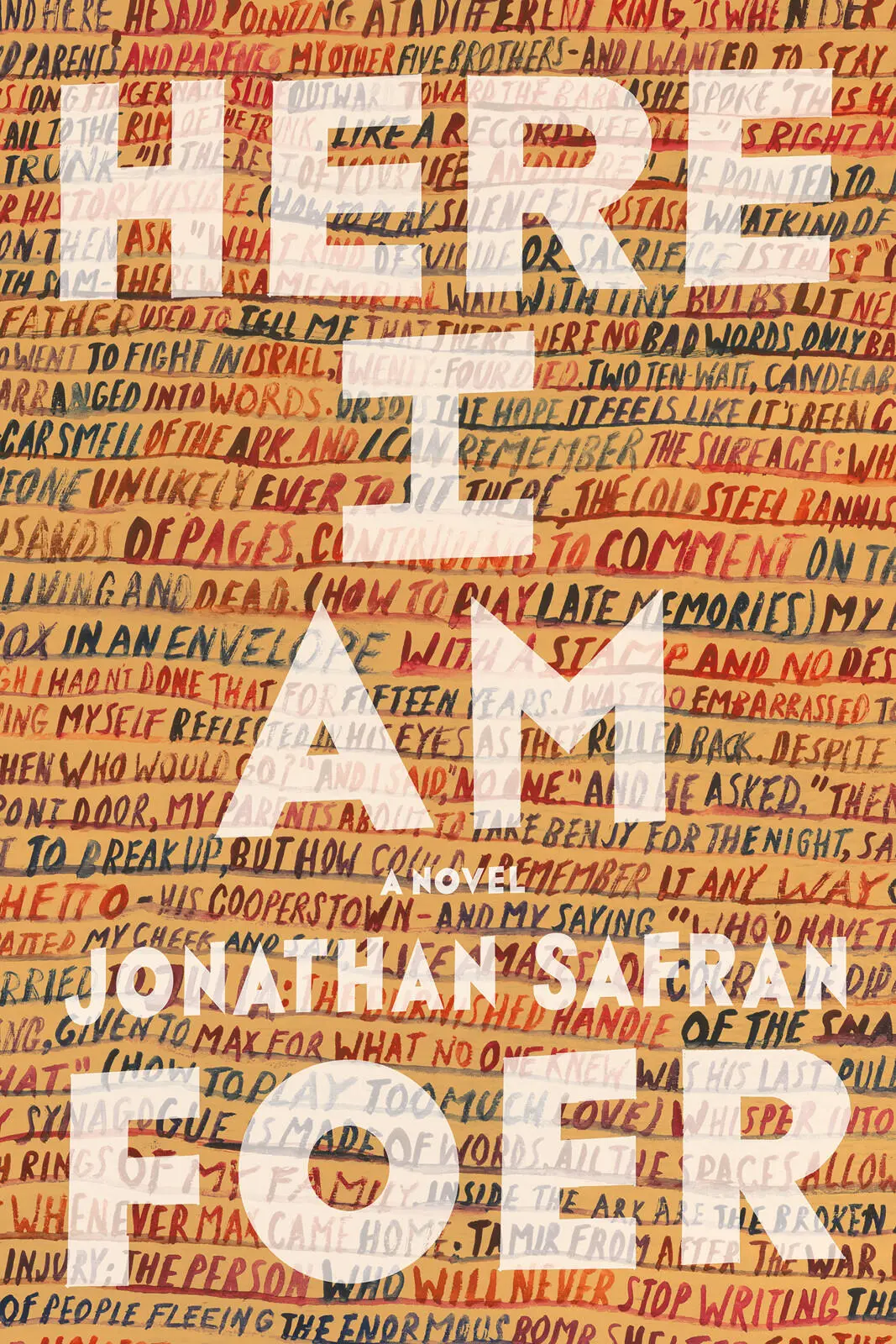
- Название:Here I Am
- Автор:
- Издательство:Hamish Hamilton
- Жанр:
- Год:2016
- ISBN:нет данных
- Рейтинг книги:5 / 5. Голосов: 1
-
Избранное:Добавить в избранное
- Отзывы:
-
Ваша оценка:
Here I Am: краткое содержание, описание и аннотация
Предлагаем к чтению аннотацию, описание, краткое содержание или предисловие (зависит от того, что написал сам автор книги «Here I Am»). Если вы не нашли необходимую информацию о книге — напишите в комментариях, мы постараемся отыскать её.
How do we fulfill our conflicting duties as father, husband, and son; wife and mother; child and adult? Jew and American? How can we claim our own identities when our lives are linked so closely to others’? These are the questions at the heart of Jonathan Safran Foer’s first novel in eleven years-a work of extraordinary scope and heartbreaking intimacy.
Unfolding over four tumultuous weeks in present-day Washington D.C.,
is the story of a fracturing family in a moment of crisis. As Jacob and Julia and their three sons are forced to confront the distances between the lives they think they want and the lives they are living, a catastrophic earthquake sets in motion a spiraling conflict in the Middle East. At stake is the very meaning of home — and the fundamental question of how much life one can bear.
Showcasing the same high-energy inventiveness, hilarious irreverence, and emotional urgency that readers and critics loved in his earlier work,
is Foer’s most searching, hard-hitting, and grandly entertaining novel yet. It not only confirms Foer’s stature as a dazzling literary talent but reveals a mature novelist who has fully come into his own as one of the most important writers of his generation.
Here I Am — читать онлайн бесплатно полную книгу (весь текст) целиком
Ниже представлен текст книги, разбитый по страницам. Система сохранения места последней прочитанной страницы, позволяет с удобством читать онлайн бесплатно книгу «Here I Am», без необходимости каждый раз заново искать на чём Вы остановились. Поставьте закладку, и сможете в любой момент перейти на страницу, на которой закончили чтение.
Интервал:
Закладка:
COME HOME
“‘Watch me,’ Gideon told his men, greatly outnumbered, facing the Midianites not far from where I now stand. ‘Follow my lead. When I get to the edge of the camp, do exactly as I do. When I and all who are with me blow our trumpets, then from all around the camp blow yours and shout, “For the Lord and for Gideon.”’ At the sight and sound of our unity, the enemy scattered and fled.
“The majority of the Jewish people have chosen not to live in Israel, and Jews do not share any one set of political or religious beliefs, and do not share a culture or language. But we are in the same river of history.
“To the Jews of the world, those who came before you — your grandparents, your great-grandparents — and those who will come after you — your grandchildren, your great-grandchildren — are calling out: ‘Come home.’
“Come home not only because your home needs you, but because you need your home.
“Come home not only to fight for Israel’s survival, but to fight for your own.
“Come home because a people without a home is not a people, just as a person without a home is not a person.
“Come home not because you agree with everything Israel does, not because you think Israel is perfect, or even any better than other countries. Come home not because Israel is what you want it to be, but because it is yours .
“Come home, because history will remember what each of us chooses in this moment.
“Come home and we will win this war and establish a lasting peace.
“Come home and we will rebuild this state to be stronger and closer to its promise than it was before the destruction.
“Come home and be another hand around the pen that writes the story of the Jewish people.
“Come home and hold the arms of Moses aloft. And then, when the guns have cooled, and the buildings have risen where they once stood, only prouder, and the streets are filled with the sounds of children playing, you will find your name not in the book of Lamentations, but the book of Life.
“And then, wherever you choose to go next, you will always be home.”
TODAY I AM NOT A MAN
“A couple of weeks ago, everybody was obsessing over what kind of apology I would give during my bar mitzvah speech. How would I explain my behavior? Would I even fess up to it? When I was being blamed, I didn’t feel like explaining myself, much less apologizing. But now that other things have taken everyone’s attention, and no one really cares anymore, I’d like to explain myself and apologize.
“My friend Billie, whom I mentioned before, told me I was repressed. She’s really beautiful, and intelligent, and good. I told her, ‘Maybe I just have inner peace.’ She said, ‘Peace between what parties?’ I thought that was such an interesting question.
“I told her, ‘I’m really not repressed.’ She said, ‘That’s exactly what a repressed person would say.’ So I said, ‘And I suppose you aren’t repressed?’ And she said, ‘Everyone is somewhat repressed.’ ‘OK,’ I said, ‘then I’m no more repressed than an average person.’
“‘Say the hardest thing,’ she said.
“I was like, ‘What?’
“And she said, ‘I don’t mean right this second. You couldn’t even know what it is without thinking long and hard about it. But once you figure it out, I dare you to say it.’
“‘And if I do?’
“‘You won’t.’
“‘But if.’
“She said, ‘I would invite you to choose the terms, but I know you’re too repressed to tell me what you’d actually want.’
“Which was obviously true.
“‘So maybe that’s actually the hardest thing to say,’ I said.
“She said, ‘What? That you want to kiss me? Doesn’t even make the top hundred.’
“I thought a lot about what she said. And I was thinking about it in Hebrew school that day when I wrote those words. I was just seeing how each of them felt, seeing how hard it was to write them, and say them to myself. That’s why I did it. But that’s not the point.
“The point is: I made a mistake. I thought that the worst thing to say was the hardest thing to say. But it’s actually pretty easy to say horrible things: retard, cunt, whatever. In a way, it’s even easier because we know exactly how bad the words are. There’s nothing scary about them. Part of what makes something really hard to say is the not knowing.
“The reason I’m here today is because I realized that the hardest thing to say isn’t a word, or a sentence, but an event. The hardest thing to say couldn’t be something you say to yourself. It requires the hardest person, or people, to say it to.”
O JEWS, YOUR TIME HAS COME!
“O Muslims, God demands of his servants the deaths of these Jews. I call on the soldiers of the Qur’an to wage our final battle against those beasts who kill the prophets. O Muslims, must I tell you the story of the Jewish woman who gave the Prophet, peace be upon Him, poisoned lamb, to kill Him? The Prophet, peace be upon Him, said to his companions, ‘Do not eat this lamb. It is telling me it has poison in it.’ But it was too late for the companion Bishr ibn al-Bara, who died from the poison. The Jewess tried to kill our Prophet, peace be upon Him, but praise God, she failed. This is the nature of the Jews, these twice-cursed people! They will try to kill you, but Allah will plant knowledge of their wicked deeds in your hearts, and save you. You must do as the Prophet, peace be upon Him, did with the Jew Kenana ibn al-Rabi, who hid the treasure of the Jews, the Banu Nadir. The Prophet, peace be upon Him, told Az-Zubair ibn Al-Awwam, ‘Torture this Jew until you learn from him what he knows.’ He held hot steel to his chest and he nearly died. And then the Prophet, peace be upon Him, delivered the Jew Kenana to Muhammad ibn Maslamah, and he cut off his head! Then he took the Jews of Kenana as slaves. Muhammad, peace be upon Him, took the most beautiful woman of the Jews for himself! This is the way, O Muslims! Let the Prophet be your teacher in your dealings with the Jews!
“O brother Palestinians! Remember! When the Muslims, the Arabs, the Palestinians, make war against the Jews, they do so to worship Allah. They enter the war as Muslims! The hadith does not say, ‘O Sunni, O Shiite, O Palestinian, O Syrian, O Persian, come fight.’ It says, ‘O Muslim’! For too long we have battled ourselves and lost. Now we will battle together and be victorious.
“We are fighting in the name of Islam, because Islam commands us to wage war unto death against anyone who plunders our land. Surrender is the way of Satan!”
COME HOME
But then, after his final word, the camera stayed on the prime minister. His gaze held. And the camera held. At first it seemed like an awkward broadcasting mistake, but it was no accident.
His gaze held.
And the camera held.
And then the prime minister did something so outrageously symbolic, so potentially kitschy, so many miles over the top, it risked breaking the legs of its intended recipients just as they approached the necessary leap of faith.
He removed a shofar from beneath the lectern. And without any explanation of its meaning — its biblical or historical significance, its intent to awaken sleeping Jews to repent and return, without even sharing that this particular shofar, this twice-curled ram’s horn, was two thousand years old, that it was the shofar discovered at Masada, stashed in a water hole and preserved by the dry desert heat, that its inside contained biological remnants of a noble Jewish martyr — he brought it to his lips.
Читать дальшеИнтервал:
Закладка:
Похожие книги на «Here I Am»
Представляем Вашему вниманию похожие книги на «Here I Am» списком для выбора. Мы отобрали схожую по названию и смыслу литературу в надежде предоставить читателям больше вариантов отыскать новые, интересные, ещё непрочитанные произведения.





Обсуждение, отзывы о книге «Here I Am» и просто собственные мнения читателей. Оставьте ваши комментарии, напишите, что Вы думаете о произведении, его смысле или главных героях. Укажите что конкретно понравилось, а что нет, и почему Вы так считаете.