Derek Robinson - Damned Good Show
Здесь есть возможность читать онлайн «Derek Robinson - Damned Good Show» весь текст электронной книги совершенно бесплатно (целиком полную версию без сокращений). В некоторых случаях можно слушать аудио, скачать через торрент в формате fb2 и присутствует краткое содержание. Город: New York, Год выпуска: 2013, ISBN: 2013, Издательство: MacLehose Press, Жанр: Историческая проза, prose_military, на английском языке. Описание произведения, (предисловие) а так же отзывы посетителей доступны на портале библиотеки ЛибКат.
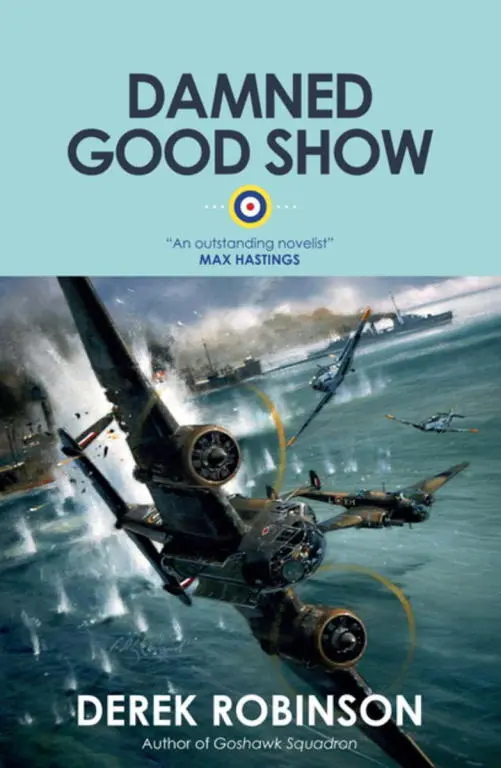
- Название:Damned Good Show
- Автор:
- Издательство:MacLehose Press
- Жанр:
- Год:2013
- Город:New York
- ISBN:978-1-62365-322-4
- Рейтинг книги:3 / 5. Голосов: 1
-
Избранное:Добавить в избранное
- Отзывы:
-
Ваша оценка:
Damned Good Show: краткое содержание, описание и аннотация
Предлагаем к чтению аннотацию, описание, краткое содержание или предисловие (зависит от того, что написал сам автор книги «Damned Good Show»). Если вы не нашли необходимую информацию о книге — напишите в комментариях, мы постараемся отыскать её.
Robinson’s crooked salute to the dogged heroes of the R.A.F.’s early bombing campaign is a wickedly humourous portrait of men doing their duty in flying death traps, fully aware, in those dark days of war, there was nothing else to do but dig in and hang on.
Damned Good Show — читать онлайн бесплатно полную книгу (весь текст) целиком
Ниже представлен текст книги, разбитый по страницам. Система сохранения места последней прочитанной страницы, позволяет с удобством читать онлайн бесплатно книгу «Damned Good Show», без необходимости каждый раз заново искать на чём Вы остановились. Поставьте закладку, и сможете в любой момент перейти на страницу, на которой закончили чтение.
Интервал:
Закладка:
“Awfully kind. Have you any general advice? This is my first op.”
“Don’t say anything unless you must. The skipper doesn’t like chat.”
That was why Gilchrist’s nickname was Chatty. Even his intercom checks were terse: just a word or two from each position: front guns, second pilot, nav, WOP, rear guns. The passenger added: “Skull.” Then no comment, unless the nav gave a course change; and that was briefly said, briefly acknowledged. Skull lay on the crew bed, just a narrow bunk. The crew had no time to rest, so this must be for casualties, he decided. His brain was not accustomed to idleness. It calculated that he was lying directly above the bomb bay. An hour passed. The engine noise battered his ears like a continually breaking wave. He dozed.
The wireless op shook his shoulder and told him to turn on his oxygen. He clipped his mask shut and inhaled. His heart was thudding and his mouth was dry. The oxygen tasted of rubber and his nasal passages complained but after a while his heartbeat slowed and all his senses brightened. The engines seemed to be throbbing with a strange urgency. Perhaps that was in his head. He sat on the bed and, for no reason, sang a song: “You’d be so nice to come home to…” Why not? With his intercom mike switched off, nobody could hear him. He could scarcely hear himself.
A voice said, “Enemy coast coming up.” That must be the front gunner. Skull took his oxygen bottle, went forward, re-plugged his intercom and stood behind the pilots. The instrument panel made a faint green glow. He discovered the air speed: one hundred and fifty-five miles an hour. Altimeter said fourteen thousand three hundred. Half as high as Everest. My goodness. The rest of the panel was a sprawl of gauges and switches and levers which he would never understand. He looked up and saw a band of searchlights, from far left to far right. Each moved slowly. They reminded him of reeds growing in a stream, pulled this way and that by the wandering current. It was all very soothing. Lots of colored lights began to decorate the sky, climbing slowly, then suddenly fast, then falling away. Skull gripped the seat-back: C-Charlie was in a gentle dive. The searchlights were more intense, busier. Now they reminded Skull of Hollywood: of film premières, glamour, ballyhoo. Innocent fun. Lights sparkled on the ground. It was all very pretty. Soon Gilchrist had raced through the defended belt and blackness returned. C-Charlie climbed again.
Skull had a spell in the bomb-aimer’s position, looking down. Nothing memorable happened. Once, he saw another airplane but it turned out to be the Wellington’s moon-shadow on cloud. There was more and more cloud. He went back to the bed. The wireless op came and looked at him, so he gave a thumbs-up. The gesture felt theatrical and fraudulent, and he was glad the oxygen mask hid his face.
Another hour passed. Tedium, cold, the foul taste of oxygen, a hungry stomach but no appetite for food. And he’d have to endure all this again on the way back. Then, a sudden shout on the intercom and C-Charlie banked so steeply that he fell on the floor.
Now there was a lot of chat. From it, Skull guessed that another Wellington had loomed out of the night and Gilchrist had avoided it. Bins had said, at briefing, that sixty bombers would be over the Ruhr. When C-Charlie was level, Skull went forward.
Wherever he looked, he saw searchlights hunting in teams, and a continuous sparkle of flak. Some of the flak rippled in a straight line and vanished. Some climbed like a chain of rockets and fell away. Skull was amazed by the extravagance. All it takes is one shell , he thought. Gilchrist ignored the flak. He was talking to his navigator, discussing the absence of landmarks. The problem was industrial haze, made worse by cloud. The nav claimed that dead reckoning put them over Gelsenkirchen, which meant Essen was to the southwest. The front gunner was pretty sure he’d seen Mulheim, so Essen must be east. Gilchrist asked the rear gunner what he could see. “Fuck all, skip,” he said. “Some bastard’s dropped a flare and the haze is worse than ever.” Gilchrist decided to fly on.
When Skull smelled the harsh tang of cordite for the first time, he wanted to turn and run. Cordite meant the shell had exploded bang in front, on the same level, not long ago. Men down there were trying to kill him, and getting close to succeeding. He felt weak, and sat on the main spar. All the time, Gilchrist was holding his fatuous conversation with the crew about the layout of the Ruhr. They went on and on and bloody on. Wasn’t that Duisburg? More like Oberhausen. Well, this is Mulheim, then. Could be Bochum, skip. So we passed Gelsenkirchen? Sod this haze…
Skull stood up and was horrified to see how much worse the flak was. Nothing could fly through that, it was madness. And still the discussion went on. He had a parachute, he knew the exits, he could leave, now. The Wimpy rocked like a boat in a swell. “Turbulence,” Gilchrist said. “There’s a kite ahead. We’ll follow him.” Skull had to sit down again. After a minute, Gilchrist said: “Ah… poor devil. You should see this, Skull.” He got up, weak at the knees. Far below, searchlights coned a Wellington. Flak chased it, tickled it. Flame streaked from a wing and the aircraft exploded. “Log that, would you, nav?” Gilchrist said.
He found Essen because, he said, he recognized the smell. A peculiar chemical stink, he said, that only Essen produced. The nav crawled down to his bomb-aiming position. Gilchrist lost height, circling widely, until Skull could see light flak bursting all around. Quickly, quickly, drop the bombs , he thought. The nav said he was sure he recognized the steel works, but too late, C-Charlie had overshot. Someone said it looked more like Gelsenkirchen. “We’ll go round again,” Gilchrist said. Skull unplugged his intercom. “I’ll kill you, you incompetent idiot!” he screamed. Nobody heard.
Second time round, they dropped the bombs and held steady for the flash and the camera. Skull was shaking with cold. He tripped and fell on his way to the bed, bloodied his nose. A piece of shell had nicked the fabric beside the bed, ripping it away. He lay down and let freezing air crash against him. When C-Charlie landed at Coney Garth, Skull couldn’t walk, couldn’t speak. The blood wagon took him to the MO, who gave him a big sedative and a nice warm cot.
Zoë was bored with being cooped up in the Blazers’ house, and she wanted to go for a walk. Silk brought her a pair of Waaf overalls and a bucket. “Nobody ever stops a Waaf if she’s carrying a bucket,” he said. “Everyone assumes she’s doing a job. Carry it in your right hand and you won’t even have to salute.”
She tried on the overalls. “Primitive,” she said. “Barbaric. Quite odious. No thank you.”
“What’s wrong with them?”
“They’re an obscene joke. They make me look shabby.”
“That’s the whole bloody point, you stupid woman.”
She gave them back. “I can remember when you had a sense of style, Silko. Look at you now.” They were in the kitchen, and Kate was making toast for breakfast. “He keeps proposing to me,” Zoë said. “Look at that grubby uniform. Would you marry him?”
“Like a flash.”
“I look much sexier without the uniform,” Silk said. “Isn’t that right, Zoë?”
“Rather a coarse remark.” She nibbled some toast.
“Zoë can be pretty coarse herself,” he said. He was irritated: getting those overalls had not been easy. “The rich are like that.”
“I’m not rich. I’m not on the run. And I want to see my friends from the old days. Jonty Brown and Tom Stuart and Tubby Heckter. Pixie Hunt, too.”
“Not at home to callers, sweetie. Got the chop, all of them,” Silk said. “Finish your toast, we’re off. I smuggled you in, now I’ve got to smuggle you out. Then I can bring you back in, legally. Why? Because you haven’t been signed in at the Main Gate, so legally you can’t be signed out .”
Читать дальшеИнтервал:
Закладка:
Похожие книги на «Damned Good Show»
Представляем Вашему вниманию похожие книги на «Damned Good Show» списком для выбора. Мы отобрали схожую по названию и смыслу литературу в надежде предоставить читателям больше вариантов отыскать новые, интересные, ещё непрочитанные произведения.







Обсуждение, отзывы о книге «Damned Good Show» и просто собственные мнения читателей. Оставьте ваши комментарии, напишите, что Вы думаете о произведении, его смысле или главных героях. Укажите что конкретно понравилось, а что нет, и почему Вы так считаете.