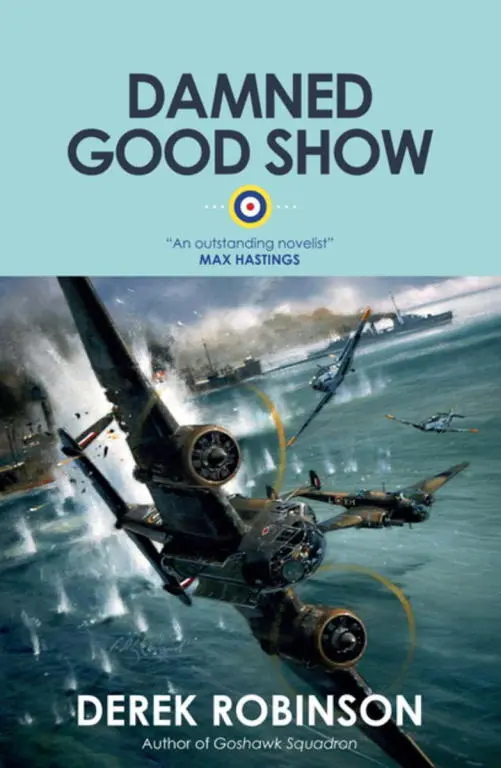
Derek Robinson - Damned Good Show
Здесь есть возможность читать онлайн «Derek Robinson - Damned Good Show» весь текст электронной книги совершенно бесплатно (целиком полную версию без сокращений). В некоторых случаях можно слушать аудио, скачать через торрент в формате fb2 и присутствует краткое содержание. Город: New York, Год выпуска: 2013, ISBN: 2013, Издательство: MacLehose Press, Жанр: Историческая проза, prose_military, на английском языке. Описание произведения, (предисловие) а так же отзывы посетителей доступны на портале библиотеки ЛибКат.
- Название:Damned Good Show
- Автор:
- Издательство:MacLehose Press
- Жанр:
- Год:2013
- Город:New York
- ISBN:978-1-62365-322-4
- Рейтинг книги:3 / 5. Голосов: 1
-
Избранное:Добавить в избранное
- Отзывы:
-
Ваша оценка:
Damned Good Show: краткое содержание, описание и аннотация
Предлагаем к чтению аннотацию, описание, краткое содержание или предисловие (зависит от того, что написал сам автор книги «Damned Good Show»). Если вы не нашли необходимую информацию о книге — напишите в комментариях, мы постараемся отыскать её.
Robinson’s crooked salute to the dogged heroes of the R.A.F.’s early bombing campaign is a wickedly humourous portrait of men doing their duty in flying death traps, fully aware, in those dark days of war, there was nothing else to do but dig in and hang on.
Damned Good Show — читать онлайн бесплатно полную книгу (весь текст) целиком
Ниже представлен текст книги, разбитый по страницам. Система сохранения места последней прочитанной страницы, позволяет с удобством читать онлайн бесплатно книгу «Damned Good Show», без необходимости каждый раз заново искать на чём Вы остановились. Поставьте закладку, и сможете в любой момент перейти на страницу, на которой закончили чтение.
Интервал:
Закладка:
At six he walked into King’s, and the Porter’s Lodge installed him in the room of an undergraduate called Cooksley, reading medicine. Skull had a bath and he was browsing through Cooksley’s books when Champion knocked and came in. “We’re dining at High Table,” he announced.
“I bet you didn’t know that bone marrow comes in two colors, red and yellow,” Skull said.
“Here’s a gown for you.”
“Not striped, you understand. Either red or yellow. The red marrow makes blood cells. That’s reassuring, isn’t it?”
“We’ll be late.”
Skull followed him. “How the blood cells escape from the marrow and enter the arteries was not revealed. Possibly in the next chapter.” He noticed that Champion’s suit, of charcoal-gray flannel, had been generously tailored to enhance the shoulders. “You look bigger,” he said. “But of course you’re a group captain now.”
Champion said, “We’re here to meet a chap called Butt. David Bensusan-Butt. You’ve never heard of him. He’s only twenty-seven but he’s private secretary to Professor Lindemann and Lindemann is Churchill’s personal adviser on weapons and science and the like. This means that Bensusan-Butt is in the Prime Minister’s office. He’s a civil servant but they’re not all stupid and Bensusan-Butt’s got a brain like Battersea Power Station. He’s a King’s man. That’s why I got you both here, away from London. He’ll be more relaxed here.”
“Relaxed about what?”
“Good question. Bomber Command has plans. It needs to be twice as big, maybe four times as big. However, we’ve got enemies in the War Cabinet. My spies tell me that Lindemann has ordered Bensusan-Butt to do a deep analysis of Bomber Command and award marks out of ten.”
Skull was introduced to the man and they talked briefly, not about the war. Skull got an impression of warmth and wit, of an intense energy, and of someone who knew exactly how each sentence would end before he began it. Then they went into Hall and were seated too far apart for conversation. Skull thought: Champion wants to run the show. This should be interesting.
When dinner ended, Champion did not linger. He led his guests to his rooms, which were much more spacious than Cooksley’s. Champion’s influence had evicted a professor of clinical biochemistry. Such raw power both impressed and depressed Skull.
“No piano, I’m afraid,” Champion said, and murmured to Skull, “Mr. Bensusan-Butt is an excellent pianist.”
“Purely for pleasure,” his guest said. “Some play squash, I play Haydn. Incidentally, can we drop the Bensusan? Butt is enough. David is even better.”
“Splendid,” Champion said. “I’m Ralph, and Skelton is… well, Skelton is Skull. Very apt. He’s my tame brain in the field of battle.”
Skull had been adjusting the blackout curtains. Now his head turned slowly. “What did you call me?” he said.
Champion should have apologized, but he had only recently been made up to group captain and he could not apologize to a flight lieutenant. Instead, he bustled about, offering drinks: brandy, port, whisky, Madeira?
“I wouldn’t mind some coffee,” Butt said.
“Of course. Skull, be a good fellow and make some coffee.”
“No.” It was said calmly but firmly.
Champion frowned. “Are you allergic to coffee?”
“No.”
Champion looked at Butt with mock-despair. “Mutiny. Is it like this in Downing Street?”
Butt smiled. “We are all mutineers in Downing Street. The Prime Minister gets restless when he is surrounded by harmony. War is not a harmonious business.”
“Well, Bomber Command has never shirked a chance to stir up trouble.” Champion went into the kitchen and filled a kettle and put it on the stove and came back. “People forget that Bomber Command has been operating against the enemy since the very first day of the war. Whenever the weather allowed we’ve hammered him in his own backyard. No other Service can claim that.” He went out. Rattling and clinking were heard. He came back with a loaded tray. “No coffee. Is tea all right? As I was saying, the Command hasn’t had full credit for its efforts throughout almost two years. Shipping strikes, Nickels, Gardening, and then the Battle of Britain which was really two battles. The fighter boys did their stuff but who sank all those invasion barges? Every Channel port from Antwerp to Dieppe-Ostend, Dunkirk, Calais, Boulogne—all through last summer, night after night, walloped by Bomber Command! And when Hitler dropped the first bombs on London, it wasn’t Spitfires that flew to Berlin the next night and gave the Germans a fright. Which is what Bomber Command has been doing ever since. Night after night. Is there a Focke-Wulf aircraft factory in Bremen? Fine. We’ll send a hundred bombers and blast it. That’s just what we did last January. Target destroyed. What’s next? And so we’ve continued. We know Nazi Germany is suffering. You can’t drop a four-thousand-pound blockbuster on Bremen without giving Hitler a headache.”
Butt poured the tea. “I have a feeling that was a preamble,” he said.
“Throat-clearing,” Skull said. “Delete paragraph one.”
“If you double the size of Bomber Command, you quadruple its destructive power,” Champion said, “How? By overwhelming the German defenses. Quadruple the size of Bomber Command and you can utterly devastate the German war machine…” He raised a hand to dramatize the point. “…without the need for a land invasion of Europe.”
Butt sipped his tea.
“That’s the view from the top,” Champion said. “But it’s the squadrons that do the real work, isn’t it? 409 Squadron at Coney Garth is one of the best. What is their formula for consistent success? Our eminent sleuth has the answer.”
Champion meant to flatter. Skull felt he was being patronized. This made no difference to Skull’s answer but it sharpened his tone of voice. “There is no formula,” he said, “because there is no consistent success.”
“That’s the trouble with academics,” Champion said. “They will quibble about words. If you don’t like ‘consistent,’ how about ‘conspicuous’?”
“The term I most dislike is ‘interrogation,’” Skull said.
“It’s what we do to pilots after an op,” Champion explained to Butt.
“It’s what we don’t do to them,” Skull said. “Interrogation suggests a degree of mental toughness. A rigorous examination of performance. That’s not what happens. A crew’s report is accepted at face value, and rarely challenged. Interrogation is a poor method of measuring success.”
Champion had an instant answer. “Then it’s just as well we don’t depend too heavily upon it. One infallible indicator of Bomber Command’s effectiveness is the enemy’s response, and I don’t think that even you, Skull, would dispute the evidence of flak damage which our bombers bring back.”
“Yes, it’s evidence,” Skull said. “But of what?”
“That the Hun has been stung! We’ve laid waste so many of his cities that flak, searchlights, night fighters are top priority over there!”
“Oh, I doubt that. The Russian front is Hitler’s top priority.”
“And Russia desperately wants us to keep bombing, to take the pressure off her. When the other man gets mad, you know your punches are hurting, and I’ve seen the German newspapers. They get very upset at Bomber Command.”
“Proves nothing,” Skull said. “Our newspapers made gloomy reading during the Blitz, but they didn’t make the German bombers any more effective.”
“Thank God for that!” Champion was brisk; he seemed to be enjoying the exchange. “You were in London in the Blitz?” he asked Butt, who nodded. “So was I. Skull was in Scotland… Ask any Londoner, Skull. He’ll tell you whether the Blitz was effective or not. Bombing hurts, old chap. It’s already hurt Berlin. Given time we’ll flatten it.”
Читать дальшеИнтервал:
Закладка:
Похожие книги на «Damned Good Show»
Представляем Вашему вниманию похожие книги на «Damned Good Show» списком для выбора. Мы отобрали схожую по названию и смыслу литературу в надежде предоставить читателям больше вариантов отыскать новые, интересные, ещё непрочитанные произведения.







Обсуждение, отзывы о книге «Damned Good Show» и просто собственные мнения читателей. Оставьте ваши комментарии, напишите, что Вы думаете о произведении, его смысле или главных героях. Укажите что конкретно понравилось, а что нет, и почему Вы так считаете.