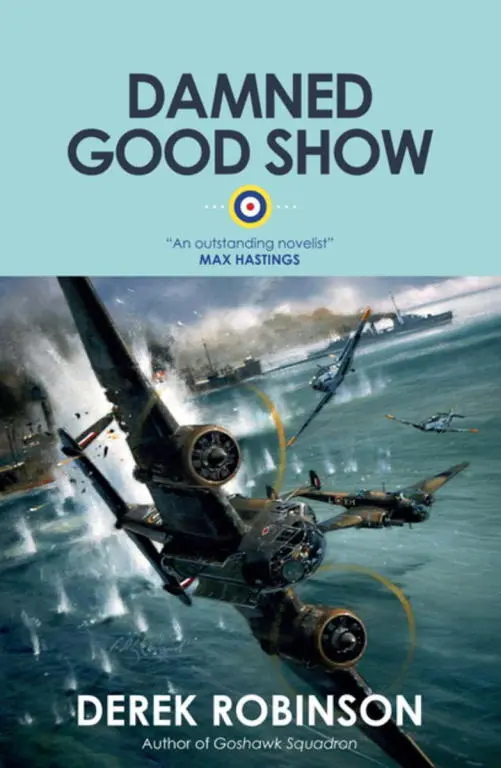
Derek Robinson - Damned Good Show
Здесь есть возможность читать онлайн «Derek Robinson - Damned Good Show» весь текст электронной книги совершенно бесплатно (целиком полную версию без сокращений). В некоторых случаях можно слушать аудио, скачать через торрент в формате fb2 и присутствует краткое содержание. Город: New York, Год выпуска: 2013, ISBN: 2013, Издательство: MacLehose Press, Жанр: Историческая проза, prose_military, на английском языке. Описание произведения, (предисловие) а так же отзывы посетителей доступны на портале библиотеки ЛибКат.
- Название:Damned Good Show
- Автор:
- Издательство:MacLehose Press
- Жанр:
- Год:2013
- Город:New York
- ISBN:978-1-62365-322-4
- Рейтинг книги:3 / 5. Голосов: 1
-
Избранное:Добавить в избранное
- Отзывы:
-
Ваша оценка:
Damned Good Show: краткое содержание, описание и аннотация
Предлагаем к чтению аннотацию, описание, краткое содержание или предисловие (зависит от того, что написал сам автор книги «Damned Good Show»). Если вы не нашли необходимую информацию о книге — напишите в комментариях, мы постараемся отыскать её.
Robinson’s crooked salute to the dogged heroes of the R.A.F.’s early bombing campaign is a wickedly humourous portrait of men doing their duty in flying death traps, fully aware, in those dark days of war, there was nothing else to do but dig in and hang on.
Damned Good Show — читать онлайн бесплатно полную книгу (весь текст) целиком
Ниже представлен текст книги, разбитый по страницам. Система сохранения места последней прочитанной страницы, позволяет с удобством читать онлайн бесплатно книгу «Damned Good Show», без необходимости каждый раз заново искать на чём Вы остановились. Поставьте закладку, и сможете в любой момент перейти на страницу, на которой закончили чтение.
Интервал:
Закладка:
Bins passed around some ten-by-twelve prints. “A bit dated, but they prove the point. Vertical photography doesn’t always reveal much. A building could be gutted by incendiaries but if the roof hasn’t collapsed, it looks intact.”
The Engineer Officer was examining the dates stamped on the backs of the prints. “My God, these are ancient. They must have been taken with the Old F.24 camera, eight-inch lens. Nowadays the photo-recce kites use a new camera. It’s got a twenty-inch lens.”
“So what?” Duff said. “The bigger the camera, the greater the error.” This astonished the Engineer Officer. He looked at Rafferty, who offered him a peppermint. “I’ll tell you what really gets on my left tit,” Duff said. “Air bloody Ministry not only doesn’t trust my crews, it doesn’t even trust Bomber Command with its own pictures! The Photo Reconnaissance Unit is in Coastal Command!”
“When did a flying-boat last bomb Berlin?” Hazard asked. Their laughter encouraged him. He waggled his pipe.
“Forget Coastal. Forget their PRU.” Duff tore one of the prints into scraps. “Only one thing matters here. Operational efficiency. Christ knows the bombing run is hairy enough, holding her straight and level until you can stuff the nose down and vanish. Well, now we can’t. Now we’ve all got to remain straight and level, and drop the photo-flash and wait and wait until the bombs explode and the flash goes off. Then we can vanish.”
“I’ve seen my bombs explode,” Pratten said. “Flames and smoke, flames and smoke. What more is a photograph going to show?”
“Tell your crews that a camera has one eye and no brain. They have two eyes and great experience. I’ll take their word over a twenty-inch lens any day of the week.”
The meeting ended. Duff was still hunched and frowning when Rollo Blazer was shown in. “I’ve got to film an op,” Rollo said. “I’ve got to fly in a Wimpy on a raid.”
“Why not?” Duff said. “Air Ministry is very keen on taking cameras on raids. There’s an op tonight, Bremen. We often go to Bremen. Very juicy target. You’ll see lots of flak.”
Rollo felt a great surge of relief. Now it was all out of his hands. He was part of the machinery of Bomber Command. It would send him to Bremen and, God willing, bring him back again, and nothing would be required of him except to shoot film and do as he was told. He felt fit and strong and surprisingly brave. “Good show,” he said.
Duff was picking up his telephone when he remembered something. “I take it you passed your medical,” he said.
“Medical? I don’t need a medical. Fit as a flea, me.”
“No medical?” Duff replaced the phone. “You’re not going to tell me that Crown Films sent you here, to go on ops, without a medical examination?”
“It was all a bit rushed, I’m afraid. Does it matter?” Rollo saw Duff’s lips compressed into a thin line and knew that it mattered a lot.
He met Kate in the anteroom and said he wouldn’t be allowed to fly until he passed a comprehensive medical. “It seems that altitude does bizarre things to the human body,” he said. “They’re afraid I might break wind and blow my boots off and kill someone.”
“You’re very chirpy, all of a sudden.”
“Why not? It’s only a matter of life and death.”
Rollo went to Sick Quarters at two o’clock, and he was still there at three.
The MO began with his medical history. Any trouble with the heart? The bowels? Throat? Lungs? Respiration in general? Any difficulty in breathing? Persistent coughing? Problems with the nasal passages?
“I had croup when I was a kid,” Rollo said. “Highly dramatic, it was. The doctor fainted when he saw me.”
“Croup, you say.” The MO thought about it. “Croup. Have you got your tonsils?”
“Damn. I left them in Tunbridge Wells. I was only six at the time. Kids are so careless. If I’d known you wanted them—”
“Be quiet.” The MO used a tongue-depressor and peered down Rollo’s throat. “My Christ, that’s a mess. What did they use, garden shears?” He looked at Rollo’s tongue. “Texture and color remind me of my bedroom carpet. Take your clothes off.”
“All of them?”
“Should I brace myself for some hideous abnormality?”
Rollo stripped. His chest disappointed the MO. “Breathe in. Out. In, and take a deep breath and hold it. A deep breath, I said… Good God, is that the best you can do?”
“It’s kept me alive so far.”
“I said hold it.”
“I can’t talk and hold my breath.”
“Then shut up.”
“I’ll shut up when you stop asking questions.”
“Take a deep breath and hold it while I count to thirty.”
Rollo collapsed at fourteen. The MO took his pulse and blood pressure. “You have the cardio-pulmonary system of a ten-year-old boy,” he said.
“Then give it back to the little sod,” Rollo wheezed.
“Goodness, how droll. Are you sure you’ve never had rheumatic fever? Fainting fits? Breathlessness? Palpitations?”
“The worst thing that happened to me was the Blitz. I survived that, didn’t I?”
“Give me a sample of urine. After that we’ll put you on the tread mill, and then you can blow up a few balloons. If you’re still conscious, we’ll get down to some serious tests.”
At the end of an hour Rollo got dressed. The MO sat at his desk, hunched over his notes. “Give it to me straight, doc,” Rollo said. “Will I ever play the violin again?” The MO didn’t look up, didn’t smile, didn’t respond. The silence lengthened and Rollo wished he’d kept his mouth shut. He could hear his pulse throbbing. It didn’t sound strong. Or steady.
“Well, you’re not fit for aircrew duties,” the MO said.
“I’m not going to carry out aircrew duties.”
“I’m aware of that. What concerns me is how your somewhat battered system would respond to conditions of minus thirty degrees Fahrenheit at, say, twelve thousand feet, for several hours.” He reached a decision. “I need a second opinion. I’m sending you to an RAF aircrew assessment center. They have specialist equipment. Not far from here. Tomorrow morning, probably”
BANG LIKE RABBITS
Six Wellingtons were going to Bremen. Rollo and Kate sat at the side of the briefing room. He worked out camera angles in his head; it took his mind off flying. She looked at the faces until she noticed an air gunner watching her and she felt guilty, he should be paying attention, this was serious stuff; and she turned away. Much of the serious stuff meant nothing to her. Bins talked about primary and secondary targets, using much jargon. Skull talked of spoofs and decoys. Pug Duff had something to say about what made Bremen so important: aircraft factories and a yard that built U-boats. Specialists gave complicated advice about navigation and signals. Finally, the group captain said Bremen was about the size of Liverpool, and he didn’t need to remind everyone what the Luftwaffe had done to Liverpool. Now 409 had a chance to return the compliment, and flatten a few U-boats too. Good luck.
When Rafferty left, a civilian in a well-cut dark blue suit went with him. Good haircut. Broad mustache, neatly trimmed. “He’s a Yank,” Rollo murmured to Kate. “Wears a wedding ring. Zip fly on his pants. Very clean fingernails. Got to be a Yank.” Rollo felt better, knowing that he wasn’t flying. Tomorrow was a year away.
The next time they saw the blue suit was at dusk. By then, everyone knew he was Colonel Kemp, assistant air attaché at the American embassy. He was one of the group standing at the end of the flare-path, next to the Flying Control caravan, waving off the bombers.
Читать дальшеИнтервал:
Закладка:
Похожие книги на «Damned Good Show»
Представляем Вашему вниманию похожие книги на «Damned Good Show» списком для выбора. Мы отобрали схожую по названию и смыслу литературу в надежде предоставить читателям больше вариантов отыскать новые, интересные, ещё непрочитанные произведения.







Обсуждение, отзывы о книге «Damned Good Show» и просто собственные мнения читателей. Оставьте ваши комментарии, напишите, что Вы думаете о произведении, его смысле или главных героях. Укажите что конкретно понравилось, а что нет, и почему Вы так считаете.