Pat Frank - Hold Back the Night
Здесь есть возможность читать онлайн «Pat Frank - Hold Back the Night» весь текст электронной книги совершенно бесплатно (целиком полную версию без сокращений). В некоторых случаях можно слушать аудио, скачать через торрент в формате fb2 и присутствует краткое содержание. Город: New York, Год выпуска: 2017, ISBN: 2017, Издательство: Harper Perennial, Жанр: Историческая проза, prose_military, на английском языке. Описание произведения, (предисловие) а так же отзывы посетителей доступны на портале библиотеки ЛибКат.
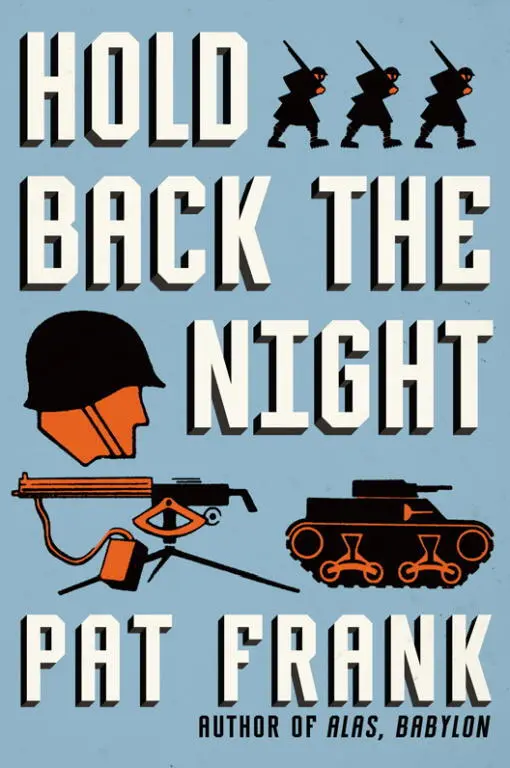
- Название:Hold Back the Night
- Автор:
- Издательство:Harper Perennial
- Жанр:
- Год:2017
- Город:New York
- ISBN:978-0-06-242181-4
- Рейтинг книги:5 / 5. Голосов: 1
-
Избранное:Добавить в избранное
- Отзывы:
-
Ваша оценка:
Hold Back the Night: краткое содержание, описание и аннотация
Предлагаем к чтению аннотацию, описание, краткое содержание или предисловие (зависит от того, что написал сам автор книги «Hold Back the Night»). Если вы не нашли необходимую информацию о книге — напишите в комментариях, мы постараемся отыскать её.
“These are not stragglers, sir. This is Dog Company…”
In Pat Frank’s classic 1951 war novel, one-hundred-twenty-six soldiers commence their long, harrowing journey at Changjin Reservoir during the height of the Korean War, but few will survive the grueling fight and eventually reach Hungnam. Vividly bringing to life the bravery, daring, and turmoil a unit of soldiers endures, Hold Back the Night reveals their gripping stories…
Captain Mackenzie, commander of Dog Company, not only bears the responsibility for victory or defeat, but also feels the full weight of the emotional toll that the war inevitably takes on him and his troops. His one consolation to inspire his band of soldiers to keep on going is an unopened bottle of Scotch that holds bittersweet memories of his wife who gave it to him as a gift.
Sergeant Ekland, a cocky, determined communications sergeant, is due for a battlefield promotion and longs for the day his tour is over so he can be reunited with his fiancée—that is if he makes it out of Korea alive.
Private Couzens, finds himself in a precarious situation with the enemy due to circumstances out of his control—a situation that causes his loyalties to come into question with his superiors.
As readers follow the lives of these men and the other unforgettable soldiers, Pat Frank’s epic novel of war, loss, and survival recounts a crucial chapter in American history. * * *
Hold Back the Night — читать онлайн бесплатно полную книгу (весь текст) целиком
Ниже представлен текст книги, разбитый по страницам. Система сохранения места последней прочитанной страницы, позволяет с удобством читать онлайн бесплатно книгу «Hold Back the Night», без необходимости каждый раз заново искать на чём Вы остановились. Поставьте закладку, и сможете в любой момент перейти на страницу, на которой закончили чтение.
Интервал:
Закладка:
His mind was mutinous and prankish, and it insisted on returning, wherever it wandered, to the bottle of Scotch. “Give yourself a break,” his mind told him. “Take a snort. It’ll relax you and let you sleep. It’ll help the others, too. They aren’t asleep yet. They’re still awake, worried and nervous because you’re worried and nervous. Bust out the bottle. It’ll give you all a good start in the morning.”
That’s the way it always was. It was in the bad times that he considered opening the bottle, like the day he had come home from the Pacific.
The Corps had sent him home, after Peleliu, to help with training. He’d flown back on NATS, like an admiral or a VIP, and of course there hadn’t been time to tell anyone he was coming, even if he could have slipped a message past the censors. He spent an hour at Okinawa, and another at Midway, and another at Pearl, reflecting how American air bases all over the world looked the same, with the same snack bars and Cokes and peanut-butter crackers and Hershey bars—all wonderful and sparkling and refreshing after Peleliu. You could drop a guy down onto an American base, and he couldn’t tell you, unless he already knew, what country he was in, or even what hemisphere. Then there was the last fourteen hours to San Francisco, and there’d been a crap game on the transport and he’d won seven hundred dollars, which once had been a lot of money, but to soldiers who hadn’t been able to spend any money at all for months or years, except a few dollars at a PX, was just so much paper. When they landed at Hamilton he’d called her, and it was on that night—that dreadful night—that he’d come closest to opening the bottle.
When Anne heard his voice she’d seemed excited, and eager, after the first disbelief, but then she said: “Darling, of course come right on out. But I’ve got another date tonight, Sam, and I don’t know how to reach him and call it off.”
“Won’t it be a bit awkward?” he said, with what he hoped was sarcasm.
She hesitated and said, “Oh, I don’t think so, Sam. I hope not.”
He went to the St. Francis, and bathed and changed, and discovered that his dress blues, which he had not worn for three years, were a bit too small for him, everywhere. A man could keep on growing, in his early twenties. But he wore them, because in December San Francisco was raw and chill, after the Palaus, and everything else he had was tropical. As an afterthought, he called the floor maid, and had a First Division patch, with its Southern Cross stars, stitched on his sleeve. He caught the train to San José, and took a taxi to the Longstreet home in Los Altos.
It was awkward, very awkward. The other date was an Air Force major with a guardsman’s mustache and an Eighth Air Force patch on his sleeve and three rows of flashy ribbons on his chest. Mackenzie didn’t know what all these ribbons meant, but he felt they must have been legitimate, because one of them was a Purple Heart. The major seemed completely at home at the Longstreets’. He knew where to find the cheese in the refrigerator, and the ice tongs, and he made a point of brewing the coffee, and he joked with the Longstreets familiarly as if he were a favorite nephew—or a son-in-law.
There took place between them one of those strange duels of patience that occur when two men are determined to have one woman alone, and are forced by the manners of the moment not to settle the matter in the way of cavemen, or cavaliers of the eighteenth century. The major won. The major outlasted him, and outwaited him. The major was fresh, while Mackenzie was tired from forty hours of flight across the Pacific. Or perhaps Mackenzie was not certain of his self-control, and feared he might blow up and cause a scene. Or perhaps he was deeply and secretly afraid that this was the way it would be, was bound to be, and was braced to accept it. And in addition to all this, Mackenzie’s uniform was uncomfortable and tight, the collar biting into his neck, and his trousers climbing his legs whenever he sat down.
At midnight he gave up, and bade them goodnight with politeness as empty and insincere as a headwaiter’s smile. The major obligingly called a cab for him, and courteously refrained from following when Anne escorted him to the walk. “Well, fly off into the wild blue yonder. Be seeing you around,” Mackenzie told her, in parting.
And she said, standing there in the moonlight, straight and angry and maddeningly desirable, because of her jasmine, and her new maturity, and her lithe beauty, and his long need for her, “Captain, you are a damned fool.”
He turned his back on her, and returned to the hotel, and in the lobby he ran into some others from the First. They told him they had some old phone numbers that had been good deals, if the girls were still in town, and some new ones that sounded promising, and they invited him along. But he went to his room. Now that he had seen Anne again he had no heart for other women. When he was in the room he took out the bottle of Scotch that he’d lugged across half the world. First he thought of throwing it out of the window, and then he thought of drinking it, and finally he thought of sending it back to her, done up in ribbons. That would tell her how he felt, if anything would.
So he ordered drinks sent up from the bar, and set them out in a row, a skirmish line of amber and crystal on the austere hotel writing desk. He killed the glasses in this line, one by one. He drank one, and then he wrote a paragraph he intended to enclose with the bottle. Then he drank another, and another.
That was the way she found him, at three in the morning, except by then he’d finished the drinks, and was wondering whether it wouldn’t be just as effective to send her back the bottle—but empty.
She knocked, and when he yelled, “Come in,” she walked into the room and straight into his arms. She found his mouth with her mouth, and tried to merge her body with his body, and for a long space of time neither wished to speak. Until he was tired, and out of breath. Then she said, “I love you, Sam. I don’t love anybody else.”
He said, “That guy.”
“I sent Tom home. I was rude to him, I guess. I’m sorry, because he was nice to me. He’s been nice to me for a long time.” And she spoke of how lonely and fearful girls could get when their men were away to the wars; and how they were afraid for their men, and being afraid, sometimes tied to another man as an anchor, and a hedge against total loss. She said she supposed this was a weakness, but that was the way it was, and what was he going to do about it?
On that particular night Mackenzie wasn’t in shape to do anything about it, except talk, and he couldn’t talk very clearly. He sat on the edge of the bed and held his head in his hands, ashamed of his condition and his inadequacy, and tried to make straight words come out of a whirling brain. “I’m going to marry you. Right now. Right this minute. Call the preacher. Tell him to come up. Tell him to come up and have a drink and marry us and we’ll get the license in the morning.”
At last she persuaded him to lie flat on the bed, and she undressed him, stilling his protests with kisses. When she had him between the sheets she kissed him one last time, and although he clutched at her, and begged her, and raved of his desire for her, she left him.
That had been a bad night, a worse night than this. But his next night with Anne had been different, and so now again the next night might be different.
Maybe he’d wake up in the morning and discover that the Communists were all through, that Eighth Army had rallied and was driving them back, and that the retreat was at an end. Or it might even be that this war would end. All wars ended some time, didn’t they? But some lasted for generations. Rome and Carthage. Greece and Persia. The Crusades. The Mongols and the West. England and Spain. America and Russia. No, that was wrong. That wasn’t the way to say it. The way to say it was to paraphrase Lincoln. It should read, “I believe this world cannot endure permanently half slave and half free,” for indeed in point of time, by which the space of the world was now reckoned, the world was smaller and more compact and one than Lincoln’s country, all his awkward, gangling country, of 1861.
Читать дальшеИнтервал:
Закладка:
Похожие книги на «Hold Back the Night»
Представляем Вашему вниманию похожие книги на «Hold Back the Night» списком для выбора. Мы отобрали схожую по названию и смыслу литературу в надежде предоставить читателям больше вариантов отыскать новые, интересные, ещё непрочитанные произведения.







Обсуждение, отзывы о книге «Hold Back the Night» и просто собственные мнения читателей. Оставьте ваши комментарии, напишите, что Вы думаете о произведении, его смысле или главных героях. Укажите что конкретно понравилось, а что нет, и почему Вы так считаете.