Stephen Wright - Meditations in Green
Здесь есть возможность читать онлайн «Stephen Wright - Meditations in Green» весь текст электронной книги совершенно бесплатно (целиком полную версию без сокращений). В некоторых случаях можно слушать аудио, скачать через торрент в формате fb2 и присутствует краткое содержание. Город: New York, Год выпуска: 2020, ISBN: 2020, Издательство: Little, Brown and Company, Жанр: Историческая проза, prose_military, на английском языке. Описание произведения, (предисловие) а так же отзывы посетителей доступны на портале библиотеки ЛибКат.
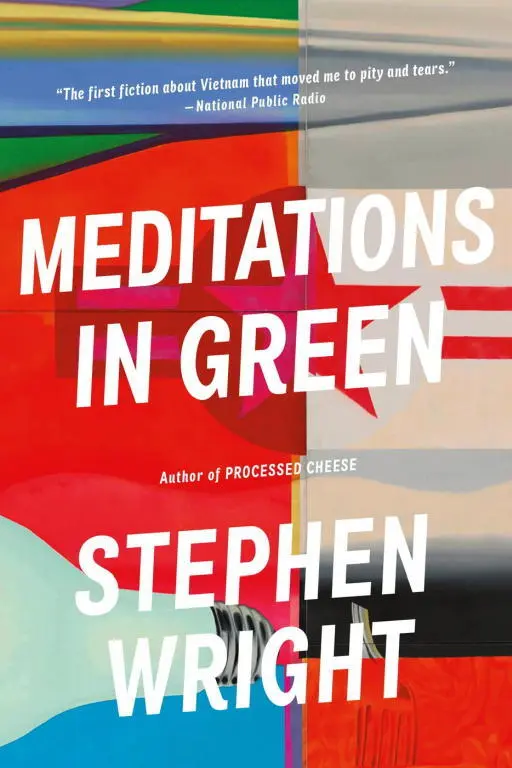
- Название:Meditations in Green
- Автор:
- Издательство:Little, Brown and Company
- Жанр:
- Год:2020
- Город:New York
- ISBN:978-0-316-42736-4
- Рейтинг книги:5 / 5. Голосов: 1
-
Избранное:Добавить в избранное
- Отзывы:
-
Ваша оценка:
Meditations in Green: краткое содержание, описание и аннотация
Предлагаем к чтению аннотацию, описание, краткое содержание или предисловие (зависит от того, что написал сам автор книги «Meditations in Green»). Если вы не нашли необходимую информацию о книге — напишите в комментариях, мы постараемся отыскать её.
Deployed to Vietnam with the U.S. Army’s 1069 Intelligence Group, Spec. 4 James Griffin starts out clear-eyed and hardworking, believing he can glide through the war unharmed. But the kaleidoscope of horrors he experiences gets inside him relentlessly. He gradually collapses and ends up unstrung, in step with the exploding hell around him and waiting for the cataclysm that will bring him home, dead or not.
Griffin survives, but back in the U.S. his battles intensify. Beset by addiction, he takes up meditating on household plants and attempts to adjust to civilian life and beat back the insanity that threatens to overwhelm him.
Meditations in Green is a haunting exploration of the harrowing costs of war and yet-unhealed wounds, “the impact of an experience so devastating that words can hardly contain it” (Walter Kendrick, the New York Times Book Review). Through passages gorgeous, agonizing, and surreal, Stephen Wright paints a searing portrait of a nation driven to the brink by violence and deceit.
Meditations in Green — читать онлайн бесплатно полную книгу (весь текст) целиком
Ниже представлен текст книги, разбитый по страницам. Система сохранения места последней прочитанной страницы, позволяет с удобством читать онлайн бесплатно книгу «Meditations in Green», без необходимости каждый раз заново искать на чём Вы остановились. Поставьте закладку, и сможете в любой момент перейти на страницу, на которой закончили чтение.
Интервал:
Закладка:
You never spoke the proper name. (Slang kept the demon contained.) In a leather pouch tied to your dog tag chain you carried two capsules of Dexedrine given to you by Doc. (In case of an emergency.) You were careful only to smoke. (Smoking prevented addiction. Everyone knew that.)
He forgot about his workday headaches, the weather turned cool, what was insomnia? The particulars of his environment no longer oppressed him since particulars were irrelevant. Bunk, mess hall, roof top, office stool. Distinctions merged. Time was a landscape of delights. A quiet uncomplaining Griffin spent hours at the office, patiently sharpening pencils and with stoned devotion shading in his wall map with tinted squares and rectangles of orange and blue and white. The colors of the banner under which he marched. The irritatingly random clusters of black dots on Cross’s radar maps and the epidemic of measles on McFarland’s infrared maps couldn’t compare with the clean line and bold composition of Griffin’s bright wastelands. The film was another matter. It was all special effects out there. Crops aged overnight, roots shriveled, stalks collapsed where they stood into the common unmarked grave of poisoned earth. Trees turned in their uniforms, their weapons, and were mustered out, skeletal limbs too weak to assume the position of attention. The topsoils melted away, the sun baked the crust into bricks of laterite, nature’s parking lot. Like an impotent king locked in a tower, Griffin sat on his stool and watched the land die around him. Crater eyes stared mournfully into his own. With a grease pencil he drew in comical glasses, moustaches on the mountains, black rainbows, silver lining inside the clouds. He dreamed of chemical showers, of winged nozzles sweeping the provinces from end to end, of 100 percent coverage. Before he left for home he wanted to color in all the remaining blanks on the map, complete the picture.
At night he smoked classified trash. Hours flicked past like minutes. Captain Patch often discovered him in the morning hunched over a cluttered desk. For no obvious reason Patch liked him, spoke of Griffin as “a model troop,” “one of my best people,” so when complaints started coming in—Air Force grumbling about defaced negatives, communications about indecipherable handwriting, the pilots about mismarked targets on their flight maps—the captain simply transferred Griffin to the day shift where he could keep a fatherly eye on his favorite boy.
Griffin hadn’t spent a night in his bed since his second week in-country. He adjusted quickly to the new schedule. Early to bed each evening, he’d set his alarm for a 0300 smoke, he liked his engine to be already running by the time he got up for work four hours later.
He worked now in an office of strangers. Of the original crew only Cross remained and he and Griffin had discontinued communication months ago. There were unfamiliar presences everywhere, the compound was being infiltrated. One day an alien face who called itself Lieutenant Shramm introduced him to another alien face, rosy and freckled. “Want you to take good care of Ingersoll here,” droned the lieutenant. “He’s your replacement.” “Wonderful,” replied Griffin.
Speed Graphic, the photo lab’s amateur artist, drew him a short timer’s calendar in the shape of a mango leaf. The drawing was divided into numbered squares Griffin was supposed to cross out, one by one, to mark the passage of each day. When the leaf was black, he could go home. Eighty-six, eighty-five, eighty-four… In a week he had begun to forget, one day passed, then another, unnoticed by the calendar. After several such lapses the mathematics involved in relocating his place wasn’t worth the information it provided. He was zipping too fast to be plotted and charted. The unfinished calendar hung on the wall above his head, a half-finished leaf.
Zip.
“I would have gotten sick,” said Chief Winkly, “falling down puking sick. Don’t believe I could have tolerated a sight like that.”
His collection of photography had broadened from tits and ass to blood and guts. Every day he asked Griffin for more details of the Quimby patrol.
“Yeah,” said Griffin.
“Too bad you didn’t pack a camera.”
“Yeah.”
“Guess you can barely keep your hands off the prisoners these days. I know I’d be waiting to split a few faces by now, snap some fingers. You want a turn in interrogation, let me know, I’ll see what I can do.”
“Yeah,” said Griffin, releasing a cloud of smoke into the chief’s ripe leer.
Look ma, no telltale odor, what’s he got in that cigarette?
One day Griffin passed out at work. Chief Winkly, picking his ear with a paper clip in the other room, smelled something burning and pulled him off the light table. Several frames of film had melted against his face. He didn’t feel a thing. In the mirror the shiny red scar produced images no one else could see, a mountain stream, a dirt road, a forest of trees branded into his skin.
Captain Patch often found him staring at the wall, a mess of unfinished paperwork clutched in his hands.
Griffin realized it didn’t matter whether he was on this airfield or back on the block, RVN or USA, here, there, space was so insignificant once you had truly learned how to occupy an interval of time.
Then he might have volunteered or perhaps he was ordered to spend a couple weeks as the II section’s representative on the perimeter.
“I’ll sleep better each night,” said Trips, “knowing it’s you out there on the watch towers.”
“Eternal freedom is the price of vigilance,” said Griffin.
So he went to the perimeter and listened to a sergeant who walked like a rooster describe the order of weapons to be employed in the event of a ground attack, a barrage of bombs and bullets culminating in the detonation by storage battery of something called foo gas, drums of explosives and jellied gasoline buried on both sides of each bunker that either blunted the enemy penetration or permitted your ghosts to cheer jets from Da Nang obliterating the runway from commie hands, thank you gentleman, off-duty hours may be occupied filling sandbags and stringing wire.
During the day Griffin couldn’t keep his finger off the trigger of the M-60 machine gun mounted on a wooden table inside the bunker. That cool metallic curve. Framed in the window slot before him was a continuous showing of the full-color travelogue Welcome To Beautiful Vietnam. Those women in their black silk pants, green rice fields and conical hats, the brown children with sticks perched atop the water buffalo, lumbering flanks, dark massive horns, solid as tanks, how much metal to bring one down? How many seconds—his finger stroked thoughtfully—from National Geographic to Gray’s Anatomy ? His stubbled chin rested against the plastic butt of the gun. Muzzle velocities, trajectories, impact patterns. All this physics concentrated in the soft tip of his finger. “They had weapons under their blouses, Sarge, they wouldn’t stop.” His tongue slid out, touched metal. Yes, death might very likely taste like that. The buffalo he’d pay for, of course, in monthly deductions from his salary. At the sound of an approaching motorboat he swiveled the gun to the left and sighted on a small red Honda bouncing through the field toward the perimeter, its rider, a Vietnamese teenager, outfitted in black pointed-toe boots, crimson velvet pants, blue satin shirt, and white ten-gallon hat. A cassette recorder strapped to the handle bars blasted out Blind Faith, almost completely obscuring the boy’s familiar cries of “Acid, speed, grass, and scag; acid, speed, grass, and scag.” The milkman. His daily rounds.
At night Griffin sat naked and alone on top of the bunker, listening to the rats and centipedes who lived in the wire. In the nearby village a light glided back and forth, appeared, disappeared, a ghost in a castle, and then abruptly went out. Darkness swirled around him like black dust. It made no difference if his eyes were open or closed. He couldn’t see the skyline, the sandbags, his own hand. He could feel the jungle, huge and silent, move right up to the wire and lean its warm dark presence against his skin. A spider’s web broke delicately across his face. The night flowed in and out of his body. He wanted to walk out into it, float away through the black and green tide. Something scurried in the weeds. He masturbated on a sandbag.
Читать дальшеИнтервал:
Закладка:
Похожие книги на «Meditations in Green»
Представляем Вашему вниманию похожие книги на «Meditations in Green» списком для выбора. Мы отобрали схожую по названию и смыслу литературу в надежде предоставить читателям больше вариантов отыскать новые, интересные, ещё непрочитанные произведения.









Обсуждение, отзывы о книге «Meditations in Green» и просто собственные мнения читателей. Оставьте ваши комментарии, напишите, что Вы думаете о произведении, его смысле или главных героях. Укажите что конкретно понравилось, а что нет, и почему Вы так считаете.