Stephen Wright - Meditations in Green
Здесь есть возможность читать онлайн «Stephen Wright - Meditations in Green» весь текст электронной книги совершенно бесплатно (целиком полную версию без сокращений). В некоторых случаях можно слушать аудио, скачать через торрент в формате fb2 и присутствует краткое содержание. Город: New York, Год выпуска: 2020, ISBN: 2020, Издательство: Little, Brown and Company, Жанр: Историческая проза, prose_military, на английском языке. Описание произведения, (предисловие) а так же отзывы посетителей доступны на портале библиотеки ЛибКат.
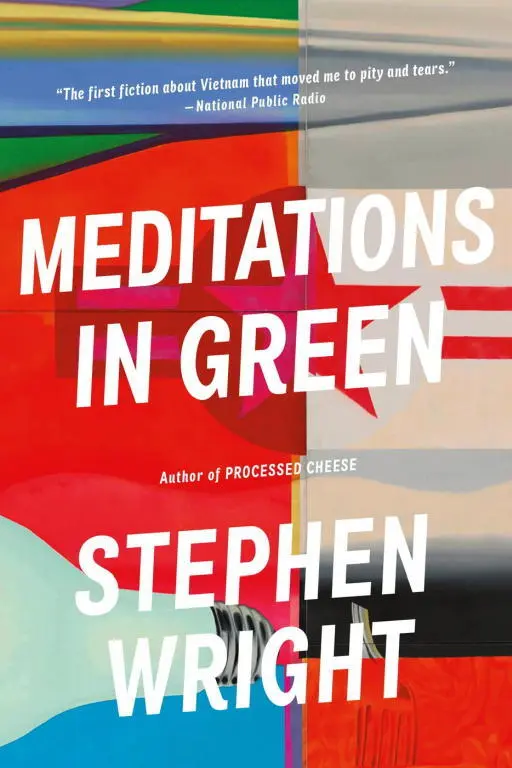
- Название:Meditations in Green
- Автор:
- Издательство:Little, Brown and Company
- Жанр:
- Год:2020
- Город:New York
- ISBN:978-0-316-42736-4
- Рейтинг книги:5 / 5. Голосов: 1
-
Избранное:Добавить в избранное
- Отзывы:
-
Ваша оценка:
Meditations in Green: краткое содержание, описание и аннотация
Предлагаем к чтению аннотацию, описание, краткое содержание или предисловие (зависит от того, что написал сам автор книги «Meditations in Green»). Если вы не нашли необходимую информацию о книге — напишите в комментариях, мы постараемся отыскать её.
Deployed to Vietnam with the U.S. Army’s 1069 Intelligence Group, Spec. 4 James Griffin starts out clear-eyed and hardworking, believing he can glide through the war unharmed. But the kaleidoscope of horrors he experiences gets inside him relentlessly. He gradually collapses and ends up unstrung, in step with the exploding hell around him and waiting for the cataclysm that will bring him home, dead or not.
Griffin survives, but back in the U.S. his battles intensify. Beset by addiction, he takes up meditating on household plants and attempts to adjust to civilian life and beat back the insanity that threatens to overwhelm him.
Meditations in Green is a haunting exploration of the harrowing costs of war and yet-unhealed wounds, “the impact of an experience so devastating that words can hardly contain it” (Walter Kendrick, the New York Times Book Review). Through passages gorgeous, agonizing, and surreal, Stephen Wright paints a searing portrait of a nation driven to the brink by violence and deceit.
Meditations in Green — читать онлайн бесплатно полную книгу (весь текст) целиком
Ниже представлен текст книги, разбитый по страницам. Система сохранения места последней прочитанной страницы, позволяет с удобством читать онлайн бесплатно книгу «Meditations in Green», без необходимости каждый раз заново искать на чём Вы остановились. Поставьте закладку, и сможете в любой момент перейти на страницу, на которой закончили чтение.
Интервал:
Закладка:
“She say she lose her job.”
“What?”
“She say you tell people Mamasan bad person.”
“Good God.” Now he understood.
“She say you tell honcho man she lose her job.”
Worse than learning your mother was a thief. She was a pimp, too.
“I won’t tell anyone,” said Griffin. “I promise.”
The girl spoke to Mamasan who listened without comment. She bowed once to Griffin and left the room.
“Mamasan no steal,” said Missy Lee. “Mamasan good worker.”
“Yes,” replied Griffin. “She good worker.” He sat on the bed. He was tired. If he could find a cool bunker…
“I go now,” said Missy Lee.
“Fine. You go.”
“You good man.”
“I don’t think so.”
She assumed an expression of mock surprise. “Yes,” she said emphatically. “You good man. You make family very happy.”
“What family?”
Should he offer her a twenty? Would she be pleased or insulted? His mind was too weary to explore consequences. Let her ask.
“Mamasan’s family.”
American military uniforms should be woven with money, fives, tens, twenties, stitched into combat durable shirts and pants, all most civilians saw anyway: a fool wrapped in cash.
“Wait a minute. Whose family?”
The girl looked puzzled. “Mamasan’s family,” she said.
Griffin pointed at her, then toward the door. “Is Mamasan your Mamasan?”
“Oh yes,” she answered, smiling, nodding eagerly. “She number one Mamasan.”
“Number one.” Of course. What else was a daughter to think?
How much innocence went to make up this person he imagined was himself, how much remained to be shredded?
“Yes, she work very hard.”
“Go on, Missy Lee, you go back to your work, too.”
She nodded and slipped out the door.
Griffin sat on the edge of his bed, watching his bare feet roll back and forth over the grains of sand on the floor. As a kid he often perched on a warm dock, dangling his legs above the cool water of a forest lake. Where the fish leaped like silver birds and agile water bugs skimmed the bright surface. A million years ago. There had been terrible heat in those summers too but relief was always at your feet, spreading out blue to a pine horizon. He cried when he had to go home. Today, those fish, their brains pickled in pollution, flopped in the sun until they died. He reached for a corner of the sheet to wipe his dripping forehead and touched something clammy. He had to get out of here. He stood up, pulled on his clothes. For three days Weird Wendell had been filming in the dispensary, with the enthusiastic cooperation of Flight Surgeon Beams, the crucial medical scene in which wounded dozens in various degrees of distress were miraculously repaired by a heroical surgical team dressed in greasy coveralls and gorilla masks. Griffin could be a casualty.
He opened the hootch door on a collection of smirks. His friends. Gathered outside like a gang of teenage virgins.
“Who would have guessed,” exclaimed Trips, “that you’d be the first to pop Missy Lee. How was she?”
Griffin carefully descended the wooden steps. How long had they been out here, moist lips, cocked ears? He understood now about long-range reconnaissance patrols: deep in the bush were fatigue, terror, the possibility of death, but also clearings of privacy. He looked around. They were waiting. He smiled. “Best I ever had,” he replied, already moving through the laughter, the pats on the back, not even bothering to turn or pause but walking away as he said, “And you know, she never once asked me to take her to America.”
Cheers. Laughter. Whoops of delight.
You shits. You fucking shits.
Dear Ma and Pa,
I’m learning how to play the harmonica. My first tune—“Row, Row, Row Your Boat.” Last night a few of the guys gathered in my room to share some conversation and that tin of chocolate chip cookies (Thanks Mom) when Sam, you remember Sam? He’s the boy from Arkansas who stands guard duty in his bare feet despite the danger of snake bite. Anyway, he pulled out this mouth harp (another word for harmonica) and started playing a rendition of “Shortening Bread” that was absolutely amazing. I never realized what a rich sound you could get out of these things. He’s the one who’s teaching me.
Sometimes I think it’s moments like last night that redeem the other times of this awful war.
I try to keep busy but seems like these days never want to end. Sometimes the boredom is so terrible it’s enough to make one wish for a little excitement, not too much though, I know how something like that would worry the both of you so.
I guess that’s all for now. It must be beautiful back home now. At night when I close my eyes I see snow on our roof. Ah well, next season I’ll be there. Take care of yourselves and please don’t worry about me. See you in 203.
Love, LewP.S. The other night one of our sergeants went crazy from tension and started running around screaming and shooting at people with his pistol until the OD hit him over the head with an entrenching tool. Lucky there was no one seriously hurt.
MEDITATION IN GREEN: 9
In the morning dew condenses on the spiky flowerlike knots of metal arranged in regular intervals along the wire fence surrounding them. The mountains appear huge and blue in the far distance.
She doesn’t feel well today. She misses home, not home as it is now, but home as it was then, in the time of the Stone Buffalo. Bieng-the-Golden-Eye was still chief then and even though Ndoong-the-Son took his own life near the Water-of-the-Elephant’s-Trunk and everyone was sad for so long the Spirits had not run away yet and the land talked back and The Jar was always full. If all the soldiers would only…
She heard stirring in the hootch behind her. She recognized the voices of Mae-Jieng and Dur-the-Widow already arguing over the metal spoon. She sighed, her breath momentarily visible in the cool air. Their quarrels made her tired. If the guards heard them they would rush in and beat up some people even before the counting and the eating of the morning rice. She was afraid of the Vietnamese and she hated them very much. They laughed and called the Montagnards “monkeys.” Then they took out their sticks and beat somebody. They beat somebody every day unless the American Whites came and stopped them. The American Whites were a mystery, sometimes friendly and nice, sometimes angry and terrifying. It was their machines that had dropped the Medicine Cloud into the Forest of the Singing Tigers the summer of the Sky Sickness when the corn died and the water tasted bad, so much illness, Troo-Wan and her children died.
She can no longer hear the voices inside so the argument must have ended. Maybe today there will be no beating. She has heard that trucks are coming to take them to another camp. She hopes there will be a doctor there. Her belly has begun to ache. She is afraid of the pain and wishes her husband Bbaang had not gone away with the Green Hats. Maybe he will be in the new camp. Her belly aches. She is afraid of this baby. She feels something move inside her and she touches herself. Her fingers come away wet. She has begun to bleed.
“You sounded like The Return of the Mummy coming up the stairs,” I said. “I was ready to pile furniture behind the door.”
“You look utterly devolved,” said Huey. She had on a Tibetan goatskin cap pulled down over her ears, a black leather jacket, purple pants, and tall boots. She stood in the doorway, studying me for a moment. “Okay, where is he?”
“I haven’t seen him in days. Honest. Three days.” I held up fingers. “Count ’em.”
Читать дальшеИнтервал:
Закладка:
Похожие книги на «Meditations in Green»
Представляем Вашему вниманию похожие книги на «Meditations in Green» списком для выбора. Мы отобрали схожую по названию и смыслу литературу в надежде предоставить читателям больше вариантов отыскать новые, интересные, ещё непрочитанные произведения.











Обсуждение, отзывы о книге «Meditations in Green» и просто собственные мнения читателей. Оставьте ваши комментарии, напишите, что Вы думаете о произведении, его смысле или главных героях. Укажите что конкретно понравилось, а что нет, и почему Вы так считаете.