Stephen Wright - Meditations in Green
Здесь есть возможность читать онлайн «Stephen Wright - Meditations in Green» весь текст электронной книги совершенно бесплатно (целиком полную версию без сокращений). В некоторых случаях можно слушать аудио, скачать через торрент в формате fb2 и присутствует краткое содержание. Город: New York, Год выпуска: 2020, ISBN: 2020, Издательство: Little, Brown and Company, Жанр: Историческая проза, prose_military, на английском языке. Описание произведения, (предисловие) а так же отзывы посетителей доступны на портале библиотеки ЛибКат.
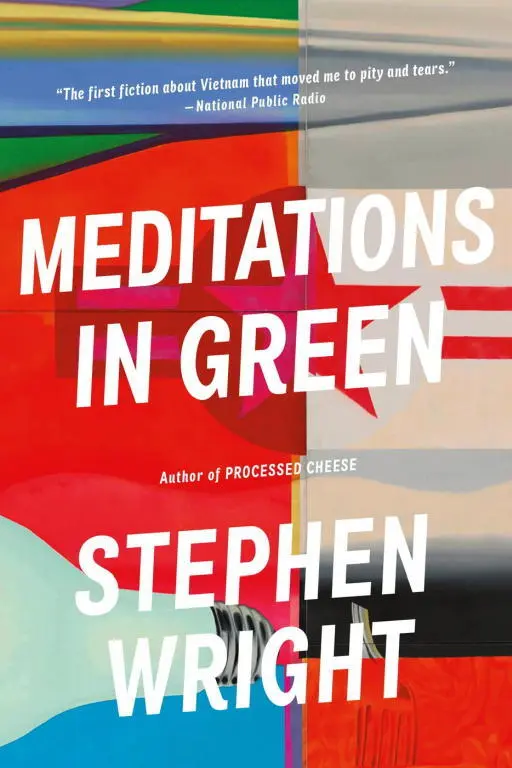
- Название:Meditations in Green
- Автор:
- Издательство:Little, Brown and Company
- Жанр:
- Год:2020
- Город:New York
- ISBN:978-0-316-42736-4
- Рейтинг книги:5 / 5. Голосов: 1
-
Избранное:Добавить в избранное
- Отзывы:
-
Ваша оценка:
Meditations in Green: краткое содержание, описание и аннотация
Предлагаем к чтению аннотацию, описание, краткое содержание или предисловие (зависит от того, что написал сам автор книги «Meditations in Green»). Если вы не нашли необходимую информацию о книге — напишите в комментариях, мы постараемся отыскать её.
Deployed to Vietnam with the U.S. Army’s 1069 Intelligence Group, Spec. 4 James Griffin starts out clear-eyed and hardworking, believing he can glide through the war unharmed. But the kaleidoscope of horrors he experiences gets inside him relentlessly. He gradually collapses and ends up unstrung, in step with the exploding hell around him and waiting for the cataclysm that will bring him home, dead or not.
Griffin survives, but back in the U.S. his battles intensify. Beset by addiction, he takes up meditating on household plants and attempts to adjust to civilian life and beat back the insanity that threatens to overwhelm him.
Meditations in Green is a haunting exploration of the harrowing costs of war and yet-unhealed wounds, “the impact of an experience so devastating that words can hardly contain it” (Walter Kendrick, the New York Times Book Review). Through passages gorgeous, agonizing, and surreal, Stephen Wright paints a searing portrait of a nation driven to the brink by violence and deceit.
Meditations in Green — читать онлайн бесплатно полную книгу (весь текст) целиком
Ниже представлен текст книги, разбитый по страницам. Система сохранения места последней прочитанной страницы, позволяет с удобством читать онлайн бесплатно книгу «Meditations in Green», без необходимости каждый раз заново искать на чём Вы остановились. Поставьте закладку, и сможете в любой момент перейти на страницу, на которой закончили чтение.
Интервал:
Закладка:
“I’m going to try a couple new images on you. Concentrate, focus your attention. Shape, color, texture, the parameters of beauty. Fill your head. Cultivate your garden.”
“It’s curious but whenever you say the word garden, I always think of that movie Suddenly Last Summer. You ever see it, Katharine Hepburn gliding in white out into her hothouse jungle of carnivorous plants and droopy vines and flapping prehistoric birds where Montgomery Clift stands, polite but awed. ‘It’s so… so unexpected,’ he stammers. ‘Like the dawn of creation,’ she replies.”
Arden laughed. “You’re marvelous, Griffin, a real cocksuck, but marvelous. Why don’t you tell me what it is you want from your meditations?”
“Oh, I don’t know, some distant kin, a second cousin or a great uncle, to authenticity, I suppose.”
There was a pause in which I could hear the mournful chanting of seekers locked in cell-like rooms down the corridor.
“Christ!” Arden shouted, slamming a fist into the desktop. The vases rattled, the flowers jiggled. “And what the fuck is that, huh? ‘Authenticity, authenticity.’ Marx? Nietzsche? Dale Carnegie? Haven’t you been listening? Doesn’t anyone listen? Those other voices are dust, murmurings in the dust, so why do all you people persist in following them? Can no one but me see that what is dust is sterile? Always this resistance. Instead of sincere practice everyone gives me hypocritical excuses: ‘My analyst claims playing in the shrubbery is dangerously regressive,’ ‘Doesn’t Sartre seem to indicate that vegetation is, au contraire, an oppressive presence, a distasteful reminder of the essentially nihilistic and somewhat de trop quality of nature’s pullulative force.’ Well shit, I say, to hell with all that. It’s dead, dead, certifiably dead. We have entered the autumn of that overgrown culture and all the dead dry leaves are fluttering down from the great dead trees, piling higher and higher all around until we’re choking on the goddamn brittle stuff. Get rid of it! Rake it up, bum it, let the wind carry the ashes away. Let us have done with the season of death and black thoughts and brown funks. Spring approaches. Green is the color of the future. Think green!” And crash! Down came his fist. “Green, green, green.” Crash, crash, crash.
The office was clean and spare, a soldier’s room. Functional furniture functionally arranged, no decorations. Major Martin Holly was pleased. Apparently his predecessor had also been a simple man. A singular type in a compromised world. Men of spartan vigor were the posts in a fence sagging at the top, buckling in the middle. Erosion was general. The war had gone on too long, a joke without a punch line. Da Nang already resembled a hippie ghetto. In the offices there desktops were concealed beneath dumps of neglected paperwork, personal correspondence, hometown newspapers, cock books, stale food, half-empty soda cans, and Styrofoam cups fuzzy with mold; once-aseptic walls had become infected with a creeping fungus of pinups, film and travel posters, family photographs, and crudely drawn, militantly obscene short-timers’ calendars. The living quarters were worse. Officers slouched; privates could no longer accurately recite the chain of command; the salute was an arbitrary flip of the wrist; fistfighting was a nightly occurrence at the EM club; dope was peddled openly in battalion streets; and the pleasant mannered clerk who had typed Holly’s orders sat beneath a large color picture of a screaming black man, red bandana tied around his bushy head, huge electric guitar thrust between velvet pipestem pants. Major Holly was glad to be gone. No doubt the 1069th Military Intelligence Group had its problems too, but here he would be in charge, he would correct them. In Da Nang his primary responsibilities had been to sip Pinch and play chess with The General, Holly’s uncommon ability at that elegant game of circumscribed movement within a symmetrical space was certainly a factor in winning for him this command opportunity. The General encouraged displays of wit, and those who sparkled found themselves invited to after-hours conversation, special missions, outcountry jaunts. The General’s wife and daughter lived in a bungalow overlooking Manila Bay, and each Friday afternoon, if nothing appeared pending in The Territory, The General flew to The Philippines for the weekend accompanied by favorite members of his staff. Major Holly had been a regular guest. He had enjoyed those trips, respite from the pressures of a difficult war, even though it was his unvoiced opinion that such excursions were too frequent and too long and tended to blur the edge necessary for competent tactical thought. The General regarded his weekends as rejuvenations. The family was balm for the soul, he joked, Holly tonic for the mind. “He can speak extemporaneously for more than five minutes without resorting to that nonword ‘irregardless,’” The General explained to envious aides. After a few drinks The General particularly liked hearing Holly’s seriocomic analyses of the war, his favorite the argument that laid the blame for the origin of intervention upon too enthusiastic a reading of the novels of the late Ian Fleming. The General often requested that Holly repeat this theory to various visitors military, civilian, and congressional even though Holly himself, whether nursing a Planter’s Punch in the shade of a date palm on Luzon or watching distant pillars of smoke through binoculars from The General’s private helicopter, most often experienced himself not as some romantic adventurer but more like a displaced creature out of Graham Greene.
In the first hour of his new command Major Holly inspected his desk. The bottom drawer, unfortunately, was jammed shut. Then, without bending to look, he carefully ran the fingers of his right hand along the under edge of the desktop, feeling for fossilized deposits of old chewing gum. Happily, there was none. Now he could be assured that sometime in the future when coordinating mission objectives with superiors or reprimanding subordinates his train of thought would not be suddenly derailed by idle fingers stumbling upon a cold clot of sticky gum. No one should chew it. There should be a reg. It ruined teeth and appearance. It turned a soldier into a punk.
Holly himself was blessed with The Look. Blue eyes protected by the thick lenses of gold aviator frames. The hair, short as putting-green grass, too short to reflect any definite color. Firm jaw. Cleft chin. A sea captain’s wrinkles. Just one minor flaw, tiny, hardly noticeable. High on the left cheek rested a brown velvety mole his straying hand found unable to resist touching, rubbing, squeezing. Hairs proliferated there despite frequent plucking and the surreptitious application of various depilatories. It was as if one minuscule but prominent spot had deliberately seceded from the austere well-tended country of his face, had gone soft, mushy, fertile. Sometimes he imagined this dot of color added a quaint old-fashioned sexual note to his appearance, but deep in fatigue and depression he often worried about its effect upon his career. In an age when everyone’s file was arranged to read as identically as possible, careers could be bent by such trifles as the pitch of a voice, the break in a smile. Appearance. In the military you couldn’t ever forget. Burnished surfaces were mandatory.
On the first day of his command Major Holly met with his section leaders, glanced through the late colonel’s files, answered affirmatively The General’s telephoned request to locate the maddeningly elusive 5th NVA Regiment, and personally changed the air conditioner filter in his office.
Setting. The deployment of objects about a central consciousness. This was crucial. Certain emotional transactions required certain specific settings. Military life sensitized one to the animistic force of things. Grooming, clothes, furniture, wall color, weapons. Minds could be encouraged to coalesce about such stuff. If there was a supernatural it resided in things. The new recruit learned this truth gradually over the course of training as the alien objects of military life transmitted day by day the power contained in their strangeness and thereby became personal extensions of his own enlarged and militarized consciousness. (The General loved this idea too, spoke often of recommending Holly to Basic Training Command.) The settings in the army at their simplest were two: enclosed and exposed. Holly was familiar enough with the latter; he knew what it was like in the bush, he knew about slipping and sliding, that had been two years ago when his mind had been too scattered, dulled, and absorbed to note the contours of its moods. Only a staff officer had the time and personal security to reflect on mental processes, only a bored staff officer could have formulated this theory. So, for the average staff officer then, four objects shared the burden of consciousness: the desk, the bar table, the podium, and the floor. Least pleasant, of course, was an acute awareness of the floor—its solidity, monotony, proximate relationship to you. Holly called this linoleum consciousness, a state that occurred, when it did, in the magnified presence of one’s displeased superiors. In the military this state could most often be found within the corridors and offices of the Pentagon where the sight of bird colonels and even generals melting into the linoleum was a too common spectacle. (“Humiliation,” remarked The General, “goddamn army runs on it. There’s a sex angle too, but you’re not supposed to consider that for two more grades yet.”) All these buffed floors and polished shoes. Reflective surfaces everywhere. The better to ponder your unworthiness? No, no one wished to be too aware of the floor. The best site for consciousness was behind a well-fortified desk. There the power crackled palpably. How often had Holly sat across from a general at his desk and watched those shoulder stars begin to glitter so much like Christmas tree ornaments you could have sworn there were wires under the coat. One general Holly knew had had all the light bulbs above his head fixed twenty to thirty watts higher than those in the rest of the office. The deviousness of the insecure. Actually, there was no need for such tricks. A commander behind his desk was potent magic without any artificial assistance. Seated in his chair, Holly was plugged in, he experienced radiance.
Читать дальшеИнтервал:
Закладка:
Похожие книги на «Meditations in Green»
Представляем Вашему вниманию похожие книги на «Meditations in Green» списком для выбора. Мы отобрали схожую по названию и смыслу литературу в надежде предоставить читателям больше вариантов отыскать новые, интересные, ещё непрочитанные произведения.











Обсуждение, отзывы о книге «Meditations in Green» и просто собственные мнения читателей. Оставьте ваши комментарии, напишите, что Вы думаете о произведении, его смысле или главных героях. Укажите что конкретно понравилось, а что нет, и почему Вы так считаете.