Stephen Wright - Meditations in Green
Здесь есть возможность читать онлайн «Stephen Wright - Meditations in Green» весь текст электронной книги совершенно бесплатно (целиком полную версию без сокращений). В некоторых случаях можно слушать аудио, скачать через торрент в формате fb2 и присутствует краткое содержание. Город: New York, Год выпуска: 2020, ISBN: 2020, Издательство: Little, Brown and Company, Жанр: Историческая проза, prose_military, на английском языке. Описание произведения, (предисловие) а так же отзывы посетителей доступны на портале библиотеки ЛибКат.
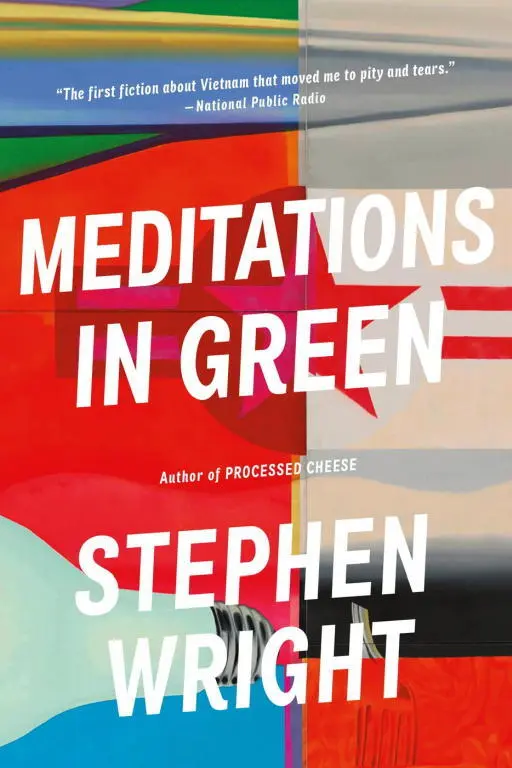
- Название:Meditations in Green
- Автор:
- Издательство:Little, Brown and Company
- Жанр:
- Год:2020
- Город:New York
- ISBN:978-0-316-42736-4
- Рейтинг книги:5 / 5. Голосов: 1
-
Избранное:Добавить в избранное
- Отзывы:
-
Ваша оценка:
Meditations in Green: краткое содержание, описание и аннотация
Предлагаем к чтению аннотацию, описание, краткое содержание или предисловие (зависит от того, что написал сам автор книги «Meditations in Green»). Если вы не нашли необходимую информацию о книге — напишите в комментариях, мы постараемся отыскать её.
Deployed to Vietnam with the U.S. Army’s 1069 Intelligence Group, Spec. 4 James Griffin starts out clear-eyed and hardworking, believing he can glide through the war unharmed. But the kaleidoscope of horrors he experiences gets inside him relentlessly. He gradually collapses and ends up unstrung, in step with the exploding hell around him and waiting for the cataclysm that will bring him home, dead or not.
Griffin survives, but back in the U.S. his battles intensify. Beset by addiction, he takes up meditating on household plants and attempts to adjust to civilian life and beat back the insanity that threatens to overwhelm him.
Meditations in Green is a haunting exploration of the harrowing costs of war and yet-unhealed wounds, “the impact of an experience so devastating that words can hardly contain it” (Walter Kendrick, the New York Times Book Review). Through passages gorgeous, agonizing, and surreal, Stephen Wright paints a searing portrait of a nation driven to the brink by violence and deceit.
Meditations in Green — читать онлайн бесплатно полную книгу (весь текст) целиком
Ниже представлен текст книги, разбитый по страницам. Система сохранения места последней прочитанной страницы, позволяет с удобством читать онлайн бесплатно книгу «Meditations in Green», без необходимости каждый раз заново искать на чём Вы остановились. Поставьте закладку, и сможете в любой момент перейти на страницу, на которой закончили чтение.
Интервал:
Закладка:
“Who can tell? These parts is old and decayed. Maintenance ain’t what it should be.”
“Someone did it.”
“Hard to say.”
“Someone did it.”
Inside a Quonset hut surrounded by high chain-link fence topped with coils of barbed wire behind a red door marked RESTRICTED sat Griffin on a tall stool. His face, strongly lit from below, seemed glazed with silver, moonlike. He held a large magnifying glass in one hand as he studied a frame of the roll of black and white film spread on the light table in front of him. His eyes narrowed. He leaned forward. Something wiggled, slipped into focus, slipped out again. A dead log, not a muzzle brake. He sat up, arching his back to relieve the tightness in his shoulders, the burr in his head. All-night dreams tumbled through him like a wind too quick for memory, leaving behind the sensation of great speed, and, stuck to the morning light, barbs of an indistinct seed, the germ of the headache he would carry to work and the culture of eye strain and tedium in which it would propagate out of control. He reached forward, turned the crank on his right, and the film, unrolling from a reel on the left, moved smoothly across a long rectangle of illuminated glass. The military name for this task was image interpreter. Griffin was required to translate pictures into letters and coordinates that were instantly telexed to such important addressees as III MAF, 1AIRCAV, 25DIV, III MAG, MACV, CINCPAC, and most impressive, JCS. The data went round and round and where it came out he preferred not to hear. A camera fixed in the belly of a Mohawk OV-1A had collected today’s images during a morning break in the weather above a sector of suspected hostile activity approximately fifty kilometers southwest of Griffin’s stool. His job was to interpret the film, find the enemy in the negatives. He turned the crank. Trees, trees, trees, trees, rocks, rocks, cloud, trees, trees, road, road, stream, stream, ford, trees, road, road. He stopped cranking. With a black grease pencil he carefully circled two blurry shadows beside the white thread of a road. Next to the circles he placed question marks. Road, road, road, road, trees, trees, trees. His eyes felt hard as shells, sore as bruises. Trees, trees, trees, trees. Wherever he put circles on the film there the air force would make holes in the ground.
In the adjacent Quonset hut Captain Thomas Raleigh extended his arm and shook hands with PFC Claypool.
“Welcome to the interrogation section. How’s your Vietnamese?”
Claypool grinned. “It was okay, sir, until I heard two laundry girls in Long Binh.”
“I know the feeling, son. Don’t let it spook you. The field’s a long way from the classroom. You’ve got the basics, but you’ll do all your real learning out here.” He smiled.
“I was beginning to wonder if I was in the right country.”
“Oh, you’re in the right country all right. Where else do the people curse each other in six-tone harmony.” Captain Raleigh glanced at his watch. “We were thinking of assigning you temporarily to Sergeant Ramirez in the mess hall for a week or two, sort of an undercover job working along side of the native kitchen help who won’t know you understand the language. It’s something we like to do now and then with new personnel. You get a quick refresher course in Vietnamese and maybe we pick up a bit or two of useful intelligence. I know KP isn’t much fun but once we flushed out a whole family of VC this way. Helps to keep everybody on their toes, know what I mean?”
Behind Captain Raleigh’s back Claypool could see the cages, all empty except for the nearest one. On the floor, curled into a fetal ball, lay what appeared to be a small woman. Under her body on the concrete was a large wet puddle. Claypool found it difficult to keep his eyes off her. He wondered if she was dead.
“Okay, here’s the setup,” Captain Raleigh was saying. “We receive prisoners from all army units now operating in I Corps, the 101st, the Aviation Brigade, Special Forces, and so on. It can get pretty hectic depending on the time of year and the size of our staff. Right now we’re short about three people but monsoon is usually a slack period, anyway. We try to stay ahead by working quickly. Our facilities are adequate if we can keep the flow running. When we’re finished the prisoners are shipped out to the POW compound in Da Nang. Any questions? I would like to emphasize the fact that we are not just interested in speed, we want accuracy, too. This is an important mission we’ve got here; the information we obtain is read up and down the whole goddamn chain of command from MACV in Saigon to Pacific Headquarters in Honolulu to the Pentagon in Washington. We’ve got plenty of important eyes peeping over our shoulders, so don’t fuck up. Remember, lives depend on our input.”
The woman had not moved. She might have been a piece of modern soft sculpture or one of those dummy torsos used to teach emergency resuscitation techniques.
Captain Raleigh looked at his watch again. “I’m afraid I’ve got a section chief meeting which I must attend so I’m going to have to leave you alone for a couple minutes. Sergeant Mars should be back shortly. He’ll brief you on specific duties, help you get settled in. In the meantime look the place over, make yourself at home. We’re glad to have you and I’m sure you’ll find it interesting and challenging work.”
As soon as the captain was gone Claypool sat down at one of the vacant desks and lit a cigarette. Next to the in box was a row of gold-framed family photographs: a pleasant middle-aged woman with short blond hair and glasses, an adolescent boy posed arms folded in front of a gleaming maroon Chevy sedan, a young girl in pajamas clutching a stuffed cat, and a large black setter holding in his mouth a cloth banner declaring We All Miss You Very Much. There was a calendar with all the days of the year up to and including this one neatly X’ed out. Under a Plexiglas desktop were various memos, regulations, schedules, a few humorous birthday cards, a student’s crib sheet of typical Vietnamese phrases such as “What is your name?” “How old are you?” “Are you ill?”, an anatomical chart with all the body parts labeled in Vietnamese, and two pastel-colored signs. Pathet Lao For Lunch Bunch, said one. VC The Breakfast of Champions, said the other.
Claypool decided that the woman was probably unconscious. Should he do something? For a moment he wondered if perhaps the captain had only stepped into an adjoining room to watch him through a secret peephole in the wall. But if this was a test of some kind, just what was it that was being tested? His compassion or his callousness? Suppose he got up and spoke to the woman. It might interfere with her interrogation. Also, the sergeant might walk in at any moment. He would wait. After ten minutes of uncomfortable suspense he decided to take a look. The woman was on her right side, knees drawn up to her chin, her back toward him. He edged around to the side of the cage. He gasped. Her eyes, large and coal black, were wide open. He bent down, pressing against the wire, looking for the rise and fall of breathing. He thought her eyes moved, blinking like a reptile’s. “Hello,” he said softly. “Are you all right?” There was no response. He started to repeat the sentence in Vietnamese until he remembered that nationals were not supposed to know he could do that yet. He felt helpless and stupid. The woman stared through him as though he were a ghost. What was so fascinating? He got down on his knees, lowered his head to the floor in the same angle and direction as hers. There was only the adjacent cage and then another cage and another and another, wall after wall of bars and steel mesh receding backward to the blank windowless wall at the end of the building. Claypool got up, brushed his hands on his pants, and went back to the desk to have another cigarette. The ashtray was there and a chair and the light. He wanted to sit under a strong light for a while.
Читать дальшеИнтервал:
Закладка:
Похожие книги на «Meditations in Green»
Представляем Вашему вниманию похожие книги на «Meditations in Green» списком для выбора. Мы отобрали схожую по названию и смыслу литературу в надежде предоставить читателям больше вариантов отыскать новые, интересные, ещё непрочитанные произведения.












Обсуждение, отзывы о книге «Meditations in Green» и просто собственные мнения читателей. Оставьте ваши комментарии, напишите, что Вы думаете о произведении, его смысле или главных героях. Укажите что конкретно понравилось, а что нет, и почему Вы так считаете.