Джозеф Конрад - Suspense
Здесь есть возможность читать онлайн «Джозеф Конрад - Suspense» весь текст электронной книги совершенно бесплатно (целиком полную версию без сокращений). В некоторых случаях можно слушать аудио, скачать через торрент в формате fb2 и присутствует краткое содержание. Год выпуска: 2017, Издательство: epubBooks Classics, Жанр: Историческая проза, на английском языке. Описание произведения, (предисловие) а так же отзывы посетителей доступны на портале библиотеки ЛибКат.
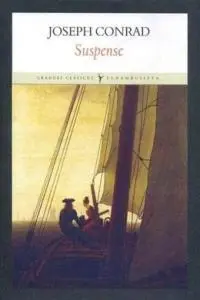
- Название:Suspense
- Автор:
- Издательство:epubBooks Classics
- Жанр:
- Год:2017
- ISBN:нет данных
- Рейтинг книги:3 / 5. Голосов: 1
-
Избранное:Добавить в избранное
- Отзывы:
-
Ваша оценка:
Suspense: краткое содержание, описание и аннотация
Предлагаем к чтению аннотацию, описание, краткое содержание или предисловие (зависит от того, что написал сам автор книги «Suspense»). Если вы не нашли необходимую информацию о книге — напишите в комментариях, мы постараемся отыскать её.
Suspense — читать онлайн бесплатно полную книгу (весь текст) целиком
Ниже представлен текст книги, разбитый по страницам. Система сохранения места последней прочитанной страницы, позволяет с удобством читать онлайн бесплатно книгу «Suspense», без необходимости каждый раз заново искать на чём Вы остановились. Поставьте закладку, и сможете в любой момент перейти на страницу, на которой закончили чтение.
Интервал:
Закладка:
He made a step forward, and then another, and stood still. “You two had better sit down and talk. Yes, sit down and talk. Renew the acquaintance of your early youth…. Your early youth,” he repeated in a faint voice. “Those youthful friendships….” He made a convulsive grimace which Cosmo had discovered to be the effect of a smile. “There is something so charming in those youthful friendships. As to myself, I don’t remember ever being youthful.” He stepped out towards the door through which Cosmo had seen Clelia enter that morning. “Let me find you when I return, enjoying yourselves most sentimentally. Most delightful.”
His long stiff back swayed in the doorway, and the door came to with a crash.
Cosmo and Adèle looked at each other without a smile. Cosmo, hat in hand, asked just audibly, “I suppose I had better stay?” She made an affirmative sign, and moving away from him, put her foot on the marble fender of the fire–place where nothing was left but hot ashes hiding a reddish glow.
V
Cosmo, ill at ease, remained looking at her. He was in doubt what the sign she had made meant, a nervous and imperious gesture, which might have been a command for him to go or to stay. In his irresolution he gazed at her, thinking that she was lovely to an incredible degree, and that the word radiant applied to her with extraordinary aptness. Light entered into her composition. And it was not the cold light of marble. “She actually glows,” he said to himself amazed, “like ripe fruit in the foliage, like a big flower in the shade.”
“Don’t gaze at my blushes,” said Madame de Montevesso in an even tone, tinged with a little mockery and a little bitterness. “Would you believe that when I was a girl I was so shy that I used to blush crimson whenever anybody looked at me or spoke to me? It’s a failing which does not meet with much sympathy. And yet my suffering was very real. It would reach such a pitch at times that I was ready to cry.”
“Shall I go away?” asked Cosmo in a deadened voice. He waited for a moment while she seemed to debate in her mind the answer to the question. In his fear of being sent away he went on: “God knows I don’t want to leave you. And after all the count is coming back and … ”
“Oh, yes, he is coming back. Sit down. Yes. It would be better. Sit down….” Cosmo sat down where he could see her admirable shoulders, the roundness of her averted head, coiffée en boucles , and girt with a gold circlet, the shadowy retreating view of her profile. The long drapery of her train flowed to the ground in a dark blue shimmer…. “He is inevitable. He has always been inevitable,” came further from her lips which he couldn’t see, for the mirror above the mantel–piece reflected nothing but her forehead with the gold mist of her hair above.
Cosmo remained silent. For nothing in the world would he have made a sound. He held his breath with expectation; and in the extreme tension of his whole being the lights grew dim around him, while her white shoulders, the thick clustering curls, the arm on which she leaned, and the other bare arm hanging inert by her side, seemed the only source of light in the room.
“You don’t know me at all,” began the Countess de Montevesso. “I don’t charge you with forgetting; but the little you may remember of me cannot be of any use. It is only natural that I should be a stranger to you. But you cannot be a stranger to me. For one thing, you were a boy; and then you were not a child of outcasts without a country, of refugees with a ruined past and with no future. You were a young Latham, as rooted in your native soil as the old trees of your park. Even then there seemed to me something enviable about you.”
She turned her head a little to glance at him. “You had no idea what it was like after we had gone to London. My ignorance of the world was so profound that I felt ill at ease in it. I hoped I had an attractive face, but I only discovered that I was pretty from the remarks of the people in the street I overheard. I spent my life by the side of my mother’s couch. I never went out except attended by my father or by Aglae. My only amusement was to play a game of chess now and then with an old doctor, also a refugee, who looked after my mother, or listen to the conversation of the people who came to see us. Amongst them there were all the prominent men and women of the old régime. Refugees. They seldom spoke the truth to each other, and yet they were no more stupid than the rest of the world. Nobody could be more good–natured and better company, more frivolous or more inconsiderate. I have seen women of the highest rank work ten hours a day to get bread for their children, but they also slandered one another, told falsehoods about their conduct and their work, and quarrelled among themselves in the style of washerwomen. Morals were even looser than in the times before the Revolution. Manners were forgotten. Every transgression was excused in those who were regarded as good Royalists. I don’t mean this to apply to the great body of the refugees. Some of them led irreproachable lives. Round our princes there were some most absurd intrigues. I didn’t know much of all this, but I remember my poor father’s helpless indignations and my own appalled disgust at the things I could not help hearing and seeing.”
She turned her head to look at Cosmo. “I am telling you all this to give you some idea of the air I had to breathe,” she said in a changed tone. “I don’t think it contaminated me. I felt its odiousness; but all this seemed without remedy. I didn’t even suffer much from it. What I suffered most from was our domestic anxieties; my mother’s fears lest the small resources we had to live on should fail us altogether. Our daily crust of bread seemed to depend on political events in Europe, and they were going against us. Battles, negotiations, everything. A blight seemed to have fallen on the Royalist cause. My mother didn’t conceal her distress. What touched me more still was the care–worn, silent anxiety of my poor father.”
She paused, looking at Cosmo intently, meeting his eyes fixed on her face. “I was getting on for sixteen,” she continued. “No one ever paid the slightest attention to me. The only genuine passion in my heart was filial love…. But is it any good in going on? And then I can’t tell what you may have heard already.”
“All I have heard,” said Cosmo, in a tone of profound respect, “was that Adèle de Montevesso’s life has been irreproachable.”
“I remember the time when all the world was doing its best to make it impossible. Would it shock you very much if I told you that I don’t care at all about its good opinion now? There was a time when it would put the worst construction possible on my distress, on my bewilderment, on my very innocence.”
“Why should the world do that to you?” asked Cosmo.
“Why? But I see that you know nothing. I met my husband first at a select concert that was being given by the music–master of the late Queen of France. My mother was feeling a little better, and insisted on my going out a little. Those were small fashionable affairs. I had a good voice myself, and that evening I sang with Madame Seppio. An English gentleman—his name doesn’t matter—presented Monsieur de Montevesso to me as a friend of his just returned from India, and anxious to be introduced to the best society. What with my usual shyness and the unattractive appearance of the man, I don’t think I received his attentions very well. There was really no reason I should notice him particularly. It wasn’t difficult to see that he had not the manners of a man of the world. Where could he have acquired them? He had left his village at seventeen, he enlisted in the Irish regiment which served in France, then he deserted perhaps. I only know that some years afterwards he was a captain in the service of Russia. From there he made his way to India. I believe the governor–general used him as a sort of unofficial agent amongst the native princes, but he got into some scrape with the company. By what steps he managed to get on to the back of an elephant and command the army of a native prince I really don’t know. And even if I had known then it would not have made him more interesting in my eyes. I was relieved when he made me a deep bow with his hand on his heart and went away. He left a most fugitive impression, but the very next morning he sent his English friend to ask my parents for my hand. That friend was a nobleman, a man of honour, and the offers he was empowered to make were so generous that my parents thought they must tell me of them. I was so astonished that at first I couldn’t speak. I simply went away and shut myself up in my room. They were not people to press me for an answer. The poor worried dears thought that I wouldn’t even consent to contemplate this marriage; while I, shut up in my room, I was afraid, remembering the way they had spoken to me of that offer, that they would reject it without consulting me any further. I sent word by Aglae that I would give my answer next day, and that I begged to be left to myself. Then I escaped from the house, followed by Aglae, who was never so much frightened in her life, and went to see the wife of that friend of my present husband. I begged her to send at once for General de Montevesso—at that time he called himself general. The King of Sardinia had given him this rank in acknowledgment of some service that his great wealth had enabled him to render to the court of Turin. That lady, of course, had many scruples about doing something so highly unconventional, but at last, overcome by the exaltation of my feelings, she consented.”
Читать дальшеИнтервал:
Закладка:
Похожие книги на «Suspense»
Представляем Вашему вниманию похожие книги на «Suspense» списком для выбора. Мы отобрали схожую по названию и смыслу литературу в надежде предоставить читателям больше вариантов отыскать новые, интересные, ещё непрочитанные произведения.



Обсуждение, отзывы о книге «Suspense» и просто собственные мнения читателей. Оставьте ваши комментарии, напишите, что Вы думаете о произведении, его смысле или главных героях. Укажите что конкретно понравилось, а что нет, и почему Вы так считаете.