Джозеф Конрад - Suspense
Здесь есть возможность читать онлайн «Джозеф Конрад - Suspense» весь текст электронной книги совершенно бесплатно (целиком полную версию без сокращений). В некоторых случаях можно слушать аудио, скачать через торрент в формате fb2 и присутствует краткое содержание. Год выпуска: 2017, Издательство: epubBooks Classics, Жанр: Историческая проза, на английском языке. Описание произведения, (предисловие) а так же отзывы посетителей доступны на портале библиотеки ЛибКат.
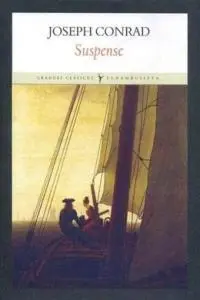
- Название:Suspense
- Автор:
- Издательство:epubBooks Classics
- Жанр:
- Год:2017
- ISBN:нет данных
- Рейтинг книги:3 / 5. Голосов: 1
-
Избранное:Добавить в избранное
- Отзывы:
-
Ваша оценка:
Suspense: краткое содержание, описание и аннотация
Предлагаем к чтению аннотацию, описание, краткое содержание или предисловие (зависит от того, что написал сам автор книги «Suspense»). Если вы не нашли необходимую информацию о книге — напишите в комментариях, мы постараемся отыскать её.
Suspense — читать онлайн бесплатно полную книгу (весь текст) целиком
Ниже представлен текст книги, разбитый по страницам. Система сохранения места последней прочитанной страницы, позволяет с удобством читать онлайн бесплатно книгу «Suspense», без необходимости каждый раз заново искать на чём Вы остановились. Поставьте закладку, и сможете в любой момент перейти на страницу, на которой закончили чтение.
Интервал:
Закладка:
“Ah,” said Lady William with a particular intonation, which made Cosmo wonder what he could have said to provoke scepticism. But Lady William was asking herself how it was that this young Englishman seemed to be familiar with the freakish girl who was an object of many surmises in Genoa, and whose company, it was understood, Count Helion de Montevesso had imposed upon his wife. Meantime Cosmo, with the eyes of all the women concentrated upon him with complete frankness, began to feel uncomfortable. Lady William noticed it, and out of pure kindness spoke to him again.
“If I understand rightly you have known Madame de Montevesso from childhood.”
“I can’t call myself really a childhood’s friend. I was so much away from home,” explained Cosmo. “But she lived for some years in my parents’ house, and everybody loved her there; my mother, my father, my sister, and—it seems to me, looking back now—that I too must have loved her at that time; though we very seldom exchanged more than a few words in the course of the day.”
He spoke with feeling, and glanced in the direction of the group near the console, where the head of Adèle appeared radiant under the sparkling crystals of the lustre. Lady William, bending sideways a little, leaned her cheek against her hand in a listening attitude. Cosmo felt that he was expected to go on speaking, but it seemed to him that he had nothing more to say. He fell back upon a general remark.
“I think boys are very stupid creatures. However, I wasn’t so stupid as not to feel that Adèle d’Armand was very intelligent and quite different from us all. Her very gentleness set her apart. Moreover, Henrietta and I were younger. To my sister and myself she seemed almost grown up. A couple of years makes a very great difference at that age. Soon after she went away we children heard that she was married. She seemed lost to us then. Presently she went back to France, and once there she was lost indeed. When one looked towards France in those days it seems to me there was nothing to be seen but Napoleon. And then her marriage too. A Countess de Montevesso didn’t mean anything to us. I came here expecting to see a stranger.”
Cosmo checked himself. It was impossible to say whether Lady William had heard him, or even whether she had been listening at all, but she asked:
“You never met Count Helion?”
“I haven’t the slightest idea of the man. He is not in this room, is he? What is he like?”
Lady William looked amused for a moment at the artless curiosity of the Countess de Montevesso’s young friend; but it was in an indifferent tone that she said:
“Count Helion is a man of immense wealth, which he amassed in India somewhere. He is much older than his wife. More than twice her age.” Cosmo showed his surprise and Lady William continued smoothly: “Of course, all the world knows that Adèle has been a model wife.”
Cosmo noted the faintest possible shade of emphasis on those last words and thought to himself: “That means she is not happy, and that the world knows it.” But several men having approached the circle, the conversation became general. He vacated his seat by the side of Lady William, and got introduced by Adèle to several people, amongst whom was a delicate young woman, splendidly dressed, and of a slightly Jewish type, who, though she was the wife of General Count Bubna, Commander–in–Chief of the Austrian troops and the representative of Austria at the Court of Turin, behaved with a strange timidity and appeared almost too shy to speak. A simple Madame Ferrati, or so at least Cosmo heard her name, a lady with white tousled hair, had an aggressive manner. Cosmo remarked, in the course of the evening, that she seemed rather to be persecuting Lady William, who, however, remained amiably abstracted, and did not seem to mind anything. The marquis, getting away from the console, had seated himself near the little Madame Bubna. This, Cosmo thought, was an unavoidable sort of thing for him to do. A young man with a grave manner and something malicious in his eye, apparently a First Secretary of the Embassy, informed Cosmo shortly after they had been made known to each other that “the wife of the general would not naturally be received in Vienna society,” and that this was the secret of Bubna sticking to his Italian command so long, even now when really all the excitement was over. Of course, he was very much in love with his wife. He used to give her balls twice a week at the expense of the Turin Municipality. Old Bubna understood the art of pillaging to perfection, but apart from that he was a parfait galant homme and an able soldier. Bonaparte had a very great liking for him. Bubna was the only friend Bonaparte had in this room. He meant sympathy as man for man. Years ago, when Bubna was in Paris, he got on very well with the emperor. Bonaparte knew how to flatter a man. It was worth while to sit up half the night to hear Bubna talking about Bonaparte. “I am posting you up like this,” concluded the secretary, “because I see you are in the intimacy of the marquis and of Madame de Montevesso here.”
He went away then to talk to somebody else, and presently Madame de Montevesso, passing close to Cosmo, whispered to him, “Stay to the last,” and went on without waiting for his answer. Cosmo amongst all the groups engaged in animated conversation felt rather lonely, totally estranged from the ideas those people were expressing to each other. He could not possibly be in sympathy with the fears and the hopes, strictly personal, and with the Royalist–legitimist enthusiasms of these advocates of an order of things that had been buried for a quarter of a century, and now was paraded like a rouged and powdered corpse putting on a swagger of life and revenge. Then he reflected that in this room, at any rate, it was probably nothing but scandalous gossip and trivial talk of futile intrigues. There was no need for him to be indignant. He was even amused at himself, and looking about him in a kindlier frame of mind he perceived that the person nearest to him was that strange girl with the round eyes. She had kept perfectly still on her uncomfortable stool like a captured savage. Her green flounced skirt was spread on each side of the seat. The bodice of her dress, which was black, was cut low, her bare arms were youthfully red and immature. Her hair was done up smoothly and pulled up from her forehead in the manner of the portraits of the fifteenth century.
“Why do they dress her in this bizarre manner?” thought Cosmo. It couldn’t be Adèle’s conception. Perhaps of the count himself. Yet that did not seem likely. Perhaps it was her own atrocious taste. But if so it ought to have been repressed. He reflected that there could be nothing improper in him talking to the niece of the house. He would try his conversational Italian. With the feeling of venturing on a doubtful experiment, he approached her from the back, sat down at her elbow, and waited. She could not possibly remain unaware of him being there.
At last she turned her head for a point–blank stare, and once she had her eyes on him she never attempted to take them away. Cosmo uttered carefully a complimentary phrase about her dress, which was received in perfect silence. Her carmine lips remained as still as her round black eyes for quite a long time. Suddenly in a low tone, with an accent which surprised Cosmo, but which he supposed to be Piedmontese, and with a sort of spiteful triumph, she said:
“I knew very well it would suit me. You think it does?”
Her whole personality had such an aggressive mien that Cosmo, startled and amused, hastened to say, “Undoubtedly”—lest she should fly at his eyes.
She showed him her teeth in a grin of savage complacency, and the subject seemed exhausted. Cosmo set himself the task to daunt her by a steady gaze. In less than two seconds he regretted his venture. He felt certain that she would not be the one to look away first. There was not the slightest doubt about that. In order to cover his retreat he let his eyes wander vaguely about the room, smiled agreeably and said:
Читать дальшеИнтервал:
Закладка:
Похожие книги на «Suspense»
Представляем Вашему вниманию похожие книги на «Suspense» списком для выбора. Мы отобрали схожую по названию и смыслу литературу в надежде предоставить читателям больше вариантов отыскать новые, интересные, ещё непрочитанные произведения.




Обсуждение, отзывы о книге «Suspense» и просто собственные мнения читателей. Оставьте ваши комментарии, напишите, что Вы думаете о произведении, его смысле или главных героях. Укажите что конкретно понравилось, а что нет, и почему Вы так считаете.