Джозеф Конрад - Suspense
Здесь есть возможность читать онлайн «Джозеф Конрад - Suspense» весь текст электронной книги совершенно бесплатно (целиком полную версию без сокращений). В некоторых случаях можно слушать аудио, скачать через торрент в формате fb2 и присутствует краткое содержание. Год выпуска: 2017, Издательство: epubBooks Classics, Жанр: Историческая проза, на английском языке. Описание произведения, (предисловие) а так же отзывы посетителей доступны на портале библиотеки ЛибКат.
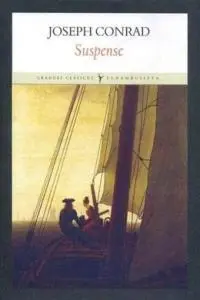
- Название:Suspense
- Автор:
- Издательство:epubBooks Classics
- Жанр:
- Год:2017
- ISBN:нет данных
- Рейтинг книги:3 / 5. Голосов: 1
-
Избранное:Добавить в избранное
- Отзывы:
-
Ваша оценка:
Suspense: краткое содержание, описание и аннотация
Предлагаем к чтению аннотацию, описание, краткое содержание или предисловие (зависит от того, что написал сам автор книги «Suspense»). Если вы не нашли необходимую информацию о книге — напишите в комментариях, мы постараемся отыскать её.
Suspense — читать онлайн бесплатно полную книгу (весь текст) целиком
Ниже представлен текст книги, разбитый по страницам. Система сохранения места последней прочитанной страницы, позволяет с удобством читать онлайн бесплатно книгу «Suspense», без необходимости каждый раз заново искать на чём Вы остановились. Поставьте закладку, и сможете в любой момент перейти на страницу, на которой закончили чтение.
Интервал:
Закладка:
“Your uncle is not here. Shall I have the pleasure of seeing him this evening?”
“No,” she said. “You won’t see him this evening. But he knows you have been here this morning.”
This was, strictly speaking, news to Cosmo, but he said at once and with great indifference:
“Why shouldn’t he? Probably Madame de Montevesso has told him. I used to know your aunt when she was younger than you are, signorina.”
“How do you know how old I am?”
Cosmo asked himself if she would ever wink those black eyes of hers.
“I know that you are not a hundred years old.”
This struck her as humorous, because there was a sound as of a faint giggle, which generally speaking is a silly kind of sound, but in her case had a disturbing quality. It was followed by the hoarse declaration:
“Aunt didn’t. I told uncle. I looked a lot at you in the morning. Why didn’t you look at me?”
“I was afraid of being indiscreet,” said Cosmo readily, concealing his astonishment.
“What silliness,” she commented scornfully. “And this evening too! I was looking at you all the time, and you did nothing but look at all those witches here, one after another.”
“I find all the ladies in the room perfectly charming,” said Cosmo.
“You lie. I suppose you do nothing else from morning till night.”
“I am sorry you have such a bad opinion of me, but it being what it is, hadn’t I better go away?”
“Directly I set eyes on you I knew you were one of that sort.”
“And did you impart your opinion of me to your uncle?” asked Cosmo. He could be no more offended with that girl than if she had been an unmannerly animal. Her peculiar stare remained unchanged, but her general expression softened for a moment.
“No. But I took care to tell him that you were a very handsome gentleman…. You are a very handsome gentleman.”
What surprised Cosmo was not the downright statement, but the thought that flashed through his mind that it was as dreadful as being told that one was good to eat. For a time he stared without any thought of unwinking competition. He was not amused. Distinctly not. He asked:
“Where were you born?”
“How can I tell? In the mountains, I suppose. Somewhere where you will never go. How can it possibly concern you?”
Cosmo offered an apology for his indiscretion, and she received it with a sort of uncomprehending scorn. She said after a pause: “None of those witches, young or old, ever speaks to me. And even you didn’t want to speak to me. You only spoke to me … Oh, no! I know why you spoke to me.”
“Why did I speak to you?” asked Cosmo thoughtfully. “Won’t you tell me?”
Upon the firm roundness of that high–coloured face came a subtle change, which suggested something in the nature of cunning, and the rough somewhat veiled voice came from between the red lips which had no more charm or life than the painted lips carved on a piece of wood.
“If I were to tell you, you would be as wise as myself.”
“Where would be the harm of me being as wise as yourself?” said Cosmo, trying to be playful, but somehow missing the tone of playfulness so completely that he was struck by his failure himself.
“If you were as wise as myself, you would never come to this house again, and I don’t want you to stay away,” was the answer delivered in a hostile tone.
Cosmo said: “You don’t! Well, at any rate it can’t be because of kindness, so I won’t thank you for it.” He said this with extreme amiability. Becoming aware that people were beginning to leave, he observed, out of the corner of his eye, that nobody went away without glancing in their direction. Then the departure of Lady William caused a general stir, and gave Cosmo the occasion to get up and move away. Lady William gave him a gracious nod, and the marquis, coming up to him, introduced him at the last moment to General Count Bubna, just as that distinguished person was making ready to take his wife away. Everybody was standing up, and for the first time Cosmo felt himself completely unobserved. Obeying a discreet sign of the Countess de Montevesso he moved unaffectedly in the direction of a closed door, the white and gold door he remembered well from his morning visit. When he had got near to it and within reach of the handle, he turned about. He had the view of the guests’ backs as they moved slowly out. Adèle looked over her shoulder for a moment with an affirmative nod. He understood it, hesitated no longer, opened the door and slipped through without, as far as he could judge, being seen by anybody.
It was as he had thought. He found himself in Madame de Montevesso’s boudoir, in which he had been received that morning.
IV
He shut the door behind him gently and remained between it and the screen. He had expected to be followed at once by Adèle. What could be detaining her? But he remembered the remarkable proportions of that suite of reception rooms. He had seen some apartments in Paris, but nothing quite so long as that. The old marquis would, no doubt, conduct the little Madame Bubna to the very door of the ante–room. The ambassador of the most Christian king owed that attention to the representative of his apostolic majesty and commander–in–chief of the Austrian troops. This was the exact form which his thought took. The Christian king, the apostolic majesty—all those submerged heads were bobbing up out of the subsiding flood.
He pictured them to himself in their mental simplicity, and with their grand air; the marquis magnificent and ageing, and the dutiful daughter by his side with her radiant head and her divine form. It was impossible to believe that these two had been also submerged at one time.
All those people were mere playthings, reflected Cosmo without a pang. But who or what was playing with them? he thought further, boldly, and remained for a moment as if amused by the marvellousness of it, in the manner of people watching the changes on the stage. But what could have become of them?
She might next moment be opening the door. Could she have made him stay behind because she wanted to speak with him alone? Why, yes, obviously. Cosmo did not ask himself what she wanted to talk to him about. It was not wonder that he felt, it was a subtle emotion resembling impatience, for the arrival of a promised felicity of an indefinite kind. All this was by no means poignant. It was merely delightfully disturbing.
“I shall have a tête–à–tête , that’s clear,” he thought, as he advanced into the room. The air all round him was delightfully warm. Whatever she would have to say would be wonderful, because of her voice. He would look into her face. She did not intimidate him, and it was impossible to have too much of that. After all, he thought, immensely amused, it was only Adèle, Ad …
His mental monologue was cut short by the shock of perceiving seated on the painted sofa a man, who was looking at him in perfect silence and immobility. The fact was that Count Helion, having come into the boudoir sooner than his wife had expected him to do, had directed his eyes to the screen ever since he had heard the opening and the shutting of the door. One of his hands was resting on his thigh, the other hung down, holding negligently a number of some gazette which was partly resting on the floor. Though not very big, that piece of paper attracted Cosmo’s eyes; and it was in this way that he became aware of the brown fingers covered with rings, of the gaunt legs encased in silk stockings, and of the crossed feet in dress–shoes with gold buckles, almost before he took in the impression of the broad but lean face which seemed to have been stained with walnut juice long enough for the stain to have worn down thin, letting the native pallor come through. The same tint extended to the bald top of the head. But what was really extraordinary was the hair: two patches of black behind each temple, obviously dyed. The man, as to whose identity Cosmo could have no doubt, got up, displaying the full length of his bony frame, in a tense and soldierly stiffness associated with cross–belts and a cowhide knapsack on the back. “A grenadier,” thought Cosmo, startled by this unexpected meeting, which also caused him profound annoyance as though he had been induced to walk into a trap. What he could not understand was why the man should make that grimace at him. It convulsed his whole physiognomy, involving his lips, his cheeks and his very eyes in a sort of spasm. The most awful thing was that it stayed there…“Why, it’s a smile,” thought Cosmo with sudden relief. It was so sudden that he broke into a smile without any particular volition of his own. Thereupon the face of Count Helion recovered its normal aspect, and Cosmo heard his voice for the first time. It proceeded from the depths of his chest. It was resonant and blurred and portentous, with an effect of stiffness somehow in accord with the man’s bearing. It informed Cosmo that Count Helion had been waiting in the countess’s boudoir on purpose to make his acquaintance, while in the man’s eyes there was a watchfulness as though he had been uttering a momentous disclosure and was anxious as to its effect. A perfectly horizontal, jet–black moustache underlining the nose of Count Helion, which was broad at the base and thin at the end, suggested comic possibilities in that head which had too much individuality to be looked upon by Cosmo simply as the head of Adèle’s husband; and Cosmo hardly looked at it in that light. His hold on that fact was slippery. He preserved his equanimity perfectly, and said that he himself had wondered whether he would have the pleasure of making the count’s acquaintance that evening. Both men sat down.
Читать дальшеИнтервал:
Закладка:
Похожие книги на «Suspense»
Представляем Вашему вниманию похожие книги на «Suspense» списком для выбора. Мы отобрали схожую по названию и смыслу литературу в надежде предоставить читателям больше вариантов отыскать новые, интересные, ещё непрочитанные произведения.


Обсуждение, отзывы о книге «Suspense» и просто собственные мнения читателей. Оставьте ваши комментарии, напишите, что Вы думаете о произведении, его смысле или главных героях. Укажите что конкретно понравилось, а что нет, и почему Вы так считаете.