Michael Shaara - The Killer Angels
Здесь есть возможность читать онлайн «Michael Shaara - The Killer Angels» весь текст электронной книги совершенно бесплатно (целиком полную версию без сокращений). В некоторых случаях можно слушать аудио, скачать через торрент в формате fb2 и присутствует краткое содержание. Жанр: Историческая проза, на английском языке. Описание произведения, (предисловие) а так же отзывы посетителей доступны на портале библиотеки ЛибКат.
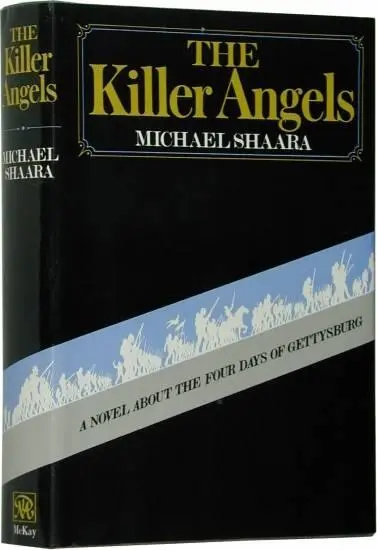
- Название:The Killer Angels
- Автор:
- Жанр:
- Год:неизвестен
- ISBN:нет данных
- Рейтинг книги:5 / 5. Голосов: 1
-
Избранное:Добавить в избранное
- Отзывы:
-
Ваша оценка:
The Killer Angels: краткое содержание, описание и аннотация
Предлагаем к чтению аннотацию, описание, краткое содержание или предисловие (зависит от того, что написал сам автор книги «The Killer Angels»). Если вы не нашли необходимую информацию о книге — напишите в комментариях, мы постараемся отыскать её.
Reading about the past is rarely so much fun as on these pages.
The Killer Angels — читать онлайн бесплатно полную книгу (весь текст) целиком
Ниже представлен текст книги, разбитый по страницам. Система сохранения места последней прочитанной страницы, позволяет с удобством читать онлайн бесплатно книгу «The Killer Angels», без необходимости каждый раз заново искать на чём Вы остановились. Поставьте закладку, и сможете в любой момент перейти на страницу, на которой закончили чтение.
Интервал:
Закладка:
”Friday, July third.”
”Yes, sir, I believe that is correct.”
”And tomorrow will be the Fourth of July.”
”Sir?”
”Independence Day.”
Taylor grunted, surprised. “I’d quite forgotten.” Curious coincidence. Lee thought. Perhaps an omen?
Taylor said, “The good Lord has a sense of humor.”
”Wouldn’t it be ironic-“ Lee could not resist the thought-“if we should gain our independence from them, on their own Independence Day?” He shook his head, wondering. He believed in a Purpose as surely as he believed that the stars above him were really there. He thought himself too dull to read God’s plan, thought he was not meant to know God’s plan, a servant only. And yet sometimes there were glimpses. To Taylor he said, “I’ll go sit with Traveler awhile and think. You will keep these people away.”
”Yes, sir.”
”I am sorry to keep you so late.”
”My pleasure, sir.”
”We should have a larger staff.”
”Sir, I shall be offended.”
”Well, I want to think for a while, alone.”
”Sir” Lee moved off into the dark pasture. Now in motion he was aware of stiffness, of weakness, of a suspended fear.
He moved as if his body was Jailed with cold cement that was slowly hardening, and yet there was something inside bright and hot and fearful, as if something somewhere could break at any moment, as if a rock in his chest was teetering and could come crashing down. He found the dark horse in the night and stood caressing the warm skin, thick bristly mane, feeding sugar, talking.
Two alternatives. We move away to better ground, as Longstreet suggests. Or we stay To the end.
He sat on a rail fence. And so we broke the vow is Longstreet’s bitter phrase. It stuck in the mind like one of those spiny sticker burrs they had in the South, in Florida, small hooked seeds that lurk in the grass. Honest and stubborn man, Longstreet. We broke the vow. No point in thinking.
He remembered the night in Arlington when the news came: secession. He remembered a paneled wall and firelight. When we heard the news we went into mourning.
But outside there was cheering in the streets, bonfires of joy.
They had their war at last. But where was there ever any choice? The sight of fire against wood paneling, a bonfire seen far off at night through a window, soft and sparky glows always to remind him of that embedded night when he found that he had no choice. The war had come. He was a member of the army that would march against his home, his sons. He was not only to serve in it but actually to lead it, to make the plans and issue the orders to kill and bum and ruin. He could not do that. Each man would make his own decision, but Lee could not raise his hand against his own. And so what then? To stand by and watch, observer at the death? To do nothing? To wait until the war was over?
And if so, from what vantage point and what distance? How far do you stand from the attack on your home, whatever the cause, so that you can bear it? It had nothing to do with causes; it was no longer a matter of vows.
When Virginia left the Union she bore his home away as surely as if she were a ship setting out to sea, and what was left behind on the shore was not his any more. So it was no cause and no country he fought for, no ideal and no justice.
He fought for his people, for the children and the kin, and not even the land, because not even the land was worth the war, but the people were, wrong as they were, insane even as many of them were, they were his own, he belonged with his own. And so he took up arms willfully, knowingly, in perhaps the wrong cause against his own sacred oath and stood now upon alien ground he had once sworn to defend, sworn in honor, and he had arrived there really in the hands of God, without any choice at all; there had never been an alternative except to run away, and he could not do that. But Longstreet was right, of course: he had broken the vow. And he would pay. He knew that and accepted it. He had already paid. He closed his eyes. Dear God, let it end soon. Now he must focus his mind on the war.
Alternatives? Any real choice here?
Move on, to higher ground in another place. Or stay and fight.
Well, if we stay, we must fight. No waiting. We will never be stronger. They will be gaining men from all directions. Most of the men will be militia and not the match of our boys, but they will come in thousands, bringing fresh guns. Supplies will come to them in rivers, but nothing will come to us. Richmond has nothing to send.
So if we stay, we fight soon. No more chance of surprise.
No more need for speed or mobility. But no more delay We cannot sit and wait. Bad effect on the troops.
And if we pull out?
He saw that in his mind’s eye: his boys backing off, pulling out, looking up in wonder and rage at the Yankee troops still in possession of the high ground. If we fall back, we will have fought here for two days and we will leave knowing that we did not drive them off, and if it was no defeat, surely it was no victory. And we have never yet left the enemy in command of the field.
I never saw soldiers fight well after a retreat. We have always been outgunned. Our strength is in our pride. But they have good ground. And they have fought well. On home ground.
He saw a man coming toward him, easy gait, rolling and serene, instantly recognizable: Jeb Stuart. Lee stood up.
This must be done. Stuart came up, saluted pleasantly, took off the plumed hat and bowed.
”You wish to see me, sir?”
”I asked to see you alone,” Lee said quietly. “I wished to speak with you alone, away from other officers. That has not been possible until now I am sorry to keep you up so late.”
”Sir, I was not asleep,” Stuart drawled, smiled, gave the sunny impression that sleep held no importance, none at all.
Lee thought: here’s one with faith in himself. Must protect that. And yet, there’s a lesson to be learned. He said, “Are you aware. General, that there are officers on my staff who have requested your court-martial?” Stuart froze. His mouth hung open. He shook his head once quickly, then cocked it to one side.
Lee said, “I have not concurred. But it is the opinion of some excellent officers that you have let us all down.”
”General Lee,” Stuart was struggling. Lee thought: now there will be anger. “Sir,” Stuart said tightly, “if you will tell me who these gentlemen…”
”There will be none of that.” Lee’s voice was cold and sharp. He spoke as you speak to a child, a small child, from a great height. “There is no time for that.”
”I only ask that I be allowed-“ Lee cut him off. “There is no time,” Lee said. He was not a man to speak this way to a brother officer, a fellow Virginian; he shocked Stuart to silence with the iciness of his voice. Stuart stood like a beggar, his hat in his hands.
”General Stuart,” Lee said slowly, “you were the eyes of this army.” He paused.
Stuart said softly, a pathetic voice, “General Lee, if you please…” But Lee went on.
”You were my eyes. Your mission was to screen this army from the enemy cavalry and to report any movement by the enemy’s main body. That mission was not fulfilled.” Stuart stood motionless.
Lee said, “You left this army without word of your movements, or of the movements of the enemy, for several days. We were forced into battle without adequate knowledge of the enemy’s position, or strength, without knowledge of the ground. It is only by God’s grace that we have escaped disaster.”
”General Lee.” Stuart was in pain, and the old man felt pity, but this was necessary; it had to be done as a bad tooth has to be pulled, and there was no turning away. Yet even now he felt the pity rise, and he wanted to say, it’s all right, boy, it’s all right; this is only a lesson, just one painful quick moment of learning, over in a moment, hold on, it’ll be all right. His voice began to soften. He could not help it.
Читать дальшеИнтервал:
Закладка:
Похожие книги на «The Killer Angels»
Представляем Вашему вниманию похожие книги на «The Killer Angels» списком для выбора. Мы отобрали схожую по названию и смыслу литературу в надежде предоставить читателям больше вариантов отыскать новые, интересные, ещё непрочитанные произведения.




Обсуждение, отзывы о книге «The Killer Angels» и просто собственные мнения читателей. Оставьте ваши комментарии, напишите, что Вы думаете о произведении, его смысле или главных героях. Укажите что конкретно понравилось, а что нет, и почему Вы так считаете.