Michael Shaara - The Killer Angels
Здесь есть возможность читать онлайн «Michael Shaara - The Killer Angels» весь текст электронной книги совершенно бесплатно (целиком полную версию без сокращений). В некоторых случаях можно слушать аудио, скачать через торрент в формате fb2 и присутствует краткое содержание. Жанр: Историческая проза, на английском языке. Описание произведения, (предисловие) а так же отзывы посетителей доступны на портале библиотеки ЛибКат.
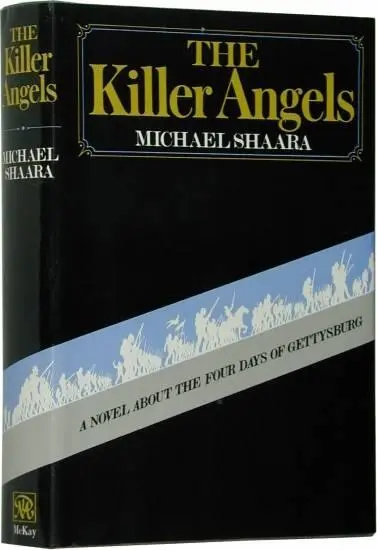
- Название:The Killer Angels
- Автор:
- Жанр:
- Год:неизвестен
- ISBN:нет данных
- Рейтинг книги:5 / 5. Голосов: 1
-
Избранное:Добавить в избранное
- Отзывы:
-
Ваша оценка:
The Killer Angels: краткое содержание, описание и аннотация
Предлагаем к чтению аннотацию, описание, краткое содержание или предисловие (зависит от того, что написал сам автор книги «The Killer Angels»). Если вы не нашли необходимую информацию о книге — напишите в комментариях, мы постараемся отыскать её.
Reading about the past is rarely so much fun as on these pages.
The Killer Angels — читать онлайн бесплатно полную книгу (весь текст) целиком
Ниже представлен текст книги, разбитый по страницам. Система сохранения места последней прочитанной страницы, позволяет с удобством читать онлайн бесплатно книгу «The Killer Angels», без необходимости каждый раз заново искать на чём Вы остановились. Поставьте закладку, и сможете в любой момент перейти на страницу, на которой закончили чтение.
Интервал:
Закладка:
He was becoming tired. Think on all that later, the theology of it.
He limped along the line. Signs of exhaustion. Men down, everywhere. He thought: we cannot hold.
Looked up toward the crest. Fire still hot there, still hot everywhere. Down into the dark. They are damned good men, those Rebs. Rebs, I salute you. I don’t think we can hold you.
He gathered with Spear and Kilrain back behind the line.
He saw another long gap, sent Ruel Thomas to this one.
Spear made a count.
”We’ve lost a third of the men. Colonel. Over a hundred down. The left is too thin.”
”How’s the ammunition?”
”I’m checking.”
A new face, dirt-stained, bloody: Homan Melcher, Lieutenant, Company F, a gaunt boy with buck teeth.
”Colonel? Request permission to go pick up some of our wounded. We left a few boys out there.”
”Wait,” Chamberlain said.
Spear came back, shaking his head. “We’re out.” Alarm stained his face, a grayness in his cheeks.
”Some of the boys have nothing at all.”
”Nothing,” Chamberlain said.
Officers were coming from the right. Down to a round or two per man. And now there was a silence around him. No man spoke. They stood and looked at him, and then looked down into the dark and then looked back at Chamberlain.
One man said, “Sir, I guess we ought to pull out.”
Chamberlain said, “Can’t do that.”
Spear: “We won’t hold ‘ em again. Colonel, you know we can’t hold ‘em again.”
Chamberlain: “If we don’t hold, they go right on by and over the hill and the whole flank caves in.”
He looked from face to face. The enormity of it, the weight of the line, was a mass too great to express. But he could see it as clearly as in a broad wide vision, a Biblical dream: If the line broke here, then the hill was gone, all these boys from Pennsylvania, New York, hit from behind above. Once the hill went, the flank of the army went. Good God! He could see troops running; he could see the blue flood, the bloody tide.
Kilrain: “Colonel, they’re coming.”
Chamberlain marveled. But we’re not so bad ourselves.
One recourse: Can’t go back. Can’t stay where we are.
Results: inevitable.
The idea formed.
”Let’s fix bayonets,” Chamberlain said.
For a moment no one moved.
”We’ll have the advantage of moving downhill,” he said.
Spear understood. His eyes saw; he nodded automatically. The men coming up the hill stopped to volley; weak fire came in return. Chamberlain said, “They’ve got to be tired, those Rebs. They’ve got to be close to the end. Fix bayonets. Wait. Ellis, you take the left wing. I want a right wheel forward of the whole Regiment.”
Lieutenant Melcher said, perplexed, “Sir, excuse me but what’s a ‘right wheel forward’?”
Ellis Spear said, “He means ‘charge,’ Lieutenant, ‘charge.’ “
Chamberlain nodded. “Not quite. We charge swinging down to the right. We straighten out our line. Clarke hangs onto the Eight-third, and we swing like a door, sweeping them down the hill. Understand? Everybody understand? Ellis, you take the wing, and when I yell you go to it, the whole Regiment goes forward, swinging to the right.”
”Well,” Ellis Spear said. He shook his head. “Well.”
”Let’s go.” Chamberlain raised his saber, bawled at the top of his voice, “Fix bayonets!”
He was thinking: We don’t have two hundred men left.
Not two hundred. More than that coming at us. He saw Melcher bounding away toward his company, yelling, waving. Bayonets were coming out, clinking, clattering. He heard men beginning to shout. Marine men, strange shouts, hoarse, wordless, animal. He limped to the front, toward the great boulder where Tozier stood with the colors, Kilrain at his side. The Rebs were in plain view, moving, firing.
Chamberlain saw clearly a tall man aiming a rifle at him. At me. Saw the smoke, the flash, but did not hear the bullet go by. Missed. Ha! He stepped out into the open, balanced on the gray rock. Tozier had lifted the colors into the clear. The Rebs were thirty yards off. Chamberlain raised his saber, let loose the shout that was the greatest sound he could make, boiling the yell up from his chest: Fix bayonets! Charge!
Fix bayonets! Charge! Fix bayonets! Charge! He leaped down from the boulder, still screaming, his voice beginning to crack and give, and all around him his men were roaring animal screams, and he saw the whole Regiment rising and pouring over the wall and beginning to bound down through the dark bushes, over the dead and dying and wounded, hats coming off, hair flying, mouths making sounds, one man firing as he ran, the last bullet, last round. Chamberlain saw gray men below stop, freeze, crouch, then quickly turn. The move was so quick he could not believe it. Men were turning and running. Some were stopping to fire. There was the yellow flash and then they turned. Chamberlain saw a man drop a rifle and run. Another. A bullet plucked at Chamberlain’s coat, a hard pluck so that he thought he had caught a mom but looked down and saw the huge gash. But he was not hit. He saw an officer: handsome full-bearded man in gray, sword and revolver. Chamberlain ran toward him, stumbled, cursed the bad foot, looked up and aimed and fired and missed, then held aloft the saber. The officer turned, saw him coming, raised a pistol, and Chamberlain ran toward it downhill, unable to stop, stumbling downhill seeing the black hole of the pistol turning toward him, not anything but the small hole yards away, feet away, the officer’s face a blur behind it and no thought, a moment of gray suspension rushing silently, soundlessly toward the black hole… and the gun did not fire; the hammer clicked down on an empty shell, and Chamberlain was at the man’s throat with the saber and the man was handing him his sword, all in one motion, and Chamberlain stopped.
”The pistol too,” he said.
The officer handed him the gun: a cavalry revolver, Colt.
”Your prisoner, sir.” The face of the officer was very white, like old paper. Chamberlain nodded.
He looked up to see an open space. The Rebs had begun to fall back; now they were running. He had never seen them run; he stared, began limping forward to see. Great cries, incredible sounds, firing and yelling. The Regiment was driving a line, swinging to the fight, into the dark valley. Men were surrendering. He saw masses of gray coats, a hundred or more, moving back up the slope to his front, in good order, the only ones not running, and thought If they form again we’re in trouble, desperate trouble, and he began moving that way, ignoring the officer he had just captured. At that moment a new wave of firing broke out on the other side of the gray mass. He saw a line of white smoke erupt, the gray troops waver and move back this way, stop, rifles begin to fall, men begin to run to the right, trying to get away. Another line of fire-Morrill. B Company. Chamberlain moved that way. A soldier grabbed his Reb officer, grinning, by the arm. Chamberlain passed a man sitting on a rock, holding his stomach. He had been bayoneted. Blood coming from his mouth. Stepped on a dead body, wedged between rocks. Came upon Ellis Spear, grinning crazily, foolishly, face stretched and glowing with a wondrous light.
”By God, Colonel, by God, by God,” Spear said. He pointed. Men were running off down the valley. The Regiment was moving across the front of the 83rd Pennsylvania. He looked up the hill and saw them waving and a cheering. Chamberlain said, aloud, “I’ll be damned.”
The Regiment had not stopped, was chasing the Rebs down the long valley between the hills. Rebs had stopped everywhere, surrendering. Chamberlain said to Spear, “Go on up and stop the boys. They’ve gone far enough.”
Читать дальшеИнтервал:
Закладка:
Похожие книги на «The Killer Angels»
Представляем Вашему вниманию похожие книги на «The Killer Angels» списком для выбора. Мы отобрали схожую по названию и смыслу литературу в надежде предоставить читателям больше вариантов отыскать новые, интересные, ещё непрочитанные произведения.








Обсуждение, отзывы о книге «The Killer Angels» и просто собственные мнения читателей. Оставьте ваши комментарии, напишите, что Вы думаете о произведении, его смысле или главных героях. Укажите что конкретно понравилось, а что нет, и почему Вы так считаете.