Ken Follett - World Without End
Здесь есть возможность читать онлайн «Ken Follett - World Without End» весь текст электронной книги совершенно бесплатно (целиком полную версию без сокращений). В некоторых случаях можно слушать аудио, скачать через торрент в формате fb2 и присутствует краткое содержание. Жанр: Историческая проза, на английском языке. Описание произведения, (предисловие) а так же отзывы посетителей доступны на портале библиотеки ЛибКат.
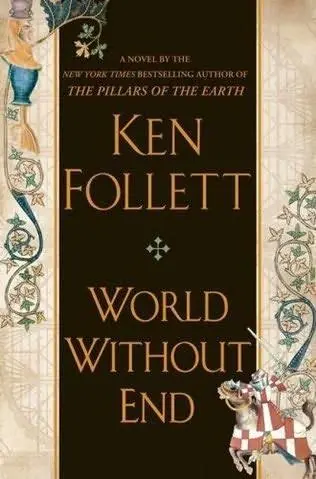
- Название:World Without End
- Автор:
- Жанр:
- Год:неизвестен
- ISBN:нет данных
- Рейтинг книги:5 / 5. Голосов: 1
-
Избранное:Добавить в избранное
- Отзывы:
-
Ваша оценка:
World Without End: краткое содержание, описание и аннотация
Предлагаем к чтению аннотацию, описание, краткое содержание или предисловие (зависит от того, что написал сам автор книги «World Without End»). Если вы не нашли необходимую информацию о книге — напишите в комментариях, мы постараемся отыскать её.
Ken Follett has 90 million readers worldwide. The Pillars of the Earth is his bestselling book of all time. Now, eighteen years after the publication of The Pillars of the Earth, Ken Follett has written the most-anticipated sequel of the year, World Without End.
In 1989 Ken Follett astonished the literary world with The Pillars of the Earth, a sweeping epic novel set in twelfth-century England centered on the building of a cathedral and many of the hundreds of lives it affected. Critics were overwhelmed-"it will hold you, fascinate you, surround you" (Chicago Tribune)-and readers everywhere hoped for a sequel.
World Without End takes place in the same town of Kingsbridge, two centuries after the townspeople finished building the exquisite Gothic cathedral that was at the heart of The Pillars of the Earth. The cathedral and the priory are again at the center of a web of love and hate, greed and pride, ambition and revenge, but this sequel stands on its own. This time the men and women of an extraordinary cast of characters find themselves at a crossroad of new ideas-about medicine, commerce, architecture, and justice. In a world where proponents of the old ways fiercely battle those with progressive minds, the intrigue and tension quickly reach a boiling point against the devastating backdrop of the greatest natural disaster ever to strike the human race-the Black Death.
Three years in the writing, and nearly eighteen years since its predecessor, World Without End breathes new life into the epic historical novel and once again shows that Ken Follett is a masterful author writing at the top of his craft.
World Without End — читать онлайн бесплатно полную книгу (весь текст) целиком
Ниже представлен текст книги, разбитый по страницам. Система сохранения места последней прочитанной страницы, позволяет с удобством читать онлайн бесплатно книгу «World Without End», без необходимости каждый раз заново искать на чём Вы остановились. Поставьте закладку, и сможете в любой момент перейти на страницу, на которой закончили чтение.
Интервал:
Закладка:
When a serf died, his land might be inherited by his widow, his sons or a married daughter. In any event, the handover had to be licensed by the lord, and a stiff tax, called a heriot, was due. In normal circumstances Samuel’s land would automatically have been inherited by his two sons, and there would have been no need for a court hearing. They would have clubbed together to pay the heriot, then either divided up the land or farmed it together, and made some arrangement for their mother. But one of Samuel’s sons had died with him, which complicated matters.
Every adult in the village attended the court, in general. Gwenda had a particular interest today. Wulfric’s future would be decided, and the fact that he planned to spend that future with another woman did not dampen Gwenda’s concern. Perhaps she should have wished him a miserable life with Annet, she sometimes thought; but she could not. She wanted him to be happy.
When the service was over, a large wooden chair and two benches were brought in from the manor house. Nate took the chair and the jurymen sat on the benches. Everyone else stood.
Wulfric spoke simply. “My father held ninety acres of the lord of Wigleigh,” he said. “Fifty acres were held by his father before him, and forty by his uncle who died ten years ago. As my mother is dead, and so is my brother, and I have no sisters, I am the sole heir.”
“How old are you?” said Nate.
“Sixteen years.”
“You can’t even call yourself a man, yet.”
It seemed Nate was going to make things difficult. Gwenda knew why. He wanted a bribe. But Wulfric had no money.
“Years aren’t everything,” Wulfric said. “I’m taller and stronger than most grown men.”
Aaron Appletree, one of the jurors, said: “David Johns inherited from his father when he was eighteen.”
Nate said: “Eighteen isn’t sixteen. I don’t recall an instance where a sixteen-year-old was allowed to inherit.”
David Johns was not a juror, and he was standing next to Gwenda. “I didn’t have no ninety acres, neither,” he said, and there was a ripple of laughter. David had a half-virgate, like most of them.
Another juror spoke. “Ninety acres is too much for one man, let alone a boy. Why, it was farmed by three until now.” The speaker was Billy Howard, a man in his middle twenties who had wooed Annet unsuccessfully – which might be why he wanted to side with Nate in putting obstacles in Wulfric’s way. “I’ve got forty acres, and I have to hire labourers at harvest time.”
Several of the men nodded agreement. Gwenda began to feel pessimistic. It was not going Wulfric’s way.
“I can get help,” Wulfric said.
Nate said: “Have you got money to pay labourers?”
Wulfric looked a bit desperate, and Gwenda’s heart went out to him. “My father’s purse was lost when the bridge collapsed, and I spent what money I had on the funeral,” he said. “But I can offer my labourers a share of the harvest.”
Nate shook his head. “Everyone in the village is already working full time on their own lands, and those who have no land are already employed. And no one is likely to give up a job that pays cash for one that offers a share of an uncertain crop.”
“I will get the harvest in,” Wulfric said with passionate determination. “I can work day and night, if I have to. I’ll prove to you all that I can handle it.”
There was so much yearning on his handsome face that Gwenda wanted to jump up and shout her support for him. But the men were shaking their heads. Everyone knew that one man could not harvest ninety acres on his own.
Nate turned to Perkin. “He’s engaged to your daughter. Can’t you do something for him?”
Perkin looked thoughtful. “Perhaps you should transfer the land to me, for the time being. I could pay the heriot. Then, when he marries Annet, he could take over his land.”
“No!” Wulfric said immediately.
Gwenda knew why he was so against the idea. Perkin was nothing if not sly. He would spend every waking minute between now and the wedding trying to figure out a way of keeping Wulfric’s land for himself.
Nate said to Wulfric: “If you have no money, how will you pay the heriot?”
“I’ll have money when I get the harvest in.”
“If you get the harvest in. And then it may not be enough. Your father paid three pounds for his father’s lands and two pounds for his uncle’s.”
Gwenda gasped. Five pounds was a fortune. It seemed impossible that Wulfric could raise so much money. It would probably have taken all his family’s savings.
Nate went on: “Besides, the heriot is normally paid before the inheritor takes possession – not after the harvest.”
Aaron Appletree said: “In the circumstances, Nate, you might show leniency on that point.”
“Might I? A lord may show leniency, for he holds sway over his own possessions. But if a bailiff shows leniency, he’s giving away someone else’s gold.”
“But we will only be making a recommendation, in any case. Nothing will be final until approved by the new lord of Wigleigh, whoever he may be.”
That was true, strictly speaking, Gwenda thought; but in practice it was unlikely a new lord would overturn an inheritance from father to son.
Wulfric said: “Sir, my father’s heriot was not so much as five pounds.”
“We must check the rolls.” Nate’s response was so quick that Gwenda guessed he had been waiting for Wulfric to challenge the amount. Nate often engineered a pause of some kind in the middle of a hearing, she reflected. She presumed it was to give the parties an opportunity to offer him a bribe. Perhaps he thought Wulfric was concealing some money.
Two jurors brought from the vestry the chest containing the manorial rolls, the record of the manor court’s decisions, written on long strips of parchment rolled into cylinders. Nate could read and write – a bailiff had to be literate, in order to compile accounts for the lord. He searched through the box for the right one.
Gwenda felt that Wulfric was doing badly. His plain speaking and evident honesty were not enough. Nate wanted above all else to make sure he collected the lord’s heriot. Perkin was manoeuvring to get the land for himself. Billy Howard wanted to do Wulfric down out of sheer malice. And Wulfric had no money for a bribe.
He was also guileless. He believed that if he stated his case he would get justice. He had no sense of managing the situation.
Perhaps she could help him. A child of Joby’s could not grow up without learning something about guile.
Wulfric had not appealed to the villagers’ self-interest in his arguments. She would do so for him. She turned to David Johns, standing beside her. “I’m surprised you men aren’t more worried about this,” she said.
He gave her a shrewd look. “What are you getting at, lass?”
“Despite the sudden deaths, this is an inheritance from father to son. If you let Nate quibble about this one, he’ll question them all. He can always dream up some reason for arguing about a legacy. Aren’t you afraid he’ll interfere with your own sons’ rights?”
David looked worried. “You might have a point, there, girl,” he said, and he turned to talk to his neighbour on the other side.
Gwenda also felt it was a mistake for Wulfric to demand a final ruling today. Better to ask for a temporary judgement, which the jurymen would grant more readily. She went to speak to Wulfric. He was arguing with Perkin and Annet. When Gwenda appeared Perkin looked suspicious, and Annet put her nose in the air, but Wulfric was as courteous as ever. “Hello, my travelling companion,” he said. “I heard you left your father’s house.”
“He threatened to sell me.”
“A second time?”
Читать дальшеИнтервал:
Закладка:
Похожие книги на «World Without End»
Представляем Вашему вниманию похожие книги на «World Without End» списком для выбора. Мы отобрали схожую по названию и смыслу литературу в надежде предоставить читателям больше вариантов отыскать новые, интересные, ещё непрочитанные произведения.

Обсуждение, отзывы о книге «World Without End» и просто собственные мнения читателей. Оставьте ваши комментарии, напишите, что Вы думаете о произведении, его смысле или главных героях. Укажите что конкретно понравилось, а что нет, и почему Вы так считаете.