Ken Follett - World Without End
Здесь есть возможность читать онлайн «Ken Follett - World Without End» весь текст электронной книги совершенно бесплатно (целиком полную версию без сокращений). В некоторых случаях можно слушать аудио, скачать через торрент в формате fb2 и присутствует краткое содержание. Жанр: Историческая проза, на английском языке. Описание произведения, (предисловие) а так же отзывы посетителей доступны на портале библиотеки ЛибКат.
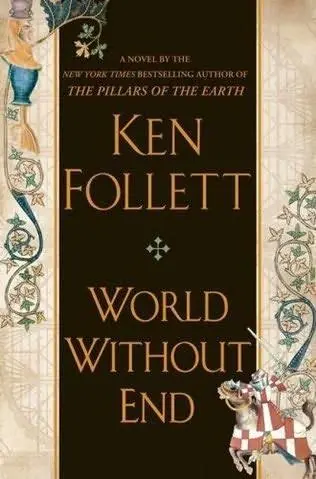
- Название:World Without End
- Автор:
- Жанр:
- Год:неизвестен
- ISBN:нет данных
- Рейтинг книги:5 / 5. Голосов: 1
-
Избранное:Добавить в избранное
- Отзывы:
-
Ваша оценка:
World Without End: краткое содержание, описание и аннотация
Предлагаем к чтению аннотацию, описание, краткое содержание или предисловие (зависит от того, что написал сам автор книги «World Without End»). Если вы не нашли необходимую информацию о книге — напишите в комментариях, мы постараемся отыскать её.
Ken Follett has 90 million readers worldwide. The Pillars of the Earth is his bestselling book of all time. Now, eighteen years after the publication of The Pillars of the Earth, Ken Follett has written the most-anticipated sequel of the year, World Without End.
In 1989 Ken Follett astonished the literary world with The Pillars of the Earth, a sweeping epic novel set in twelfth-century England centered on the building of a cathedral and many of the hundreds of lives it affected. Critics were overwhelmed-"it will hold you, fascinate you, surround you" (Chicago Tribune)-and readers everywhere hoped for a sequel.
World Without End takes place in the same town of Kingsbridge, two centuries after the townspeople finished building the exquisite Gothic cathedral that was at the heart of The Pillars of the Earth. The cathedral and the priory are again at the center of a web of love and hate, greed and pride, ambition and revenge, but this sequel stands on its own. This time the men and women of an extraordinary cast of characters find themselves at a crossroad of new ideas-about medicine, commerce, architecture, and justice. In a world where proponents of the old ways fiercely battle those with progressive minds, the intrigue and tension quickly reach a boiling point against the devastating backdrop of the greatest natural disaster ever to strike the human race-the Black Death.
Three years in the writing, and nearly eighteen years since its predecessor, World Without End breathes new life into the epic historical novel and once again shows that Ken Follett is a masterful author writing at the top of his craft.
World Without End — читать онлайн бесплатно полную книгу (весь текст) целиком
Ниже представлен текст книги, разбитый по страницам. Система сохранения места последней прочитанной страницы, позволяет с удобством читать онлайн бесплатно книгу «World Without End», без необходимости каждый раз заново искать на чём Вы остановились. Поставьте закладку, и сможете в любой момент перейти на страницу, на которой закончили чтение.
Интервал:
Закладка:
When her sobs subsided enough for her to speak again, she said: “Pa sold me, Ma. He sold me for a cow, and I had to go with outlaws.”
“That was wrong,” her mother said.
“It was worse than wrong! He’s wicked, evil – he’s a devil.”
Ma withdrew from the embrace. “Don’t say such things.”
“They’re true!”
“He’s your father.”
“A father doesn’t sell his children like livestock. I have no father.”
“He’s fed you for eighteen years.”
Gwenda stared uncomprehendingly. “How can you be so hard? He sold me to outlaws!”
“And he got us a cow. So there’s milk for Eric, even though my breasts have dried up. And you’re here, aren’t you?”
Gwenda was shocked. “You’re defending him!”
“He’s all I’ve got, Gwenda. He’s not a prince. He’s not even a peasant. He’s a landless labourer. But he’s done everything he can for this family for almost twenty-five years. He worked when he could and thieved when he had to. He kept you alive, and your brother, and with a fair wind he’ll do the same for Cath and Joanie and Eric. Whatever his faults, we’d be worse off without him. So don’t you call him a devil.”
Gwenda was struck dumb. She had hardly got used to the idea that her father had betrayed her. Now she had to face the fact that her mother was as bad. She felt disoriented. It was like when the bridge had moved under her feet: she could hardly understand what was happening to her.
Her father came into the house carrying the jug of ale. He seemed not to notice the atmosphere. He took three wooden cups from the shelf over the fireplace. “Now, then,” he said cheerfully. “Let’s drink to the return of our big girl.”
Gwenda was hungry and thirsty after walking all day. She took the cup and drank deeply. But she knew her father in this mood. “What are you planning?” she said.
“Well, now,” he said. “It’s the Shiring Fair next week, isn’t it?”
“So what?”
“Well… we could do it again.”
She could hardly believe what she was hearing. “Do what again?”
“I sell you, you go with the buyer, then you escape and come home. You’re none the worse.”
“None the worse?”
“And we’ve got a cow worth twelve shillings! Why, it takes me near half a year of labouring to earn twelve shillings.”
“And after that? What then?”
“Well, there’s other fairs – Winchester, Gloucester, I don’t know how many.” He refilled her cup from the ale jug. “Why – this could be better than the year you stole Sir Gerald’s purse!”
She did not drink. There was a bitter taste in her mouth, as if she had eaten something corrupt. She thought of arguing with him. Harsh words came to her lips, angry accusations, curses – but she did not speak them. The way she felt was beyond rage. What was the point of having a row? She could never trust her father again. And, because Ma refused to be disloyal to him, Gwenda could not trust her either.
“What am I to do?” she said aloud, but she did not want an answer from anyone in the room: the question was to herself. In this family she had become a commodity, to be sold at city fairs. If she was not prepared to accept that, what could she do?
She could leave.
She realized with a shock that this house was no longer a home to her. The blow shook the foundations of her existence. She had lived here since before she could remember. Now she did not feel safe here. She had to get out.
Not next week, she realized; not even tomorrow morning – she had to go now.
She had nowhere to go, but that made no difference. To stay here, and eat the bread her father put on the table, would be to yield to his authority. She would be accepting his evaluation of her, as a commodity to be sold. She was sorry she had drunk the first cup of ale. Her only chance was to reject him immediately and get out from under his roof.
Gwenda looked at her mother. “You’re wrong,” she said. “He is a devil. And the old stories are right: when you make a bargain with the devil, you end up paying more than you thought.”
Ma looked away.
Gwenda stood up. The refilled cup was still in her hand. She tipped it, pouring the ale on the floor. Skip immediately started to lick it up.
Her father said angrily: “I paid a farthing for this jug of ale!”
“Goodbye,” said Gwenda, and she walked out.
18
On the following Sunday, Gwenda attended the court hearing that would decide the fate of the man she loved.
The manorial court was held in the church after the service. It was the forum in which the village took collective action. Some of the questions it addressed were disputes – arguments over field boundaries, accusations of theft or rape, quarrels about debts – but more often it made pragmatic decisions, such as when to begin ploughing with the communal eight-ox team.
In theory, the lord of the manor sat in judgement over his serfs. But Norman law – brought to England by invaders from France almost three centuries earlier – compelled lords to follow the customs of their predecessors; and, in order to find out what those customs were, they had to formally consult twelve men of good standing in the village – a jury. So, in practice, the proceedings often became a negotiation between lord and villagers.
On this particular Sunday, Wigleigh had no lord. Sir Stephen had been killed in the collapse of the bridge. Gwenda had brought this news to the village. She also reported that Earl Roland, who had the task of appointing Stephen’s replacement, had been gravely injured. On the day before she left Kingsbridge, the earl had recovered consciousness for the first time – but he had woken into a fever so violent that he was unable to speak a coherent sentence. So there was no prospect of a new lord of Wigleigh yet.
This was not an unusual circumstance. Lords were frequently away: at war, in Parliament, fighting lawsuits, or just attending on their earl or the king. Earl Roland always appointed a deputy, usually one of his sons – but, in this case, he had not been able to do so. In the absence of an overlord, the bailiff had to manage the landholding as best he could.
The job of a bailiff or reeve was, in theory, to carry out the lord’s decisions, but this inevitably gave him a degree of power over his fellows. Exactly how much power depended on the lord’s personal preference: some held tight control, others were lax. Sir Stephen had kept a loose rein, but Earl Roland was notoriously strict.
Nate Reeve had been bailiff to Sir Stephen and to Sir Henry before him, and would presumably be bailiff to whoever came next. He was a hunchback, a small, bent figure, thin and energetic. He was shrewd and greedy, careful to make the most of his limited power by demanding bribes from the villagers at every opportunity.
Gwenda disliked Nate. It was not his greed she objected to: all bailiffs had that vice. But Nate was a man twisted by resentment as much as by his physical defect. His father had been bailiff to the earl of Shiring, but Nate had not inherited that grand position, and he blamed his hump for the fact that he had ended up in the small village of Wigleigh. He seemed to hate all young, strong, handsome people. In his leisure hours he liked to drink wine with Perkin, Annet’s father – who always paid for the liquor.
The question before the court today was what to do about Wulfric’s family’s land.
It was a large holding. Peasants were not all equal, and they did not have equal lands. The standard was a virgate, which was thirty acres in this part of England. In theory a virgate was the area of land one man could farm, and normally yielded enough to feed one family. However, most Wigleigh peasants had a half-virgate, fifteen acres, or thereabouts. They were obliged to find additional means of support for their families: netting birds in the woods, trapping fish in the stream that ran through Brookfield, making belts or sandals from cheap leather offcuts, weaving cloth from yarn for Kingsbridge merchants, or poaching the king’s deer in the forest. A few had more than a virgate. Perkin had a hundred acres, and Wulfric’s father, Samuel, had had ninety. Such wealthy peasants needed help to farm their land, either from their sons and other relatives, or from hired labourers such as Gwenda’s father.
Читать дальшеИнтервал:
Закладка:
Похожие книги на «World Without End»
Представляем Вашему вниманию похожие книги на «World Without End» списком для выбора. Мы отобрали схожую по названию и смыслу литературу в надежде предоставить читателям больше вариантов отыскать новые, интересные, ещё непрочитанные произведения.

Обсуждение, отзывы о книге «World Without End» и просто собственные мнения читателей. Оставьте ваши комментарии, напишите, что Вы думаете о произведении, его смысле или главных героях. Укажите что конкретно понравилось, а что нет, и почему Вы так считаете.