Ken Follett - World Without End
Здесь есть возможность читать онлайн «Ken Follett - World Without End» весь текст электронной книги совершенно бесплатно (целиком полную версию без сокращений). В некоторых случаях можно слушать аудио, скачать через торрент в формате fb2 и присутствует краткое содержание. Жанр: Историческая проза, на английском языке. Описание произведения, (предисловие) а так же отзывы посетителей доступны на портале библиотеки ЛибКат.
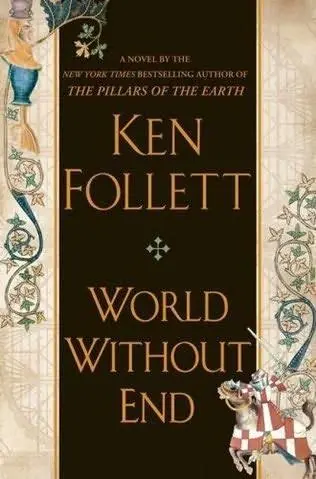
- Название:World Without End
- Автор:
- Жанр:
- Год:неизвестен
- ISBN:нет данных
- Рейтинг книги:5 / 5. Голосов: 1
-
Избранное:Добавить в избранное
- Отзывы:
-
Ваша оценка:
World Without End: краткое содержание, описание и аннотация
Предлагаем к чтению аннотацию, описание, краткое содержание или предисловие (зависит от того, что написал сам автор книги «World Without End»). Если вы не нашли необходимую информацию о книге — напишите в комментариях, мы постараемся отыскать её.
Ken Follett has 90 million readers worldwide. The Pillars of the Earth is his bestselling book of all time. Now, eighteen years after the publication of The Pillars of the Earth, Ken Follett has written the most-anticipated sequel of the year, World Without End.
In 1989 Ken Follett astonished the literary world with The Pillars of the Earth, a sweeping epic novel set in twelfth-century England centered on the building of a cathedral and many of the hundreds of lives it affected. Critics were overwhelmed-"it will hold you, fascinate you, surround you" (Chicago Tribune)-and readers everywhere hoped for a sequel.
World Without End takes place in the same town of Kingsbridge, two centuries after the townspeople finished building the exquisite Gothic cathedral that was at the heart of The Pillars of the Earth. The cathedral and the priory are again at the center of a web of love and hate, greed and pride, ambition and revenge, but this sequel stands on its own. This time the men and women of an extraordinary cast of characters find themselves at a crossroad of new ideas-about medicine, commerce, architecture, and justice. In a world where proponents of the old ways fiercely battle those with progressive minds, the intrigue and tension quickly reach a boiling point against the devastating backdrop of the greatest natural disaster ever to strike the human race-the Black Death.
Three years in the writing, and nearly eighteen years since its predecessor, World Without End breathes new life into the epic historical novel and once again shows that Ken Follett is a masterful author writing at the top of his craft.
World Without End — читать онлайн бесплатно полную книгу (весь текст) целиком
Ниже представлен текст книги, разбитый по страницам. Система сохранения места последней прочитанной страницы, позволяет с удобством читать онлайн бесплатно книгу «World Without End», без необходимости каждый раз заново искать на чём Вы остановились. Поставьте закладку, и сможете в любой момент перейти на страницу, на которой закончили чтение.
Интервал:
Закладка:
She had no weapons other than her eating knife, which would just about cut through a baked hare, but would hardly disable a man. She wished with all her heart that she had had the nerve to pull Alwyn’s long dagger out of his head and bring it away with her. Now she was virtually defenceless.
She had a row of small bouses on one side of her – the suburban homes of people too poor to live in the city – and, on the other side, the pasture called Lovers’ Field, owned by the priory. Sim was so close behind her that she could hear his breathing, harsh and ragged like her own. Terror gave her a last burst of energy. Skip barked, but there was more fear than defiance in his note – he had not forgotten the stone that hit him on the nose.
The approach to the bridge was a swamp of sticky mud, churned up by boots, hooves and cartwheels. Gwenda waded through it, desperately hoping that the heavier Sim would be hampered even more than she.
At last she reached the bridge. She pushed into the crowd, which was less dense at this end. They were all looking the other way, where a heavy cart loaded with wool was blocking the passage of an ox-cart. She had to get to Caris’s house, almost in sight now on the main street. “Let me through!” she screamed, fighting her way forward. Only one person seemed to hear her. A head turned to look, and she saw the face of her brother Philemon. His mouth dropped open in alarm, and he tried to move towards her, but the crowd resisted him as it resisted her.
Gwenda tried to push past the team of oxen drawing the wool cart, but an ox tossed its massive head and knocked her sideways. She lost her footing – and, at that moment, a big hand grasped her arm in a powerful grip, and she knew she was recaptured.
“I’ve got you, you bitch,” Sim gasped. He pulled her to him and slapped her across the face as hard as he could. She had no strength left to resist him. Skip snapped ineffectually at his heels. “You won’t get away from me again,” he said.
Despair engulfed her. It had all been for nothing: seducing Alwyn, murdering him, running for miles. She was back where she had started, the captive of Sim.
Then the bridge seemed to move.
13
Merthin saw the bridge bend.
Over the central pier on the near side, the entire roadbed sagged like a horse with a broken back. The people tormenting Nell suddenly found the surface beneath their feet unsteady. They staggered, grabbing their neighbours for support. One fell backwards over the parapet into the river; then another, then another. The shouts and catcalls directed at Nell were quickly drowned out by yells of warning and screams of fright.
Merthin said: “Oh, no!”
Caris screamed: “What’s happening?”
All those people, he wanted to say – people we grew up with, women who have been kind to us, men we hate, children who admire us; mothers and sons, uncles and nieces; cruel masters and sworn enemies and panting lovers – they’re going to die. But he could not get any words out.
For a moment – less than a breath – Merthin hoped the structure might stabilize in the new position; but he was disappointed. The bridge sagged again. This time, the interlocked timbers began to tear free of their joints. The longitudinal planks on which the people were standing sprang from their wooden pegs; the transverse joints that supported the roadbed twisted out of their sockets; and the iron braces that Elfric had hammered across the cracks were ripped out of the wood.
The central part of the bridge seemed to lurch downward on the side nearest Merthin, the upstream side. The wool cart tilted, and the spectators standing and sitting on the piled woolsacks were hurled into the river. Great timbers snapped and flew through the air, killing everyone they struck. The insubstantial parapet gave way, and the cart slid slowly off the edge, its helpless oxen lowing in terror. It fell with nightmare slowness through the air and hit the water with a thunderclap. Suddenly there were dozens of people jumping or falling into the river, then scores of them. Those already in the water were struck by the falling bodies of those who came after, and by the disintegrating timbers, some small, some huge. Horses fell, with and without riders, and carts fell on top of them.
Merthin’s first thought was of his parents. Neither of them had gone to the trial of Crazy Nell, and they would not have wanted to watch her punishment: his mother thought such public spectacles beneath her dignity, and his father was not interested when there was no more at stake than the life of a mad woman. Instead, they had gone to the priory to say goodbye to Ralph.
But Ralph was now on the bridge.
Merthin could see his brother fighting to control his horse, Griff, which was rearing and kicking out with its front hooves. “Ralph!” he yelled uselessly. Then the timbers under Griff fell into the water. “No!” Merthin shouted as horse and rider disappeared from view.
Merthin’s gaze flashed to the other end, where Caris had spotted Gwenda, and he saw her struggling with a man in a yellow tunic. Then that part gave way, and both ends of the bridge were dragged into the water by the collapsing middle.
The river was now a mass of writhing people, panicking horses, splintered timbers, smashed carts and bleeding bodies. Merthin realized that Caris was no longer by his side when he saw her hurrying along the bank towards the bridge, clambering over rocks and running along the muddy strand. She looked back at him and yelled: “Hurry up! What are you waiting for? Come and help!”
This must be what a battlefield is like, Ralph thought: the screaming, the random violence, the people falling, the horses mad with fear. It was the last thought he had before the ground dropped away beneath him.
He suffered a moment of sheer terror. He did not understand what had happened. The bridge had been there, under his horse’s hooves, but now it was not, and he and his mount were tumbling through the air. Then he could no longer feel the familiar bulk of Griff between his thighs, and he realized they had separated. An instant later he hit the cold water.
He went under and held his breath. The panic left him. Now he felt scared, but calm. He had played in the sea as a child – a seaside village nad been among his father’s domains – and he knew he would rise to the surface, though it might seem to take a long time. He was weighed down by his thick travelling clothes, now saturated, and by his sword. If he had been wearing armour, he would have sunk to the bottom and stayed there for ever. But at last his head broke the surface and he gasped for breath.
He had swum a good deal as a boy, but that was many years ago. All the same, the technique came back to him, more or less, and he was able to keep his head above water. He began to thrash his way towards the north bank. Beside him, he recognized the chestnut coat and black mane of Griff, doing the same as he was, swimming for the nearest shore.
The horse’s gait changed, and he realized it had found its footing. Ralph let his feet drift down to the river bed and found that he, too, could stand. He waded through the shallows. The sticky mud of the bottom seemed to be trying to suck him back into midstream. Griff hauled himself on to a narrow strip of beach below the priory wall. Ralph did the same.
He turned and looked back. There were several hundred people in the water, many bleeding, many screaming, many dead. Near the edge he saw a figure wearing the red-and-black livery of the earl of Shiring, floating face down. He stepped back into the water, grabbed the man by the belt, and hauled him ashore.
He turned the heavy body over, and his heart lurched with recognition. It was his friend Stephen. The face was unmarked, but Stephen’s chest appeared to have caved in. His eyes were wide open, showing no sign of life. There was no breath. The body was too damaged even for Ralph to feel for a heartbeat. A few minutes ago I was envying him, Ralph thought. Now I’m the lucky one.
Читать дальшеИнтервал:
Закладка:
Похожие книги на «World Without End»
Представляем Вашему вниманию похожие книги на «World Without End» списком для выбора. Мы отобрали схожую по названию и смыслу литературу в надежде предоставить читателям больше вариантов отыскать новые, интересные, ещё непрочитанные произведения.

Обсуждение, отзывы о книге «World Without End» и просто собственные мнения читателей. Оставьте ваши комментарии, напишите, что Вы думаете о произведении, его смысле или главных героях. Укажите что конкретно понравилось, а что нет, и почему Вы так считаете.