Ken Follett - World Without End
Здесь есть возможность читать онлайн «Ken Follett - World Without End» весь текст электронной книги совершенно бесплатно (целиком полную версию без сокращений). В некоторых случаях можно слушать аудио, скачать через торрент в формате fb2 и присутствует краткое содержание. Жанр: Историческая проза, на английском языке. Описание произведения, (предисловие) а так же отзывы посетителей доступны на портале библиотеки ЛибКат.
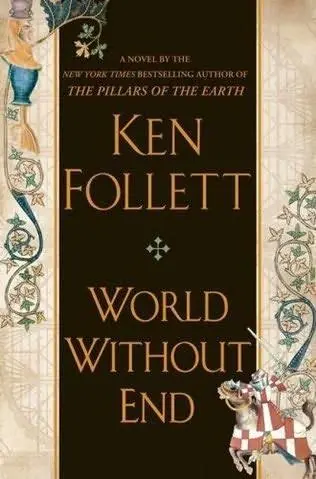
- Название:World Without End
- Автор:
- Жанр:
- Год:неизвестен
- ISBN:нет данных
- Рейтинг книги:5 / 5. Голосов: 1
-
Избранное:Добавить в избранное
- Отзывы:
-
Ваша оценка:
World Without End: краткое содержание, описание и аннотация
Предлагаем к чтению аннотацию, описание, краткое содержание или предисловие (зависит от того, что написал сам автор книги «World Without End»). Если вы не нашли необходимую информацию о книге — напишите в комментариях, мы постараемся отыскать её.
Ken Follett has 90 million readers worldwide. The Pillars of the Earth is his bestselling book of all time. Now, eighteen years after the publication of The Pillars of the Earth, Ken Follett has written the most-anticipated sequel of the year, World Without End.
In 1989 Ken Follett astonished the literary world with The Pillars of the Earth, a sweeping epic novel set in twelfth-century England centered on the building of a cathedral and many of the hundreds of lives it affected. Critics were overwhelmed-"it will hold you, fascinate you, surround you" (Chicago Tribune)-and readers everywhere hoped for a sequel.
World Without End takes place in the same town of Kingsbridge, two centuries after the townspeople finished building the exquisite Gothic cathedral that was at the heart of The Pillars of the Earth. The cathedral and the priory are again at the center of a web of love and hate, greed and pride, ambition and revenge, but this sequel stands on its own. This time the men and women of an extraordinary cast of characters find themselves at a crossroad of new ideas-about medicine, commerce, architecture, and justice. In a world where proponents of the old ways fiercely battle those with progressive minds, the intrigue and tension quickly reach a boiling point against the devastating backdrop of the greatest natural disaster ever to strike the human race-the Black Death.
Three years in the writing, and nearly eighteen years since its predecessor, World Without End breathes new life into the epic historical novel and once again shows that Ken Follett is a masterful author writing at the top of his craft.
World Without End — читать онлайн бесплатно полную книгу (весь текст) целиком
Ниже представлен текст книги, разбитый по страницам. Система сохранения места последней прочитанной страницы, позволяет с удобством читать онлайн бесплатно книгу «World Without End», без необходимости каждый раз заново искать на чём Вы остановились. Поставьте закладку, и сможете в любой момент перейти на страницу, на которой закончили чтение.
Интервал:
Закладка:
She looked thoughtful. “So, you’ve already talked to Elfric?”
“Talked?” Merthin touched his bruised cheek. “I thought he was going to kill me.”
“And his wife – my sister?”
“She screamed at me.”
“So she knows.”
“Yes. She said I have to marry Griselda. She never wanted me to be with you, anyway. I don’t know why.”
Caris muttered: “She wanted you for herself.”
That was news to Merthin. It seemed unlikely that the haughty Alice would be attracted to a lowly apprentice. “I never saw any sign of that.”
Only because you never looked at her. “That’s what made her so cross. She married Elfric in frustration. You broke my sister’s heart – and now you’re breaking mine.”
Merthin looked away. He barely recognized this picture of himself as a heartbreaker. How had things gone so wrong? Caris went quiet. Merthin stared moodily along the river to the bridge.
The crowd had come to a standstill, he saw. A heavy cart loaded with woolsacks was stuck at the southern end, probably with a broken wheel. The can pulling Nell had stopped, unable to pass. The crowd were swarming around both carts, and some people had climbed on to the woolsacks for a better view. Earl Roland was also trying to leave. He was at the town end of the bridge, on horseback, with his entourage; but even they were having trouble getting the citizens to give way. Merthin spotted his brother Ralph on his horse, chestnut-coloured with a black mane and tail. Prior Anthony, who had evidently come to see the earl off, stood wringing his hands with anxiety while Roland’s men forced their horses into the mob, trying in vain to clear a passage.
Merthin’s intuition rang an alarm. Something was badly wrong, he felt sure, though at first he did not know what. He looked more closely at the bridge. He had noticed, on Monday, that the massive oak beams stretching from one piling to another across the length of the bridge were showing cracks on the upstream side; and that the beams had been strengthened with iron braces nailed across the cracks. Merthin had not been involved in this job, which was why he had not previously looked hard at the work. On Monday he had wondered why the beams were cracking. The weakness was not half way between the uprights, as he would have expected if the timbers had simply deteriorated over time. Rather, the cracks were near the central pier, where the strain should have been less.
He had not thought about it since Monday – there was too much else on his mind – but now an explanation occurred to him. It was almost as if that central pier was not supporting the beams, but dragging them down. That would mean that something had undermined the foundation beneath the pier – and, as soon as that thought occurred to him, he realized how it could have happened. It must be the faster flow of the river, scouring the river bed from under the pier.
He remembered walking barefoot on a sandy beach, as a child, and noticing that when he stood at the sea’s edge, letting the water wash over his feet, the outgoing waves would suck the sand from under his toes. That kind of phenomenon had always fascinated him.
If he was right the central pier, with nothing underneath to support it, was now hanging from the bridge – hence the cracks. Elfric’s iron braces had not helped; in fact, they might have worsened the problem, by making it impossible for the bridge to settle slowly into a new, stable position.
Merthin guessed that the other pier of the pair – on the farther, downstream side of the bridge – was still grounded. The current surely spent most of its force on the upstream pier, and attacked the second of the pair with reduced violence. Only one pier was affected; and it seemed that the rest of the structure was knitted together strongly enough for the entire bridge to stay upright – as long as it was not subjected to extraordinary strain.
But the cracks seemed wider today than on Monday. And it was not difficult to guess why. Hundreds of people were on the bridge, a much greater load than it normally took; and there was a heavily laden wool cart, with twenty or thirty people sitting on the sacks of wool to add to the burden.
Fear gripped Merthin’s heart. He did not think the bridge could withstand that level of strain for long.
He was vaguely aware that Caris was speaking, but her meaning did not penetrate his thoughts until she raised her voice and said: “You’re not even listening!”
“There’s going to be a terrible accident,” he said.
“What do you mean?”
“We have to get everyone off the bridge.”
“Are you mad? They’re all tormenting Crazy Nell. Even Earl Roland can’t get them to move. They’re not going to listen to you.”
“I think it could collapse.”
“Oh, look!” said Caris, pointing. “Can you see someone running along the road from the forest, approaching the south end of the bridge?”
Merthin wondered what that had to do with anything, but he followed her pointing finger. Sure enough, he saw the figure of a young woman running, her hair flying.
Caris said: “It looks like Gwenda.”
Behind her, in hot pursuit, was a man in a yellow tunic.
Gwenda was more tired than she had ever been in her life.
She knew that the fastest way to cover a long distance was to run twenty paces then walk twenty paces. She had started to do that half a day ago, when she spotted Sim Chapman a mile behind her. For a while she lost sight of him, but when once again the road provided her with a long rearward view, she saw that he, too, was walking and running alternately. As mile succeeded mile and hour followed hour he gained on her. By mid-morning she had known that at this rate he would catch her before she reached Kingsbridge.
In desperation, she had taken to the forest. But she could not stray far from the road for fear of losing her way. Eventually she heard running steps and heavy breathing, and peered through the undergrowth to see Sim go by on the road. She realized that as soon as he came to a long clear stretch he would guess what she had done. Sure enough, some time later she saw him come back.
She had pressed on through the forest, stopping every few minutes to stand in silence and listen. For a long time she had evaded him, and she knew he would have to search the woods on both sides of the road to make sure she was not in hiding. But her progress was also slow, for she had to fight her way through the summer undergrowth, and keep checking that she had not strayed too far from the road.
When she heard the sound of a distant crowd she knew she could not be far from the city, and she thought she was going to escape after all. She made her way to the road and cautiously looked out from a bush. The way was clear in both directions – and, a quarter of a mile to the north, she could see the tower of the cathedral.
She was almost there.
She heard a familiar bark and her dog, Skip, emerged from the bushes at the side of the road. She bent to pat him, and he wagged joyfully, licking her hands. Tears came to her eyes.
Sim was not in sight, so she risked the open road. She wearily resumed her twenty paces of running and twenty of walking, now with Skip trotting happily beside her, thinking this was a new game. Each time she switched, she looked back over her shoulder. The third time she did so, she saw Sim.
He was only a couple of hundred yards behind.
Despair washed over her like a tidal wave. She wanted to lie down and die. But she was in the suburbs, now, and the bridge was only a quarter of a mile away. She forced herself to keep going.
She tried to sprint, but her legs refused to obey orders. A staggering jog was the best she could manage. Her feet hurt. Looking down, she saw blood seeping through the holes in her tattered shoes. As she turned the corner at Gallows Cross, she saw a huge crowd on the bridge ahead of her. They were all looking at something, and no one noticed her running for her life, with Sim Chapman close behind.
Читать дальшеИнтервал:
Закладка:
Похожие книги на «World Without End»
Представляем Вашему вниманию похожие книги на «World Without End» списком для выбора. Мы отобрали схожую по названию и смыслу литературу в надежде предоставить читателям больше вариантов отыскать новые, интересные, ещё непрочитанные произведения.






Обсуждение, отзывы о книге «World Without End» и просто собственные мнения читателей. Оставьте ваши комментарии, напишите, что Вы думаете о произведении, его смысле или главных героях. Укажите что конкретно понравилось, а что нет, и почему Вы так считаете.