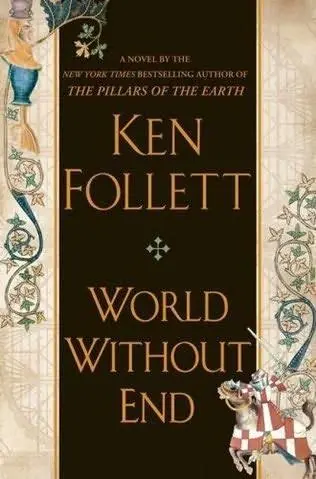
Ken Follett - World Without End
Здесь есть возможность читать онлайн «Ken Follett - World Without End» весь текст электронной книги совершенно бесплатно (целиком полную версию без сокращений). В некоторых случаях можно слушать аудио, скачать через торрент в формате fb2 и присутствует краткое содержание. Жанр: Историческая проза, на английском языке. Описание произведения, (предисловие) а так же отзывы посетителей доступны на портале библиотеки ЛибКат.
- Название:World Without End
- Автор:
- Жанр:
- Год:неизвестен
- ISBN:нет данных
- Рейтинг книги:5 / 5. Голосов: 1
-
Избранное:Добавить в избранное
- Отзывы:
-
Ваша оценка:
World Without End: краткое содержание, описание и аннотация
Предлагаем к чтению аннотацию, описание, краткое содержание или предисловие (зависит от того, что написал сам автор книги «World Without End»). Если вы не нашли необходимую информацию о книге — напишите в комментариях, мы постараемся отыскать её.
Ken Follett has 90 million readers worldwide. The Pillars of the Earth is his bestselling book of all time. Now, eighteen years after the publication of The Pillars of the Earth, Ken Follett has written the most-anticipated sequel of the year, World Without End.
In 1989 Ken Follett astonished the literary world with The Pillars of the Earth, a sweeping epic novel set in twelfth-century England centered on the building of a cathedral and many of the hundreds of lives it affected. Critics were overwhelmed-"it will hold you, fascinate you, surround you" (Chicago Tribune)-and readers everywhere hoped for a sequel.
World Without End takes place in the same town of Kingsbridge, two centuries after the townspeople finished building the exquisite Gothic cathedral that was at the heart of The Pillars of the Earth. The cathedral and the priory are again at the center of a web of love and hate, greed and pride, ambition and revenge, but this sequel stands on its own. This time the men and women of an extraordinary cast of characters find themselves at a crossroad of new ideas-about medicine, commerce, architecture, and justice. In a world where proponents of the old ways fiercely battle those with progressive minds, the intrigue and tension quickly reach a boiling point against the devastating backdrop of the greatest natural disaster ever to strike the human race-the Black Death.
Three years in the writing, and nearly eighteen years since its predecessor, World Without End breathes new life into the epic historical novel and once again shows that Ken Follett is a masterful author writing at the top of his craft.
World Without End — читать онлайн бесплатно полную книгу (весь текст) целиком
Ниже представлен текст книги, разбитый по страницам. Система сохранения места последней прочитанной страницы, позволяет с удобством читать онлайн бесплатно книгу «World Without End», без необходимости каждый раз заново искать на чём Вы остановились. Поставьте закладку, и сможете в любой момент перейти на страницу, на которой закончили чтение.
Интервал:
Закладка:
“You make it sound hopeless.”
“I don’t know. What’s hopeless? Annet might die. Wulfric might suddenly realize he’s always loved me. My father might be made earl and order him to marry me.”
Caris smiled. “You’re right. Love is never hopeless. I’d like to see this boy.”
Gwenda stood up. “I was hoping you’d say that. Let’s go and find him.”
They left the house, the dogs following at their heels. The rainstorms that had lashed the town earlier in the week had given way to occasional showers, but the main street was still a stream of mud. Because of the fair, the mud was mixed with animal droppings, rotten vegetables, and all the litter and filth of a thousand visitors.
As they splashed through the disgusting puddles, Caris asked about Gwenda’s family.
“The cow died,” Gwenda said. “Pa needs to buy another, but I don’t know how he’s going to do it. He only has a few squirrel furs to sell.”
“A cow costs twelve shillings this year,” Caris said with concern. “That’s a hundred and forty-four silver pennies.” Caris always did arithmetic in her head: she had learned Arabic numbers from Buonaventura Caroli, and she said that made it easy.
“For the last few winters that cow has kept us alive – especially the little ones.” The pain of extreme hunger was familiar to Gwenda. Even with the cow to give milk, four of Ma’s babies had died. No wonder Philemon had longed to be a monk, she thought: it was worth almost any sacrifice to have hearty meals provided every day without fail.
Caris said: “What will your father do?”
“Something underhand. It’s difficult to steal a cow – you can’t slip it into your satchel – but he’ll have a crafty scheme.” Gwenda was sounding more confident than she felt. Pa was dishonest, but not clever. He would do anything he could, legal or not, to get another cow, but he might just fail.
They passed through the priory gates into the wide fairground. The traders were wet and miserable on the sixth day of bad weather. They had exposed their stock to the rain and got little in return.
Gwenda felt awkward. She and Caris almost never talked about the disparity in wealth between the two families. Every time Gwenda visited, Caris would quietly give her a present to take home: a cheese, a smoked fish, a bolt of cloth, a jar of honey. Gwenda would thank her – and she was always profoundly grateful – but no more would be said. When Pa tried to make her take advantage of Caris’s trust by stealing from the house, Gwenda would argue that she would then be unable to visit again, whereas this way she came home with something two or three times a year. Even Pa could see the sense of that.
Gwenda looked for the stall where Perkin would be selling his hens. Annet would probably be there and, wherever Annet was, Wulfric would not be far away. Gwenda was right. There was Perkin, fat and sly, greasily polite to his customers, curt to everyone else. Annet was carrying a tray of eggs, smiling coquettishly, the tray pulling her dress tight against her breasts, her fair hair straying from her hat in wisps that played around her pink cheeks and her long neck. And there was Wulfric, looking like an archangel who had lost his way and wandered among humankind by mistake.
“There he is,” Gwenda murmured. “The tall one with-”
“I can tell which one he is,” Caris said. “He looks good enough to eat.”
“You see what I mean.”
“He’s a bit young, isn’t he?”
“Sixteen. I’m eighteen. Annet is eighteen too.”
“All right.”
“I know what you’re thinking,” Gwenda said. “He’s too handsome for me.”
“No-”
“Handsome men never fall for ugly women, do they?”
“You’re not ugly-”
“I’ve seen myself in a glass.” The memory was painful, and Gwenda grimaced. “I cried when I realized what I looked like. I have a big nose and my eyes are too close together. I resemble my father.”
Caris protested: “You have beautiful soft brown eyes, and wonderful thick hair.”
“But I’m not in Wulfric’s class.”
Wulfric was standing side-on to Gwenda and Caris, giving them a good view of his carved profile. They both admired him for a moment – then he turned, and Gwenda gasped. The other side of his face was completely different: bruised and swollen, with one eye closed.
She ran up to him. “What happened to you?” she cried.
He was startled. “Oh, hello, Gwenda. I had a fight.” He half turned away, obviously embarrassed.
“Who with?”
“Some squire of the earl’s.”
“You’re hurt!”
He looked impatient. “Don’t worry, I’m fine.”
He did not understand why she was concerned, of course. Perhaps ne even thought she was revelling in his misfortune. Then Caris spoke. “Which squire?” she said.
Wulfric looked at her with interest, realizing from her dress that she was a wealthy woman. “His name is Ralph Fitzgerald.”
“Oh – Merthin’s brother!” Caris said. “Was he hurt?”
“I broke his nose.” Wulfric looked proud.
“Weren’t you punished?”
“A night in the stocks.”
Gwenda gave a little cry of anguish. “Poor you!”
“It wasn’t so bad. My brother made sure no one pelted me.”
“Even so…” Gwenda was horrified. The idea of being imprisoned in any way seemed to her the worst kind of torture.
Annet finished with a customer and joined in the conversation. “Oh, it’s you, Gwenda,” she said coldly. Wulfric might be oblivious to Gwenda’s feelings, but Annet was not, and she treated Gwenda with a mixture of hostility and scorn. “Wulfric fought a squire who insulted me,” she said, unable to conceal her satisfaction. “He was just like a knight in a ballad.”
Gwenda said sharply: “I wouldn’t want him to get his face hurt for my sake.”
“Fortunately, that’s not very likely, is it?” Annet smiled triumphantly.
Caris said: “One never knows what the future may hold.”
Annet looked at her, startled by the interruption, and showed surprise that Gwenda’s companion was so expensively dressed.
Caris took Gwenda’s arm. “Such a pleasure to meet you Wigleigh folk,” she said graciously. “Goodbye.”
They walked on. Gwenda giggled. “You were terribly condescending to Annet.”
“She annoyed me. Her kind give women a bad name.”
“She was so pleased that Wulfric got beaten up for her sake! I’d like to poke out her eyes.”
Caris said thoughtfully: “Apart from his good looks, what is he actually like?”
“Strong, proud, loyal – just the type to get into a fight on someone else’s behalf. But he’s the kind of man who will provide tirelessly for his family, year in and year out, until the day he drops dead.”
Caris said nothing.
Gwenda said: “He doesn’t appeal to you, does he?”
“You make him sound a bit dull.”
“If you’d grown up with my father, you wouldn’t think a good provider was dull.”
“I know.” Caris squeezed Gwenda’s arm. “I think he’s wonderful for you – and, to prove it, I’m going to help you get him.”
Gwenda was not expecting that. “How?”
“Come with me.”
They left the fairground and walked to the north end of the town. Caris led Gwenda to a small house in a side street near St Mark’s parish church. “A wise woman lives here,” she said. Leaving the dogs outside, they ducked through a low doorway.
The single, narrow downstairs room was divided by a curtain. In the front half were a chair and a bench. The fireplace had to be at the back, Gwenda thought, and she wondered why someone would want to hide whatever went on in the kitchen. The room was clean, and there was a strong smell, herby and slightly acid, hardly a perfume but not unpleasant. Caris called out: “Mattie, it’s me.”
Читать дальшеИнтервал:
Закладка:
Похожие книги на «World Without End»
Представляем Вашему вниманию похожие книги на «World Without End» списком для выбора. Мы отобрали схожую по названию и смыслу литературу в надежде предоставить читателям больше вариантов отыскать новые, интересные, ещё непрочитанные произведения.


Обсуждение, отзывы о книге «World Without End» и просто собственные мнения читателей. Оставьте ваши комментарии, напишите, что Вы думаете о произведении, его смысле или главных героях. Укажите что конкретно понравилось, а что нет, и почему Вы так считаете.