Ken Follett - World Without End
Здесь есть возможность читать онлайн «Ken Follett - World Without End» весь текст электронной книги совершенно бесплатно (целиком полную версию без сокращений). В некоторых случаях можно слушать аудио, скачать через торрент в формате fb2 и присутствует краткое содержание. Жанр: Историческая проза, на английском языке. Описание произведения, (предисловие) а так же отзывы посетителей доступны на портале библиотеки ЛибКат.
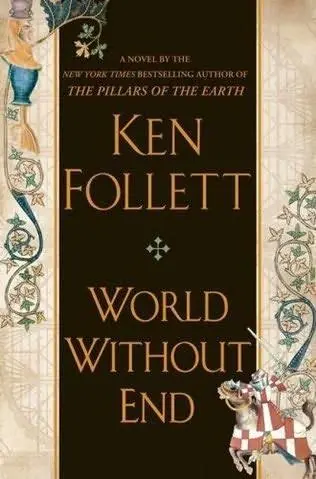
- Название:World Without End
- Автор:
- Жанр:
- Год:неизвестен
- ISBN:нет данных
- Рейтинг книги:5 / 5. Голосов: 1
-
Избранное:Добавить в избранное
- Отзывы:
-
Ваша оценка:
World Without End: краткое содержание, описание и аннотация
Предлагаем к чтению аннотацию, описание, краткое содержание или предисловие (зависит от того, что написал сам автор книги «World Without End»). Если вы не нашли необходимую информацию о книге — напишите в комментариях, мы постараемся отыскать её.
Ken Follett has 90 million readers worldwide. The Pillars of the Earth is his bestselling book of all time. Now, eighteen years after the publication of The Pillars of the Earth, Ken Follett has written the most-anticipated sequel of the year, World Without End.
In 1989 Ken Follett astonished the literary world with The Pillars of the Earth, a sweeping epic novel set in twelfth-century England centered on the building of a cathedral and many of the hundreds of lives it affected. Critics were overwhelmed-"it will hold you, fascinate you, surround you" (Chicago Tribune)-and readers everywhere hoped for a sequel.
World Without End takes place in the same town of Kingsbridge, two centuries after the townspeople finished building the exquisite Gothic cathedral that was at the heart of The Pillars of the Earth. The cathedral and the priory are again at the center of a web of love and hate, greed and pride, ambition and revenge, but this sequel stands on its own. This time the men and women of an extraordinary cast of characters find themselves at a crossroad of new ideas-about medicine, commerce, architecture, and justice. In a world where proponents of the old ways fiercely battle those with progressive minds, the intrigue and tension quickly reach a boiling point against the devastating backdrop of the greatest natural disaster ever to strike the human race-the Black Death.
Three years in the writing, and nearly eighteen years since its predecessor, World Without End breathes new life into the epic historical novel and once again shows that Ken Follett is a masterful author writing at the top of his craft.
World Without End — читать онлайн бесплатно полную книгу (весь текст) целиком
Ниже представлен текст книги, разбитый по страницам. Система сохранения места последней прочитанной страницы, позволяет с удобством читать онлайн бесплатно книгу «World Without End», без необходимости каждый раз заново искать на чём Вы остановились. Поставьте закладку, и сможете в любой момент перейти на страницу, на которой закончили чтение.
Интервал:
Закладка:
Someone screamed.
It was not merely a cry or a shriek, but a fortissimo yell of pure terror that might have awakened the dead, and it went on until one of the hired men hit the screamer a mighty blow over her head with his club and she fell unconscious to the floor, blood trickling down her cheek.
Ralph said again: “Which of you is treasurer?”
Merthin had woken up briefly when the bell rang for Matins and Caris slipped out of bed. As usual, he turned over and fell into a light doze, so that when she returned it seemed as if she had been away only for a minute or two. She was cold when she got back into bed, and he drew her to him and wrapped his arms around her. They often stayed awake for a while, talking, and usually made love before going to sleep. It was Merthin’s favourite time.
She pressed up against him, her breasts squashed comfortably against his chest. He kissed her forehead. When she had warmed up, he reached between her legs and gently stroked the soft hair there.
But she was feeling talkative. “Did you hear yesterday’s rumour? Outlaws in the woods north of town.”
“It seems a bit unlikely,” he said.
“I don’t know. The walls are decrepit on that side.”
“But what are they going to steal? Anything they want is theirs for the taking. If they need meat, there are thousands of sheep and cattle unguarded in the fields, with no one to claim ownership.”
“That’s what makes it strange.”
“These days, stealing is like leaning over the fence to breathe your neighbour’s air.”
She sighed. “Three months ago I thought this terrible plague was over.”
“How many more people have we lost?”
“We’ve buried a thousand since Easter.”
That seemed about right to Merthin. “I hear that other towns are similar.”
He felt her hair move against his shoulder as she nodded in the dark. She said: “I believe something like a quarter of the population of England is gone already.”
“And more than half the priests.”
“That’s because they make contact with so many people every time they hold a service. They can hardly escape.”
“So half the churches are closed.”
“A good thing, if you ask me. I’m sure crowds spread the plague faster than anything.”
“Anyway, most people have lost respect for religion.”
To Caris, that was no great tragedy. She said: “Perhaps they’ll stop believing in mumbo-jumbo medicine, and start thinking about what treatments actually make a difference.”
“You say that, but it’s hard for ordinary people to know what is a genuine cure and what a false remedy.”
“I’ll give you four rules.”
He smiled in the dark. She always had a list. “All right.”
“One: If there are dozens of different remedies for a complaint, you can be sure none of them works.”
“Why?”
“Because if one worked, people would forget the rest.”
“Logical.”
“Two: Just because a remedy is unpleasant doesn’t mean it’s any good. Raw larks’ brains do nothing for a sore throat, even though they make you heave; whereas a nice cup of hot water and honey will soothe you.”
“That’s good to know.”
“Three: Human and animal dung never does anyone any good. It usually makes them worse.”
“I’m relieved to hear it.”
“Four: If the remedy looks like the disease – the spotted feathers of a thrush for the pox, say, or sheep’s urine for yellow jaundice – it’s probably imaginative rubbish.”
“You should write a book about this.”
She made a scornful noise. “Universities prefer ancient Greek texts.”
“Not a book for university students. One for people like you – nuns and midwives and barbers and wise women.”
“Wise women and midwives can’t read.”
“Some can, and others have people who can read for them.”
“I suppose people might like a little book that tells them what to do about the plague.”
She was thoughtful for a few moments.
In the silence, there was a scream.
“What was that?” Merthin said.
“It sounded like a shrew being caught by an owl,” she said.
“No, it didn’t,” he said, and he got up.
One of the nuns stepped forward and addressed Ralph. She was young – they were nearly all young – with black hair and blue eyes. “Please don’t hurt Tilly,” she begged. “I’m Sister Joan, the treasurer. We’ll give you anything you want. Please don’t do any more violence.”
“I am Tam Hiding,” Ralph said. “Where are the keys to the nuns’ treasury?”
“I have them here on my belt.”
“Take me there.”
Joan hesitated. Perhaps she sensed that Ralph did not know where the treasury was. On their reconnaissance trip, Alan had been able to scout the nunnery quite thoroughly before he was caught. He had plotted their way in, identified the kitchen as a good hiding place, and located the nuns’ dormitory; but he had not been able to find the treasury. Clearly Joan did not want to reveal its location.
Ralph had no time to lose. He did not know who might have heard that scream. He pressed the point of his knife into Tilly’s throat until it drew blood. “I want to go to the treasury,” he said.
“All right, just don’t hurt Tilly! I’ll show you the way.”
“I thought you would,” Ralph said.
He left two of the hired men in the dormitory to keep the nuns quiet. He and Alan followed Joan down the steps to the cloisters, taking Tilly.
At the foot of the stairs, the other two hired men were detaining at knife point three more nuns. Ralph guessed that those on duty in the hospital had come to investigate the scream. He was pleased: another threat had been neutralized. But where were the monks?
He sent the extra nuns up into the dormitory. He left one hired man on guard at the foot of the stairs and took the other with him.
Joan led them into the refectory, which was at ground level directly under the dorm. Her flickering lamp revealed trestle tables, benches, a lectern and a wall painting of Jesus at a wedding feast.
At the far end of the room Joan moved a table to reveal a trapdoor in the floor. It had a keyhole just like a normal upright door. She turned a key in the lock and lifted the trapdoor. It gave on to a narrow spiral of stone steps. She descended the stairs. Ralph left the hired man on guard and went down, awkwardly carrying Tilly, and Alan followed him.
Ralph reached the bottom of the staircase and looked around him with a satisfied air. This was the holy of holies, the nuns’ secret treasury. It was a cramped underground room like a dungeon, but better built: the walls were of ashlar, smoothly squared-off stones as used in the cathedral, and the floor was paved with closely set flagstones. The air felt cool and dry. Ralph put Tilly, trussed like a chicken, on the floor.
Most of the room was taken up by a huge lidded box, like a coffin for a giant, chained to a ring in the wall. There was not much else: two stools, a writing desk, and a shelf bearing a stack of parchment rolls, presumably the nunnery’s account books. On a hook on the wall hung two heavy wool coats, and Ralph guessed they were for the treasurer and her assistant to wear when working down here in the coldest months of the winter.
The box was far too large to have come down the staircase. It must have been brought here in pieces and assembled in situ. Ralph pointed to the clasp, and Joan unlocked it with another of the keys on her belt.
Ralph looked inside. There were scores more parchment rolls, obviously all the charters and title deeds that proved the nunnery’s ownership of its property and rights; a pile of leather and wool bags that undoubtedly held jewelled ornaments; and another, smaller chest that probably contained money.
Читать дальшеИнтервал:
Закладка:
Похожие книги на «World Without End»
Представляем Вашему вниманию похожие книги на «World Without End» списком для выбора. Мы отобрали схожую по названию и смыслу литературу в надежде предоставить читателям больше вариантов отыскать новые, интересные, ещё непрочитанные произведения.






Обсуждение, отзывы о книге «World Without End» и просто собственные мнения читателей. Оставьте ваши комментарии, напишите, что Вы думаете о произведении, его смысле или главных героях. Укажите что конкретно понравилось, а что нет, и почему Вы так считаете.