Ken Follett - World Without End
Здесь есть возможность читать онлайн «Ken Follett - World Without End» весь текст электронной книги совершенно бесплатно (целиком полную версию без сокращений). В некоторых случаях можно слушать аудио, скачать через торрент в формате fb2 и присутствует краткое содержание. Жанр: Историческая проза, на английском языке. Описание произведения, (предисловие) а так же отзывы посетителей доступны на портале библиотеки ЛибКат.
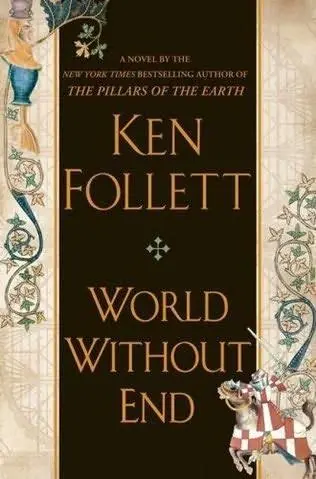
- Название:World Without End
- Автор:
- Жанр:
- Год:неизвестен
- ISBN:нет данных
- Рейтинг книги:5 / 5. Голосов: 1
-
Избранное:Добавить в избранное
- Отзывы:
-
Ваша оценка:
World Without End: краткое содержание, описание и аннотация
Предлагаем к чтению аннотацию, описание, краткое содержание или предисловие (зависит от того, что написал сам автор книги «World Without End»). Если вы не нашли необходимую информацию о книге — напишите в комментариях, мы постараемся отыскать её.
Ken Follett has 90 million readers worldwide. The Pillars of the Earth is his bestselling book of all time. Now, eighteen years after the publication of The Pillars of the Earth, Ken Follett has written the most-anticipated sequel of the year, World Without End.
In 1989 Ken Follett astonished the literary world with The Pillars of the Earth, a sweeping epic novel set in twelfth-century England centered on the building of a cathedral and many of the hundreds of lives it affected. Critics were overwhelmed-"it will hold you, fascinate you, surround you" (Chicago Tribune)-and readers everywhere hoped for a sequel.
World Without End takes place in the same town of Kingsbridge, two centuries after the townspeople finished building the exquisite Gothic cathedral that was at the heart of The Pillars of the Earth. The cathedral and the priory are again at the center of a web of love and hate, greed and pride, ambition and revenge, but this sequel stands on its own. This time the men and women of an extraordinary cast of characters find themselves at a crossroad of new ideas-about medicine, commerce, architecture, and justice. In a world where proponents of the old ways fiercely battle those with progressive minds, the intrigue and tension quickly reach a boiling point against the devastating backdrop of the greatest natural disaster ever to strike the human race-the Black Death.
Three years in the writing, and nearly eighteen years since its predecessor, World Without End breathes new life into the epic historical novel and once again shows that Ken Follett is a masterful author writing at the top of his craft.
World Without End — читать онлайн бесплатно полную книгу (весь текст) целиком
Ниже представлен текст книги, разбитый по страницам. Система сохранения места последней прочитанной страницы, позволяет с удобством читать онлайн бесплатно книгу «World Without End», без необходимости каждый раз заново искать на чём Вы остановились. Поставьте закладку, и сможете в любой момент перейти на страницу, на которой закончили чтение.
Интервал:
Закладка:
When the maid had cleared away, Caris said: “While I was ill, I thought a lot about dying.”
“You didn’t ask for a priest.”
“Whether I’ve been good or bad, I don’t think God will be fooled by a last-minute change of heart.”
“What, then?”
“I asked myself if there was anything I really regretted.”
“And was there?”
“Lots of things. I’m bad friends with my sister. I haven’t any children. I lost that scarlet coat my father gave my mother on the day she died.”
“How did you lose it?”
“I wasn’t allowed to bring it with me when I entered the nunnery. I don’t know what happened to it.”
“What was your biggest regret?”
“There were two. I haven’t built my hospital; and I’ve spent too little time in bed with you.”
He raised his eyebrows. “Well, the second one is easily rectified.”
“I know.”
“What about the nuns?”
“Nobody cares any more. You saw what it was like in the town. Here in the nunnery, we’re too busy dealing with the dying to fuss about the old rules. Joan and Oonagh sleep together every night in one of the upstairs rooms of the hospital. It doesn’t matter.”
Merthin frowned. “It’s odd that they do that, and still go to church services in the middle of the night. How do they reconcile the two things?”
“Listen. St Luke’s Gospel says: ‘He that hath two coats, let him impart to him that hath none.’ How do you think the bishop of Shiring reconciles that with his chest full of robes? Everybody takes what they like from the teachings of the church, and ignores the parts that don’t suit them.”
“And you?”
“I do the same, but I’m honest about it. So I’m going to live with you, as your wife, and if anyone questions me I shall say that these are strange times.” She got up, went to the door and barred it. “You’ve been sleeping here for two weeks. Don’t move out.”
“You don’t have to lock me in,” he said with a laugh. “I’ll stay voluntarily.” He put his arms around her.
She said: “We started something a few minutes before I fainted. Tilly interrupted us.”
“You were feverish.”
“In that way, I still am.”
“Perhaps we should pick up where we left off.”
“We could go to bed first.”
“All right.”
Holding hands, they went up the stairs.
71
Ralph and his men hid in the forest north of Kingsbridge, waiting. It was May, and the evenings were long. When night fell Ralph encouraged the others to take a nap while he sat up, watching.
With him were Alan Fernhill and four hired men, soldiers demobilized from the king’s army, fighters who had failed to find their niche in peacetime. Alan had hired them at the Red Lion in Gloucester. They did not know who Ralph was and had never seen him in daylight. They would do as they were told, take their money, and ask no questions.
Ralph stayed awake, noting the passing of time automatically, as he had when with the king in France. He had found that, if he tried too hard to figure out how many hours had gone by, he became doubtful; but, if he simply guessed, what came into his head was always right. Monks used a burning candle, marked with rings for the hours, or an hourglass with sand or water trickling through a narrow funnel; but Ralph had a better measure in his head.
He sat very still, with his back to a tree, staring into the low fire they had built. He could hear the rustle of small animals in the undergrowth and the occasional hoot of a predatory owl. He never felt so calm as in the waiting hours before action. There was quiet, and darkness, and time to think. The knowledge of danger to come, which made most men jumpy, actually soothed him.
The main risk tonight did not in fact come from the hazards of fighting. There would be some hand-to-hand combat, but the enemy would consist of fat townsmen or soft-skinned monks. The real peril was that Ralph might be recognized. What he was about to do was shocking. It would be talked of with outrage in every church in the land, perhaps in Europe. Gregory Longfellow, for whom Ralph was doing this, would be the loudest in condemning it. If the fact ever got out that Ralph was the villain, he would be hanged.
But if he succeeded, he would be the earl of Shiring.
When he judged it was two hours past midnight, he roused the others.
They left their tethered horses and walked out of the woodland and along the road to the city. Alan was carrying the equipment, as he always had when they fought in France. He had a short ladder, a coil of rope, and a grappling iron they had used when attacking city walls in Normandy. In his belt were a mason’s chisel and a hammer. They might not need these tools, but they had learned that it was best to be prepared.
Alan also had several large sacks, rolled up tightly and tied with string in a bundle.
When they came within sight of the city, Ralph gave out hoods with holes for the eyes and mouth, and they all put them on. Ralph also wore a mitten on his left hand, to conceal the tell-tale stumps of his three missing fingers. He was completely unrecognizable – unless, of course, he should be captured.
They all pulled felt bags over their boots, tying them to their knees, to muffle their footsteps.
It was hundreds of years since Kingsbridge had been attacked by an army, and security was slack, especially since the advent of the plague. Nevertheless, the southern entrance to the town was firmly closed. At the townward end of Merthin’s great bridge was a stone gatehouse barred with a mighty wooden door. But the river defended the town only on the east and south sides. To the north and west no bridge was needed, and the town was protected by a wall that was in poor repair. That was why Ralph was approaching from the north.
Mean houses huddled outside the walls like dogs at the back of a butcher’s shop. Alan had scouted the route several days ago, when the two of them had come to Kingsbridge and inquired about Tilly. Now Ralph and the hired men followed Alan, padding between the hovels as quietly as possible. Even paupers in the suburbs could raise the alarm if awakened. A dog barked, and Ralph tensed, but someone cursed the animal and it fell silent. In another moment they came to a place where the wall was broken down and they could easily clamber over the fallen stones.
They found themselves in a narrow alley behind some warehouses. It came out just inside the north gate of the city. At the gate, Ralph knew, was a sentry in a booth. The six men approached silently. Although they were now within the walls, a sentry would question them if he saw them, and shout for help if he was not satisfied with their answers. But, to Ralph’s relief, the man was fast asleep, sitting on a stool and leaning against the side of his box, a stub of candle guttering on a shelf beside him.
All the same, Ralph decided not to risk the man’s waking up. He tiptoed close, leaned into the booth, and slit the sentry’s throat with a long knife. The man woke up and tried to scream with pain, but all that came out of his mouth was blood. As he slumped, Ralph caught him and held him for the few moments it took him to lose consciousness. Then he propped the body back up against the wall of the booth.
He wiped his bloody blade on the dead man’s tunic and sheathed the knife.
The large double door that stopped the gateway had within it a smaller, man-sized doorway. Ralph unbarred this little door, ready for a quick getaway later.
The six men walked silently along the street that led to the priory.
There was no moon – Ralph had chosen tonight for that reason – but they were faintly lit by starlight. He looked anxiously at the upstairs windows of the houses on either side. If sleepless people happened to look out, they would see the unmistakably sinister sight of six masked men. Fortunately it was not quite warm enough to leave windows open at night, and all the shutters were closed. Just the same, Ralph pulled up the hood of his cloak and dragged it forward as far as it would go, in the hope of shadowing his face and concealing the mask; then he signed to the others to do the same.
Читать дальшеИнтервал:
Закладка:
Похожие книги на «World Without End»
Представляем Вашему вниманию похожие книги на «World Without End» списком для выбора. Мы отобрали схожую по названию и смыслу литературу в надежде предоставить читателям больше вариантов отыскать новые, интересные, ещё непрочитанные произведения.







Обсуждение, отзывы о книге «World Without End» и просто собственные мнения читателей. Оставьте ваши комментарии, напишите, что Вы думаете о произведении, его смысле или главных героях. Укажите что конкретно понравилось, а что нет, и почему Вы так считаете.