Ken Follett - World Without End
Здесь есть возможность читать онлайн «Ken Follett - World Without End» весь текст электронной книги совершенно бесплатно (целиком полную версию без сокращений). В некоторых случаях можно слушать аудио, скачать через торрент в формате fb2 и присутствует краткое содержание. Жанр: Историческая проза, на английском языке. Описание произведения, (предисловие) а так же отзывы посетителей доступны на портале библиотеки ЛибКат.
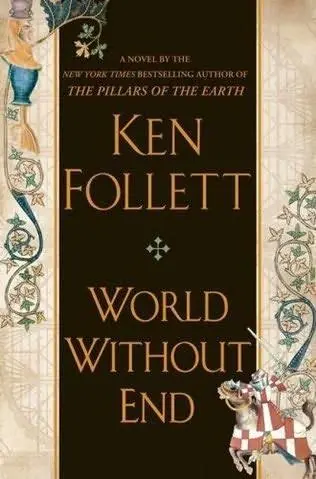
- Название:World Without End
- Автор:
- Жанр:
- Год:неизвестен
- ISBN:нет данных
- Рейтинг книги:5 / 5. Голосов: 1
-
Избранное:Добавить в избранное
- Отзывы:
-
Ваша оценка:
World Without End: краткое содержание, описание и аннотация
Предлагаем к чтению аннотацию, описание, краткое содержание или предисловие (зависит от того, что написал сам автор книги «World Without End»). Если вы не нашли необходимую информацию о книге — напишите в комментариях, мы постараемся отыскать её.
Ken Follett has 90 million readers worldwide. The Pillars of the Earth is his bestselling book of all time. Now, eighteen years after the publication of The Pillars of the Earth, Ken Follett has written the most-anticipated sequel of the year, World Without End.
In 1989 Ken Follett astonished the literary world with The Pillars of the Earth, a sweeping epic novel set in twelfth-century England centered on the building of a cathedral and many of the hundreds of lives it affected. Critics were overwhelmed-"it will hold you, fascinate you, surround you" (Chicago Tribune)-and readers everywhere hoped for a sequel.
World Without End takes place in the same town of Kingsbridge, two centuries after the townspeople finished building the exquisite Gothic cathedral that was at the heart of The Pillars of the Earth. The cathedral and the priory are again at the center of a web of love and hate, greed and pride, ambition and revenge, but this sequel stands on its own. This time the men and women of an extraordinary cast of characters find themselves at a crossroad of new ideas-about medicine, commerce, architecture, and justice. In a world where proponents of the old ways fiercely battle those with progressive minds, the intrigue and tension quickly reach a boiling point against the devastating backdrop of the greatest natural disaster ever to strike the human race-the Black Death.
Three years in the writing, and nearly eighteen years since its predecessor, World Without End breathes new life into the epic historical novel and once again shows that Ken Follett is a masterful author writing at the top of his craft.
World Without End — читать онлайн бесплатно полную книгу (весь текст) целиком
Ниже представлен текст книги, разбитый по страницам. Система сохранения места последней прочитанной страницы, позволяет с удобством читать онлайн бесплатно книгу «World Without End», без необходимости каждый раз заново искать на чём Вы остановились. Поставьте закладку, и сможете в любой момент перейти на страницу, на которой закончили чтение.
Интервал:
Закладка:
“What does that tell you?”
Caris did not answer the question. “Tilly thought Ralph wanted to kill her.”
“I know.”
“One of the hooded men was about to do away with you, at one point.” Her voice caught in her throat, and she had to stop. She took a sip of Merthin’s cider, composing herself; then she went on. “But the leader stopped him. Why would he do that? They had already murdered a nun and a noblewoman – why scruple to kill a mere builder?”
“You think it was Ralph.”
“Don’t you?”
“Yes.” Merthin sighed heavily. “Did you see his mitten?”
“I noticed he was wearing gloves.”
Merthin shook his head. “Only one. On his left hand. Not a glove with fingers, but a mitten.”
“To hide his injury.”
“I can’t be sure, and we certainly couldn’t prove anything, but I have a dreadful conviction about it.”
Caris stood up. “Let’s inspect the damage.”
They went to the nuns’ cloisters. The novices and the orphans were cleaning the treasury, bringing sacks of charred wood and ashes up the spiral staircase, giving anything not completely destroyed to Sister Joan and carrying the detritus out to the dunghill.
Laid out on a refectory table Merthin saw the cathedral ornaments: gold and silver candlesticks, crucifixes and vessels, all finely wrought and studded with precious stones. He was surprised. “Didn’t they take these?” he said.
“Yes – but they seem to have had second thoughts, and dumped them in a ditch outside town. A peasant on his way in with eggs to sell found them this morning. Luckily he was honest.”
Merthin picked up a gold aquamanile, a jug for washing the hands, made in the shape of a cockerel, the feathers of its neck beautifully chased. “It’s hard to sell something like this. Only a few people could afford to buy it, and most of those would guess it had been stolen.”
“The thieves could have melted it down and sold the gold.”
“Obviously they decided that was too much trouble.”
“Perhaps.”
She was not convinced. Nor was Merthin: his own explanation did not quite fit. The robbery had been carefully planned, that was evident. So why would the thieves not have made up their minds in advance about the ornaments? Either to take them or leave them behind?
Caris and Merthin went down the steps and into the chamber, Merthin’s stomach clenching in fear as he was grimly reminded of last night’s ordeal. More novices were cleaning the walls and floor with mops and buckets.
Caris sent the novices away to take a break. When she and Merthin were alone, she picked up a length of wood from a shelf and used it to prise up one of the flagstones underfoot. Merthin had not previously noticed that the stone was not fitted as tightly as most, having a narrow gap all around it. Now he saw that underneath was a spacious vault containing a wooden box. Caris reached into the hole and pulled out the box. She opened it with a key from her belt. It was full of gold coins.
Merthin was surprised. “They missed that!”
“There are three more concealed vaults,” Caris told him. “Another in the floor and two in the walls. They missed them all.”
“They can’t have looked very hard. Most treasuries have hiding places. People know that.”
“Especially robbers.”
“So maybe the cash wasn’t their first priority.”
“Exactly.” Caris locked the chest and put it back in its vault.
“If they didn’t want the ornaments, and they weren’t sufficiently interested in cash to search the treasury thoroughly for hidden vaults, why did they come here at all?”
“To kill Tilly. The robbery was a cover.”
Merthin thought about that. “They didn’t need an elaborate cover story,” he said after a pause. “If all they wanted was to kill Tilly, they could have done it in the dormitory and been far away from here by the time the nuns got back from Matins. If they had done it carefully – suffocated her with a feather pillow, say – we would not even have been sure she had been murdered. It would have looked as if she had died in her sleep.”
“Then there’s no explanation for the attack. They ended up with next to nothing – a few gold coins.”
Merthin looked around the underground chamber. “Where are the charters?” he said.
“They must have burned. It doesn’t much matter. I’ve got copies of everything.”
“Parchment doesn’t burn very well.”
“I’ve never tried to light it.”
“It smoulders, shrinks and distorts, but it doesn’t catch fire.”
“Perhaps the charters have been retrieved from the debris.”
“Let’s check.”
They climbed back up the steps and left the vault. Outside in the cloisters, Caris asked Joan: “Have you found any parchment among the ashes?”
She shook her head. “Nothing at all.”
“Could you have missed it?”
“I don’t think so – not unless it has burned to cinders.”
“Merthin says it doesn’t burn.” She turned to him. “Who would want our charters? They’re no use to anyone else.”
Merthin followed the thread of his own logic, just to see where it might lead. “Suppose there’s a document that you’ve got – or you might have, or they think you might have – and they want it.”
“What could it be?”
Merthin frowned. “Documents are intended to be public. The whole point of writing something down is so that people can look at it in the future. A secret document is a strange thing…” Then he thought of something.
He drew Caris away from Joan, and walked casually around the cloisters with her until he was sure they could not be overheard. Then he said: “But, of course, we do know of one secret document.”
“The letter Thomas buried in the forest.”
“Yes.”
“But why would anyone imagine it might be in the nunnery’s treasury?”
“Well, think. Has anything happened lately that might arouse such a suspicion?”
A look of dismay came over Caris’s face. “Oh, my soul,” she exclaimed.
“There is something.”
“I told you about Lynn Grange being given to us by Queen Isabella for accepting Thomas, all those years ago.”
“Did you speak to anyone else about it?”
“Yes – the bailiff of Lynn. And Thomas was angry that I had done so, and said there would be dire consequences.”
“So someone is afraid you might have got hold of Thomas’s secret letter.”
“Ralph?”
“I don’t think Ralph is aware of the letter. I was the only one of us children who saw Thomas burying it. He’s certainly never mentioned it. Ralph must be acting on behalf of someone else.”
Caris looked scared. “Queen Isabella?”
“Or the king himself.”
“Is it possible that the king ordered Ralph to invade a nunnery?”
“Not personally, no. He would have used an intermediary, someone loyal, ambitious, and with absolutely no scruples. I came across such men in Florence, hanging around the Doge’s palace. They’re the scum of the earth.”
“I wonder who it was?”
“I think I can guess,” said Merthin.
Gregory Longfellow met Ralph and Alan two days later at Wigleigh, in the small timber manor house. Wigleigh was more discreet than Tench. At Tench Hall there were too many people watching Ralph’s every move: servants, followers, his parents. Here in Wigleigh the peasants had their own backbreaking business to do, and no one would question Ralph about the contents of the sack Alan was carrying.
“I gather it went off as planned,” Gregory said. News of the invasion of the nunnery had spread all over the county in no time.
“No great difficulty,” Ralph said. He was a bit let down by Gregory’s muted reaction. After all the trouble that had been taken to get the charters, Gregory might have shown some elation.
Читать дальшеИнтервал:
Закладка:
Похожие книги на «World Without End»
Представляем Вашему вниманию похожие книги на «World Without End» списком для выбора. Мы отобрали схожую по названию и смыслу литературу в надежде предоставить читателям больше вариантов отыскать новые, интересные, ещё непрочитанные произведения.

Обсуждение, отзывы о книге «World Without End» и просто собственные мнения читателей. Оставьте ваши комментарии, напишите, что Вы думаете о произведении, его смысле или главных героях. Укажите что конкретно понравилось, а что нет, и почему Вы так считаете.