Ken Follett - World Without End
Здесь есть возможность читать онлайн «Ken Follett - World Without End» весь текст электронной книги совершенно бесплатно (целиком полную версию без сокращений). В некоторых случаях можно слушать аудио, скачать через торрент в формате fb2 и присутствует краткое содержание. Жанр: Историческая проза, на английском языке. Описание произведения, (предисловие) а так же отзывы посетителей доступны на портале библиотеки ЛибКат.
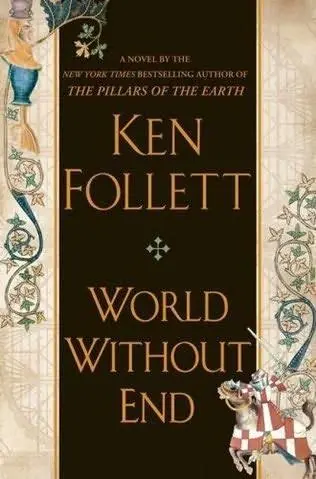
- Название:World Without End
- Автор:
- Жанр:
- Год:неизвестен
- ISBN:нет данных
- Рейтинг книги:5 / 5. Голосов: 1
-
Избранное:Добавить в избранное
- Отзывы:
-
Ваша оценка:
World Without End: краткое содержание, описание и аннотация
Предлагаем к чтению аннотацию, описание, краткое содержание или предисловие (зависит от того, что написал сам автор книги «World Without End»). Если вы не нашли необходимую информацию о книге — напишите в комментариях, мы постараемся отыскать её.
Ken Follett has 90 million readers worldwide. The Pillars of the Earth is his bestselling book of all time. Now, eighteen years after the publication of The Pillars of the Earth, Ken Follett has written the most-anticipated sequel of the year, World Without End.
In 1989 Ken Follett astonished the literary world with The Pillars of the Earth, a sweeping epic novel set in twelfth-century England centered on the building of a cathedral and many of the hundreds of lives it affected. Critics were overwhelmed-"it will hold you, fascinate you, surround you" (Chicago Tribune)-and readers everywhere hoped for a sequel.
World Without End takes place in the same town of Kingsbridge, two centuries after the townspeople finished building the exquisite Gothic cathedral that was at the heart of The Pillars of the Earth. The cathedral and the priory are again at the center of a web of love and hate, greed and pride, ambition and revenge, but this sequel stands on its own. This time the men and women of an extraordinary cast of characters find themselves at a crossroad of new ideas-about medicine, commerce, architecture, and justice. In a world where proponents of the old ways fiercely battle those with progressive minds, the intrigue and tension quickly reach a boiling point against the devastating backdrop of the greatest natural disaster ever to strike the human race-the Black Death.
Three years in the writing, and nearly eighteen years since its predecessor, World Without End breathes new life into the epic historical novel and once again shows that Ken Follett is a masterful author writing at the top of his craft.
World Without End — читать онлайн бесплатно полную книгу (весь текст) целиком
Ниже представлен текст книги, разбитый по страницам. Система сохранения места последней прочитанной страницы, позволяет с удобством читать онлайн бесплатно книгу «World Without End», без необходимости каждый раз заново искать на чём Вы остановились. Поставьте закладку, и сможете в любой момент перейти на страницу, на которой закончили чтение.
Интервал:
Закладка:
There was a pause, but it did not last long.
The French knights regrouped, reinforced by new arrivals who were appearing in their hundreds and thousands. Peering into their ranks, Ralph could see that the colours of Alençon had been joined by those of Flanders and Normandy. The standard of the count of Alençon moved to the front, then the trumpets sounded, and the horsemen began to move.
Ralph put his faceplate down and drew his sword. He thought of his mother. He knew she prayed for him every time she went to church, and he felt a moment of warm gratitude to her. Then he watched the enemy.
The huge horses were slow to start, encumbered as they were by riders in full plate armour. The setting sun glinted off the French visors, and the flags snapped in the evening breeze. Gradually the pounding of the hooves grew louder and the pace of the charge picked up. The knights yelled encouragement to their mounts and to one another, waving their swords and spears. They came like a wave on to a beach, seeming to get bigger and faster as they got nearer. Ralph’s mouth was dry and his heart beat like a big drum.
They came within bowshot, and again the prince gave the order to shoot. Once more, the arrows rose into the air and fell like deadly rain.
The charging knights were fully armoured, and it was a lucky shot indeed that found the weak spot in the joints between plates. But their mounts had only faceplates and chain-mail neck cowls. So it was the horses that were vulnerable. When the arrows pierced their shoulders and their haunches, some stopped dead, some fell, and some turned and tried to flee. The screams of beasts in pain filled the air. Collisions between horses caused more knights to fall to the ground, joining the bodies of Genoese crossbowmen. Those behind were going too fast to take evasive action, so they just rode over the fallen.
But there were thousands of knights, and they kept coming.
The range shortened for the archers, and their trajectory flattened. When the charge was a hundred yards away, they switched to a different type of arrow, with a flattened steel tip for punching through armour instead of a point. Now they could kill the riders, although a shot that hit a horse was almost as good.
The ground was already wet with rain, and now the charge encountered the pitfalls dug earlier by the English. The horses’ momentum was such that few of them could step into a hole a foot deep without stumbling, and many fell, pitching their riders on to the ground in the path of other horses.
The oncoming knights shied away from the archers so, as the English had planned, the charge was funnelled into a narrow killing field, fired upon from left and right.
This was the key to the English tactics. At this point, the wisdom of forcing the English knights to dismount became clear. If they had been on horseback they could not have resisted the urge to charge – and then the archers would have had to cease shooting, for fear of killing their own side. But, because the knights and men-at-arms remained in their lines, the enemy could be slaughtered wholesale, with no casualties on the English side.
But it was not enough. The French were too numerous and too brave. Still they came on, and at last they reached the line of dismounted knights and men-at-arms in the fork between the two masses of archers, and the real fighting began.
The horses trampled over the front ranks of English, but their charge had been slowed by the muddy uphill slope, and they were brought up short by the densely packed English line. Ralph was suddenly in the thick of it, avoiding deadly downward blows from mounted knights, swinging his sword at the legs of their horses, aiming to cripple the beasts by the easiest and most reliable method, cutting their hamstrings. The fighting was fierce: the English had nowhere to go, and the French knew that if they retreated they would have to ride back through the same lethal hail of arrows.
Men fell all around Ralph, hacked down by swords and battleaxes, then trampled by the mighty iron-shod hooves of the warhorses. He saw Earl Roland go down to a French sword. Roland’s son, Bishop Richard, swung his mace to protect his fallen father, but a warhorse shouldered Richard aside, and the earl was trampled.
The English were forced back, and Ralph realized that the French had a target: the prince of Wales.
Ralph had no affection for the privileged sixteen-year-old heir to the throne, but he knew it would be a crushing blow to English morale if the prince were captured or killed. Ralph moved back and to his left, joining several others who thickened the shield of fighting men around the prince. But the French intensified their efforts, and they were on horseback.
Then Ralph found himself fighting shoulder to shoulder with the prince, recognizing him by his quartered surcoat, with fleurs-de-lis on a blue background and heraldic lions on red. A moment later, a French horseman swung at the prince with an axe, and the prince fell to the ground.
It was a bad moment.
Ralph sprang forward and lunged at the attacker, sliding his long sword into the man’s armpit, where the armour was jointed. He had the satisfaction of feeling the point penetrate flesh, and saw blood spurt from the wound.
Someone else straddled the fallen prince and swung a big sword two-handed at men and horses alike. Ralph saw that it was the prince’s standard-bearer, Richard FitzSimon, who had dropped the flag over his supine master. For a few moments Richard and Ralph fought savagely to defend the king’s son, not knowing if he was alive or dead.
Then reinforcements arrived. The earl of Arundel appeared with a large force of men-at-arms, all fresh to the fight. The newcomers joined the battle with vigour, and they turned the tables. The French began to fall back.
The prince of Wales got to his knees. Ralph put up his visor and helped the prince to his feet. The boy seemed to be hurt, but not seriously, and Ralph turned away and fought on.
A moment later the French broke. Despite the lunacy of their tactics, their courage had almost enabled them to sever the English line – but not quite. Now they fled, many more falling as they ran the gauntlet of archers, stumbling down the bloody slope back to their own lines; and a cheer went up from the English, weary but jubilant.
Once again the Welsh invaded the battlefield, cutting the throats of the wounded and collecting thousands of arrows. The archers, too, picked up spent shafts to replenish their stocks. From the rear, cooks appeared with jugs of beer and wine, and surgeons rushed to attend injured noblemen.
Ralph saw William of Caster bend over Earl Roland. Roland was breathing, but his eyes were closed and he looked near to death.
Ralph wiped his bloody sword on the ground and put his visor up to drink a tankard of ale. The prince of Wales approached him and said: “What’s your name?”
“Ralph Fitzgerald of Wigleigh, my lord.”
“You fought bravely. You shall be Sir Ralph tomorrow, if the king listens to me.”
Ralph glowed with pleasure. “Thank you, lord.”
The prince nodded graciously and moved away.
50
Caris watched the early stages of the battle from the far side of the valley. She saw the Genoese crossbowmen try to flee, only to be cut down by knights of their own side. Then she saw the first great charge, with the colours of Charles of Alençon leading thousands of knights and men-at-arms.
She had never seen battle, and she was utterly sickened. Hundreds of knights fell to the English arrows, to be trampled by the hooves of the great warhorses. She was too far away to be able to follow the hand-to-hand fighting, but she saw the swords flash and the men fall, and she wanted to weep. As a nun, she had seen severe injuries – men who had fallen from high scaffolding, hurt themselves with sharp tools, suffered hunting accidents – and she always felt the pain and the waste of a lost hand, a crushed leg, a damaged brain. To see men inflicting such wounds on one another intentionally revolted her.
Читать дальшеИнтервал:
Закладка:
Похожие книги на «World Without End»
Представляем Вашему вниманию похожие книги на «World Without End» списком для выбора. Мы отобрали схожую по названию и смыслу литературу в надежде предоставить читателям больше вариантов отыскать новые, интересные, ещё непрочитанные произведения.

Обсуждение, отзывы о книге «World Without End» и просто собственные мнения читателей. Оставьте ваши комментарии, напишите, что Вы думаете о произведении, его смысле или главных героях. Укажите что конкретно понравилось, а что нет, и почему Вы так считаете.