Ken Follett - World Without End
Здесь есть возможность читать онлайн «Ken Follett - World Without End» весь текст электронной книги совершенно бесплатно (целиком полную версию без сокращений). В некоторых случаях можно слушать аудио, скачать через торрент в формате fb2 и присутствует краткое содержание. Жанр: Историческая проза, на английском языке. Описание произведения, (предисловие) а так же отзывы посетителей доступны на портале библиотеки ЛибКат.
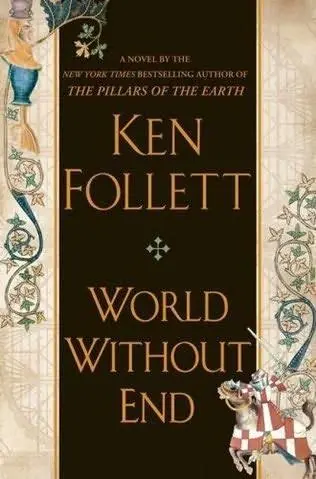
- Название:World Without End
- Автор:
- Жанр:
- Год:неизвестен
- ISBN:нет данных
- Рейтинг книги:5 / 5. Голосов: 1
-
Избранное:Добавить в избранное
- Отзывы:
-
Ваша оценка:
World Without End: краткое содержание, описание и аннотация
Предлагаем к чтению аннотацию, описание, краткое содержание или предисловие (зависит от того, что написал сам автор книги «World Without End»). Если вы не нашли необходимую информацию о книге — напишите в комментариях, мы постараемся отыскать её.
Ken Follett has 90 million readers worldwide. The Pillars of the Earth is his bestselling book of all time. Now, eighteen years after the publication of The Pillars of the Earth, Ken Follett has written the most-anticipated sequel of the year, World Without End.
In 1989 Ken Follett astonished the literary world with The Pillars of the Earth, a sweeping epic novel set in twelfth-century England centered on the building of a cathedral and many of the hundreds of lives it affected. Critics were overwhelmed-"it will hold you, fascinate you, surround you" (Chicago Tribune)-and readers everywhere hoped for a sequel.
World Without End takes place in the same town of Kingsbridge, two centuries after the townspeople finished building the exquisite Gothic cathedral that was at the heart of The Pillars of the Earth. The cathedral and the priory are again at the center of a web of love and hate, greed and pride, ambition and revenge, but this sequel stands on its own. This time the men and women of an extraordinary cast of characters find themselves at a crossroad of new ideas-about medicine, commerce, architecture, and justice. In a world where proponents of the old ways fiercely battle those with progressive minds, the intrigue and tension quickly reach a boiling point against the devastating backdrop of the greatest natural disaster ever to strike the human race-the Black Death.
Three years in the writing, and nearly eighteen years since its predecessor, World Without End breathes new life into the epic historical novel and once again shows that Ken Follett is a masterful author writing at the top of his craft.
World Without End — читать онлайн бесплатно полную книгу (весь текст) целиком
Ниже представлен текст книги, разбитый по страницам. Система сохранения места последней прочитанной страницы, позволяет с удобством читать онлайн бесплатно книгу «World Without End», без необходимости каждый раз заново искать на чём Вы остановились. Поставьте закладку, и сможете в любой момент перейти на страницу, на которой закончили чтение.
Интервал:
Закладка:
On Ralph’s right, at the end of the ridge, was a novelty: three new machines called bombards, or cannons, that used explosive powder to shoot round stones. They had been dragged all the way across Normandy but so far had never been fired, and no one was sure whether they would work. Today King Edward needed to use every means at his disposal, for the enemy’s superiority was somewhere between four-to-one and seven-to-one.
On the English left flank, the earl of Northampton’s men were drawn up in the same harrow formation. Behind the front lines, a third battalion led by the king stood in reserve. Behind the king were two fall-back positions. The baggage wagons formed the first, drawn up in a circle, with non-combatants – cooks, engineers and ostlers – inside the circle with the horses. The second was the wood itself where, in the event of a rout, the remnants of the English army could flee, and the mounted French knights would find it difficult to follow.
They had been here since early morning, with nothing to eat but pea soup with onions. Ralph was wearing his armour and had been sweltering in the heat, so the rainstorm had been welcome. It had also muddied the slope up which the French would have to charge, making their approach treacherously slippery.
Ralph could guess what the French tactics would be. The Genoese crossbowmen would shoot from behind their shields, to soften up the English line. Then, when they had done enough damage, they would step aside, and the French knights would charge on their warhorses.
There was nothing so terrifying as that charge. Called the furor fransiscus, it was the ultimate weapon of the French nobility. Their code made them disregard their own safety. Those huge horses, with riders so completely armoured that they looked like iron men, simply rolled over archers, shields, swords and men-at-arms.
Of course, it did not always work. The charge could be repulsed, especially where the terrain favoured the defenders, as it did here. However, the French were not easily discouraged: they would charge again. And they had such enormous superiority in numbers that Ralph could not see how the English could hold them off indefinitely.
He was scared, but all the same he did not regret being with the army. For seven years he had lived the life of action he had always wanted, in which strong men were kings and the weak counted for nothing. He was twenty-nine, and men of action rarely lived to be old. He had committed foul sins, but had been absolved of them all, most recently this morning, by the bishop of Shiring, who was now standing next to his father the earl, armed with a vicious-looking mace – priests were not supposed to shed blood, a rule they acknowledged cursorily by using blunt weapons on the battlefield.
The crossbowmen in their white coats reached the foot of the slope. The English archers, who had been sitting down, their arrows stuck point-first into the ground in front of them, now began to stand up and string their bows. Ralph guessed that most of them felt what he did, a mixture of relief that the long wait was over and fear at the thought of the odds against them.
Ralph thought there was plenty of time. He could see that the Genoese did not have the heavy wooden pavises that were an essential element of their tactics. The battle would not start until the shields were brought, he felt sure.
Behind the crossbowmen, thousands of knights were pouring into the valley from the south, spreading left and right behind the crossbowmen. The sun came out again, lighting up the bright colours of their banners and the horses’ coats. Ralph recognized the coat-of-arms of Charles, count of Alençon, King Philippe’s brother.
The crossbowmen stopped at the foot of the slope. There were thousands of them. As if at a signal, they all gave a terrific shout. Some jumped up in the air. Trumpets sounded.
It was their war cry, meant to terrify the enemy, and it might have worked on some foes, but the English army consisted of experienced fighting men who were at the end of a six-week campaign, and it took more than shouting to scare them. They looked on impassively.
Then, to Ralph’s utter astonishment, the Genoese lifted their crossbows and shot.
What were they doing? They had no shields!
The sound was sudden and terrifying, five thousand iron bolts flying through the air. But the crossbowmen were out of range. Perhaps they had failed to take account of the fact that they were shooting uphill; and the afternoon sun behind the English lines must have been shining in their eyes. Whatever the reason, their bolts fell uselessly short.
There was a flash of flame and a crash like thunder from the middle of the English front line. Amazed, Ralph saw smoke rising from where the new bombards were. Their sound was impressive, but when he returned his gaze to the enemy ranks he saw little actual damage. However, many of the crossbowmen were shocked enough to pause in their reloading.
At that moment, the prince of Wales shouted the order for his archers to shoot.
Two thousand longbows were raised. Knowing they were too distant to shoot in a straight line parallel with the ground, the archers aimed into the sky, intuitively plotting a shallow trajectory for their arrows. All the bows bent simultaneously, like blades of wheat in a field blown by a sudden summer breeze; then the arrows were released with a collective sound like a church bell tolling. The shafts, flying faster than the swiftest bird, rose into the air then turned downwards and fell on the crossbowmen like a hailstorm.
The enemy ranks were densely packed, and the padded Genoese coats gave little protection. Without their shields, the crossbowmen were horribly vulnerable. Hundreds of them fell dead or wounded.
But that was only the beginning.
While the surviving crossbowmen were rewinding their weapons, the English fired again and again. It took an archer only four or five seconds to pull an arrow from the ground, notch it, draw the bow, take aim, shoot and reach for another. Experienced, practised men could do it faster. In the space of a minute, twenty thousand arrows fell on the unprotected crossbowmen.
It was a massacre, and the consequence was inevitable: they turned and ran.
In moments the Genoese were out of range, and the English held their fire, laughing at their unexpected triumph and jeering at the enemy. But then the crossbowmen encountered another hazard. The French knights were moving forward. A dense herd of fleeing crossbowmen came head to head with massed horsemen itching to charge. For a moment there was chaos.
Ralph was amazed to see the enemy begin to fight among themselves. The knights drew their swords and started to hack the bowmen, who discharged their bolts at the knights then fought on with knives. The French noblemen should have been trying to stop the carnage but, as far as Ralph could see, those in the most expensive armour and riding the largest horses were at the forefront of the fight, attacking their own side with ever-greater fury.
The knights drove the crossbowmen back up the slope until they were again within longbow range. Once again the prince of Wales gave the order for the English archers to shoot. Now the hail of arrows fell among knights as well as bowmen. In seven years of warfare Ralph had seen nothing like this. Hundreds of the enemy lay dead and wounded, and not a single English soldier had been so much as scratched.
At last the French knights retreated, and the remaining crossbowmen scattered. They left the slope below the English position littered with bodies. Welsh and Cornish knifemen ran forward from the English ranks on to the battlefield and began finishing off the French wounded, retrieving undamaged arrows for the longbowmen to reuse, and no doubt robbing the corpses while they were at it. At the same time, boy runners got fresh stocks of arrows from the supply train and brought them to the English front line.
Читать дальшеИнтервал:
Закладка:
Похожие книги на «World Without End»
Представляем Вашему вниманию похожие книги на «World Without End» списком для выбора. Мы отобрали схожую по названию и смыслу литературу в надежде предоставить читателям больше вариантов отыскать новые, интересные, ещё непрочитанные произведения.


Обсуждение, отзывы о книге «World Without End» и просто собственные мнения читателей. Оставьте ваши комментарии, напишите, что Вы думаете о произведении, его смысле или главных героях. Укажите что конкретно понравилось, а что нет, и почему Вы так считаете.