Philippa Gregory - Earthly Joys
Здесь есть возможность читать онлайн «Philippa Gregory - Earthly Joys» — ознакомительный отрывок электронной книги совершенно бесплатно, а после прочтения отрывка купить полную версию. В некоторых случаях можно слушать аудио, скачать через торрент в формате fb2 и присутствует краткое содержание. Жанр: Историческая проза, на английском языке. Описание произведения, (предисловие) а так же отзывы посетителей доступны на портале библиотеки ЛибКат.
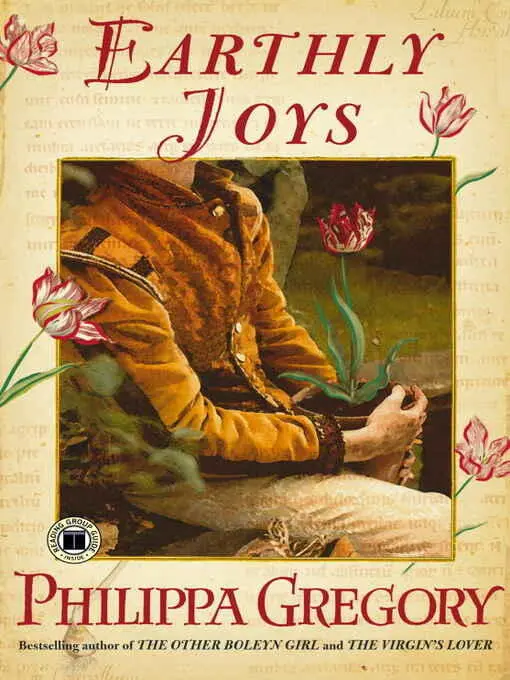
- Название:Earthly Joys
- Автор:
- Жанр:
- Год:неизвестен
- ISBN:нет данных
- Рейтинг книги:3 / 5. Голосов: 1
-
Избранное:Добавить в избранное
- Отзывы:
-
Ваша оценка:
Earthly Joys: краткое содержание, описание и аннотация
Предлагаем к чтению аннотацию, описание, краткое содержание или предисловие (зависит от того, что написал сам автор книги «Earthly Joys»). Если вы не нашли необходимую информацию о книге — напишите в комментариях, мы постараемся отыскать её.
Earthly Joys — читать онлайн ознакомительный отрывок
Ниже представлен текст книги, разбитый по страницам. Система сохранения места последней прочитанной страницы, позволяет с удобством читать онлайн бесплатно книгу «Earthly Joys», без необходимости каждый раз заново искать на чём Вы остановились. Поставьте закладку, и сможете в любой момент перейти на страницу, на которой закончили чтение.
Интервал:
Закладка:
“This way! Come on!” the queen said, and ran prettily down the stairs and out into the summer sunshine of the king’s privy garden.
“I want this garden full of scented flowers,” she told him. “The king’s windows look out over it; I want the scents to blow up to him.”
John nodded, taking in the grand sweep of the walls around the court. The south-facing walls would provide extra warmth; the walls to the east would provide shelter. “I could grow almost anything here,” he said.
“It was the king’s mother’s garden,” the queen said. It was evident from the slight movement of her head that she did not think much of her predecessor’s taste for low-growing herbs and knot gardens made of colored gravel. “I want roses against the walls and lilies everywhere. Those are my flowers, in my crest. I want this garden filled with roses and lilies to remind the king of me whenever he looks from his window.”
John bowed slightly. “Any preference as to colors?” he asked. “I can get some very handsome red and white roses, Rosamund roses. I have them growing at my garden in Lambeth.”
“Yes, yes,” she said, falling over the words in her haste. Even after five years in the country she still spoke English as if it was a strange and ugly foreign language. “And in the center bed I want a knot with our initials entwined. C and H M. Can you do that?”
John nodded. “Of course…”
She suddenly stiffened. “Of course, Your Highness,” she corrected him abruptly.
“I beg your pardon,” John said smoothly. “I was so interested in what Your Highness was saying that I forgot my manners. Of course, Your Highness.”
At once she smiled at him and gave him her hand to kiss. John bowed low and pressed his lips gently to the little fingers. His sense that he had served steadier, more intelligent and more noble masters did not show on his face.
“It is to be a garden which expresses Love,” she said. “The highest love there can be below the heavens. The love that there is between a man and his wife, and higher than that: between a king and a queen.”
“Of course, Your Majesty,” John said. “I could plant you some symbolic flowers around the roses. White violets for innocence, and periwinkle for constancy, and daisies.”
She nodded enthusiastically. “And one corner in blue as a tribute to Our Lady.” She turned her dark eyes on him. “Are you of the true faith, Tradescant?”
John thought briefly of Elizabeth in her gray Quaker-like gown, the staunch Baptist faith of his daughter-in-law and his promise to J that his conscience would not be offended by this work. He kept his face perfectly steady. “I attend the church of my fathers, Your Majesty,” he said. “I’m a simple gardener; I don’t think much of things other than plants and rarities.”
“You should think of your immortal soul,” she commanded. “And the church of your fathers is the church of Rome. I am always telling the king this!”
Tradescant bowed, thinking that she had just said enough to get both of them hanged if the king applied the laws of the land – which he manifestly only did when it suited him.
“And I shall want flowers for my chapel, for my private chapel,” she said. “Blue and white for Our Lady.”
“Of course, Your Majesty.”
“And for my private rooms, and strewing herbs, and the king wishes you to maintain and replant the physic garden and look at the herb garden.”
Tradescant bowed again.
“I want the house to be like a palace in a fairy tale,” she said, changing at once from the evangelical Roman Catholic into the flirtatious queen. “Like a bower for a fairy-tale Princess. I want people all over the country, all over Europe, to hear of it as a fairy-tale garden, a perfect garden. Have you heard of the Platonic ideal?”
John felt a sense of weariness he had never before known while talking about a garden. He had a sudden sympathy for the king, who had lost the easy male companionship of Buckingham and had no one to turn to but this vain woman.
The queen was laughing. “I suppose not!” she cried. “It does not matter, Gardener Tradescant. It is an idea which we make much of at court, in our masques and poetry and plays. I will just tell you that it is an idea that there is a perfect form of everything – of a woman, of a man, of a marriage, of a garden, of a rose, and the king and I want to attain that ideal.”
John glanced at her to see if she was speaking seriously. He thought of how the duke would have roared with laughter at the pedantry, at the pretentiousness. He would have slapped John on the back and called him Gardener Tradescant forever after.
“Think of it,” she said, her voice as sweet as syrup. “A perfect garden as a shell for a perfect palace for a perfect king and queen.”
“In a perfect country?” John asked incautiously.
She smiled. She had no sense that there might be anything behind his question but spellbound admiration. “Oh, yes,” she said. “How could it be otherwise when it is ruled by my husband, and by me?”
Summer 1631
John had thought he would enjoy some time away from his home – never in his life before had he been so settled and he feared that the domestic life of Lambeth would be too narrow for him. But he found that he missed the daily changing business of the Ark, the midsummer flowering of the garden and, more than anything else, the rapid changing of Frances, who grew, in the summer of 1631, from a rosebud-mouthed, lisping toddler to a little girl of rare determination.
He went home to Lambeth at every opportunity he could, to choose his stock from his own garden, and so that he could see his granddaughter. Each time he set off back to the palace, J would loiter in the stable yard, helping to pack the wagon with the heavy earthenware pots of plants.
“D’you need me at the palace?” he would ask, and John would drop his hand on his son’s shoulder.
“I can manage without you another week,” he would say. “I’ll tell you when I need you there.”
“I’ll come then,” J would promise. “As I agreed to.”
He would watch his father swing into the seat and go, and John would chuckle to himself at the seriousness of his beloved son who had bound himself in so many contradictory ways: to his conscience, to his promise, to his father, to his wife.
By the end of the summer John had completed the designs for the work in the king’s court, had shown them to the queen and was ready to start the labor of digging over the garden and replanting it. He had a team of men ready to start but he needed J to supervise the work while he went on to the queen’s court, so that it should be designed in time for autumn planting.
“Will you come back to the palace with me this time, J?” he asked as the family were seated on the terrace one evening. J was drinking a glass of small ale; John had a small tot of rum. “There’s the physic garden which needs replanting, and now the queen has asked for a flowery mead.”
Jane looked up from her sewing, affronted. “A what?”
John smiled. “A flowery mead,” he said. “Modeled on an old tapestry, those you see with the unicorn surrounded by hunters. It’s supposed to be like a meadow, a perfect meadow, with all the flowers of the field but no stinging nettles. You plant it with wild and garden flowers and then you cut a little path around it for the pleasure of walking with wildflowers.”
“Why not walk by a meadow, then?” Jane asked.
John took another sip of rum. “This is not a woman of sense, this is the queen. She would rather that everything was fashioned to perfection. Even a wildflower meadow. It’s an old fashion in gardening; I did not think to plant one again. And although it is supposed to look wild and untouched, it takes unending work to keep it in flower and keep the weeds checked.”
Читать дальшеИнтервал:
Закладка:
Похожие книги на «Earthly Joys»
Представляем Вашему вниманию похожие книги на «Earthly Joys» списком для выбора. Мы отобрали схожую по названию и смыслу литературу в надежде предоставить читателям больше вариантов отыскать новые, интересные, ещё непрочитанные произведения.



Обсуждение, отзывы о книге «Earthly Joys» и просто собственные мнения читателей. Оставьте ваши комментарии, напишите, что Вы думаете о произведении, его смысле или главных героях. Укажите что конкретно понравилось, а что нет, и почему Вы так считаете.