Jasper Kent - Thirteen Years Later
Здесь есть возможность читать онлайн «Jasper Kent - Thirteen Years Later» весь текст электронной книги совершенно бесплатно (целиком полную версию без сокращений). В некоторых случаях можно слушать аудио, скачать через торрент в формате fb2 и присутствует краткое содержание. Жанр: Историческая проза, Ужасы и Мистика, на английском языке. Описание произведения, (предисловие) а так же отзывы посетителей доступны на портале библиотеки ЛибКат.
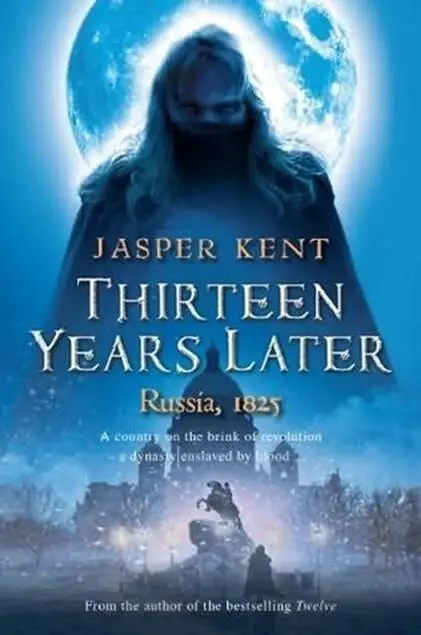
- Название:Thirteen Years Later
- Автор:
- Жанр:
- Год:неизвестен
- ISBN:нет данных
- Рейтинг книги:5 / 5. Голосов: 1
-
Избранное:Добавить в избранное
- Отзывы:
-
Ваша оценка:
Thirteen Years Later: краткое содержание, описание и аннотация
Предлагаем к чтению аннотацию, описание, краткое содержание или предисловие (зависит от того, что написал сам автор книги «Thirteen Years Later»). Если вы не нашли необходимую информацию о книге — напишите в комментариях, мы постараемся отыскать её.
Thirteen Years Later — читать онлайн бесплатно полную книгу (весь текст) целиком
Ниже представлен текст книги, разбитый по страницам. Система сохранения места последней прочитанной страницы, позволяет с удобством читать онлайн бесплатно книгу «Thirteen Years Later», без необходимости каждый раз заново искать на чём Вы остановились. Поставьте закладку, и сможете в любой момент перейти на страницу, на которой закончили чтение.
Интервал:
Закладка:
Aleksei turned his head forward, but his attention was not focussed on the exertions on stage. His mind tried to grapple with the possibilities, eliminating first the impossibilities. This was not Maks. He had never thought it would be, but the messages had ostensibly come from him, so it had to be included as a possibility. Any such pretence had now been abandoned. Moreover, it was not Iuda, nor was it Zmyeevich, nor any of the other Oprichniki. And there Aleksei’s logic ran out of facts which it might process. The initial flash of recognition had now vanished, but it had been there. The few words the man had spoken implied they had met before. Perhaps they had, in some fleeting moment Aleksei had long forgotten. But in connection with Maks and Maks’ death, Aleksei could think of no one.
The end of the act came quickly – too quickly for Aleksei, still desperately trying to understand who the man beside him could be.
‘Let me introduce myself.’ The man turned to him again as the hum of conversation in the theatre grew. He offered his hand. ‘My name is Innokyentii Sergeivich; Innokyentii Sergeivich Lukin.’
The Christian name meant nothing to Aleksei, and the patronymic could easily have been a coincidence, but combined with the surname, it was shockingly familiar. Even so, as they shook hands, with Aleksei momentarily as if in a trance, Innokyentii made the connotation clear.
‘I’m Maksim Sergeivich’s brother.’
‘Maks…’ gasped Aleksei. Again his mind raced, supplied with this new information. Maks’ brother. Did that explain why Aleksei had seen something he recognized the moment he saw Innokyentii’s face? He could not see anything in it now. Had Maks even had a brother? He had sisters, Aleksei recalled, but could not remember ever hearing of a brother. This man was around Dmitry’s age – much younger than Maks. He would have been about five when Maks had died. Perhaps a half-brother? If so, the name would suggest that it was their father whom they shared, and yet Aleksei was sure that Maks’ father had died when he was very young. Of course, what did Aleksei really know of Maks? He had never met any of his family, and had only Maks’ descriptions of who they were – the descriptions of a man who had lied for as long as they had known each other about the very matter of his national allegiance. Perhaps he had been hiding his brother, protecting him from the revelation that he was also a French spy. How little did that matter today? France was a monarchy again – an ally of Russia. It made no real difference where Innokyentii’s loyalties lay. Nor Maks’.
‘I didn’t know Maks had a brother,’ said Aleksei directly. ‘You must have been very young when he died.’
‘I understand your suspicions, Aleksei. I could be anyone. Perhaps this will convince you.’ He reached into his pocket and pulled out a folded letter, handing it to Aleksei. As soon as Aleksei opened it, he recognized the handwriting – it was his own. The date at the top was 29 August 1812. It began:
My dear Yelizaveta Malinovna…
Aleksei understood immediately what the letter was, but self-indulgently read through it, down to his own signature at the bottom. It told a mother the story of the heroic death of her son on the field of battle. The detail was invented, but the sentiment was true, truer than Aleksei had first realized when he had written the letter to Maks’ mother.
‘Mother gave it to me to help prove my bona fides,’ said Innokyentii. ‘Of course, I scarcely remember my brother, but he often spoke to Mama of you, and she in turn has told me much. Maks had a good friend in you.’
Aleksei refolded the letter. It meant nothing. It was certainly genuine, but it could easily have been stolen. Maks’ mother might not even be alive any more – the letter could have been picked up in an auction room disposing of her possessions. He was about to hand it back, but decided to call Innokyentii’s bluff.
‘I’ll return this to Yelizaveta Malinovna when I see her,’ he said.
‘That’s very kind of you. She’ll be so glad to meet you after all these years.’
The orchestra struck up again and the dancers returned to the stage. Aleksei lowered his voice, his whisper adding to his tone of mistrust.
‘You’ll forgive my suspicion, Innokyentii Sergeivich, but I fail to see why, if you are Maks’ brother, you’ve been so contrived in approaching me.’
‘Please, let’s not be so formal. You called my brother Maks – call me Kyesha.’ Aleksei made no reply. ‘And as to my caution?’ continued Kyesha. ‘I felt it wise to be circumspect. You did murder my brother, after all.’
The music rose in a sudden crescendo, becoming too loud for Aleksei to speak over. He looked over at Kyesha, whose eyes were fixed on the stage, as though his only reason for being there was to take in the entertainment, as though the last words Aleksei had heard had never passed his lips.
Aleksei turned back to face the ballet as well. Kyesha’s silence gave him time to consider. The first possibility was that he – Aleksei – had gone mad. Accusations that he was responsible for Maks’ death had been levelled at him before, but only by his own mind, awake and in dreams. This did not feel like a dream, but could it be that Kyesha was just a projection of his own conscience? Aleksei smiled to himself. It was possible, but unlikely. Anyone who knew of the circumstances of Maks’ death could twist them in the same way as did parts of Aleksei’s own mind. So how had Kyesha learned of the circumstances? Not through Aleksei’s letter. But all the Oprichniki knew what had happened. Beyond that, Aleksei had told Vadim and Dmitry Fetyukovich. And Domnikiia. Even Marfa knew something of it. However the details had reached Kyesha, no mystery was needed to explain it.
‘I’m sorry.’ Kyesha’s voice whispered in Aleksei’s ear, as if commenting on the performance. ‘“Murder” is too strong a word. But you were responsible for Maks’ death.’
Aleksei had no reply to make. He sat in silence, his eyes fixed on the stage. It was not long before the ballet came to its end, and the audience erupted in applause. Many of them rose to their feet, Kyesha included, his hands beating together rapidly to express his apparent pleasure. Aleksei stood and joined him. He had paid little attention to the quality of what he had seen that evening, but the rest of the audience had clearly found it superb.
‘We’ll meet again,’ shouted Kyesha over the noise. He was a little shorter than Aleksei, who bent forward to hear him. ‘Each evening for a week. I’m sure you can guess the time and places.’
As Kyesha was speaking, Aleksei’s eyes had been on the stage, not out of a particular interest in the curtain calls, but simply as a result of his stooped posture. He stood upright and then turned to ask Kyesha what he meant, but he had gone. Aleksei looked into the aisle, but already others were leaving their seats and heading out of the theatre. Aleksei could not distinguish the figure of Kyesha amongst them and, even had he been able to, he would have had to fight his way through the crowd to reach him.
Besides, he already understood what Kyesha meant. The clue was where he was that very night: the Bolshoi Theatre – or, at least, the theatre in Petrovsky Square – on a Saturday night. It was the first, or perhaps the last, on a list of seven days and seven locations within Moscow itself. During Bonaparte’s occupation, Aleksei and his comrades had needed a way to keep in touch as they worked to undermine the strength of the invading forces. To meet at the same place every evening would raise suspicion, but seven locations on subsequent nights – each at nine o’clock – should, and did, prevent their being detected. Kyesha had already been careful to replay the events of that terrible autumn, so many years before, with the coded message, the hidden envelope at Desna and now a Saturday meeting at the theatre. It could only be that he intended to keep to the list.
Читать дальшеИнтервал:
Закладка:
Похожие книги на «Thirteen Years Later»
Представляем Вашему вниманию похожие книги на «Thirteen Years Later» списком для выбора. Мы отобрали схожую по названию и смыслу литературу в надежде предоставить читателям больше вариантов отыскать новые, интересные, ещё непрочитанные произведения.






Обсуждение, отзывы о книге «Thirteen Years Later» и просто собственные мнения читателей. Оставьте ваши комментарии, напишите, что Вы думаете о произведении, его смысле или главных героях. Укажите что конкретно понравилось, а что нет, и почему Вы так считаете.