Jasper Kent - Thirteen Years Later
Здесь есть возможность читать онлайн «Jasper Kent - Thirteen Years Later» весь текст электронной книги совершенно бесплатно (целиком полную версию без сокращений). В некоторых случаях можно слушать аудио, скачать через торрент в формате fb2 и присутствует краткое содержание. Жанр: Историческая проза, Ужасы и Мистика, на английском языке. Описание произведения, (предисловие) а так же отзывы посетителей доступны на портале библиотеки ЛибКат.
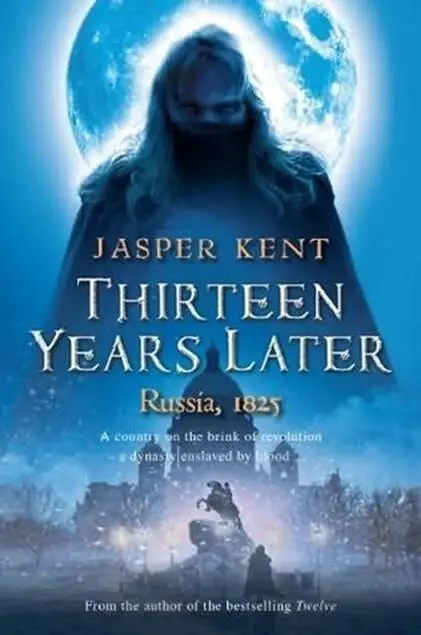
- Название:Thirteen Years Later
- Автор:
- Жанр:
- Год:неизвестен
- ISBN:нет данных
- Рейтинг книги:5 / 5. Голосов: 1
-
Избранное:Добавить в избранное
- Отзывы:
-
Ваша оценка:
Thirteen Years Later: краткое содержание, описание и аннотация
Предлагаем к чтению аннотацию, описание, краткое содержание или предисловие (зависит от того, что написал сам автор книги «Thirteen Years Later»). Если вы не нашли необходимую информацию о книге — напишите в комментариях, мы постараемся отыскать её.
Thirteen Years Later — читать онлайн бесплатно полную книгу (весь текст) целиком
Ниже представлен текст книги, разбитый по страницам. Система сохранения места последней прочитанной страницы, позволяет с удобством читать онлайн бесплатно книгу «Thirteen Years Later», без необходимости каждый раз заново искать на чём Вы остановились. Поставьте закладку, и сможете в любой момент перейти на страницу, на которой закончили чтение.
Интервал:
Закладка:
‘It will be next year – the summer, I would guess; once Aleksandr returns to Petersburg. His death will be the signal.’
‘His death?’ For a moment, Aleksei wondered whether the idea was too much for the young officer to stomach. ‘But how can we predict that?’ Aleksei gave him a stony look. It didn’t take long for realization to dawn. ‘Oh, I see,’ he said. ‘It’s for the good of the country, I suppose.’
It was a debate Aleksei had had with Maks, long ago. He could not remember precisely when. Maks had spoken of the benefit to the country (for Maks, the country would as likely have been France as Russia), but he had seemed to forget that a country is only a grouping of citizens within a geographical boundary. The tsar was a citizen of Russia, but his death would not do him any good.
‘Would you kill a serf, if it was for the good of the country?’ Aleksei knew he shouldn’t get into such discussions, not here, but it was likely that Obukhov would assume that he was simply playing devil’s advocate.
‘We’re doing this for the serfs,’ said Obukhov earnestly. Maks would have come up with a better answer. Would Obukhov, he wondered, kill ten million serfs to liberate ten million and one? Aleksei suddenly remembered where he had had that conversation with Maks. It was in that hut near Desna, moments before Maks had died. He gulped down his vodka and raised his hand to order another. He wondered whether he should press the point with Obukhov, but before he could, they were interrupted by a sound from the next room.
A piano had started playing, and after a few bars, voices joined it. The song was ‘Where Are Those Islands?’ Aleksei, like many of those present, was personally acquainted with the lyricist. He had spoken to him only days before. It was Kondraty Fyodorovich Ryleev, leader of the Northern Society, in whose house Aleksei had but recently discussed the very assassination of which he had just informed Obukhov. Ryleev was a poet of some standing, and works such as ‘Where Are Those Islands?’ were sung in the most conservative of establishments. Other pieces, which revealed more of his politics, were not. Sometimes he was mentioned in the same breath as Pushkin – in terms of politics as well as talent – but Pushkin was more idealistic, which not only benefited his poetry, but kept him away from serious revolutionary groups such as this one; that and exile to the south, though as far as Aleksei knew, he had not become involved with the Southern Society.
Along with most of the other officers in the room, Aleksei and Obukhov made their way through to join in with the singing. The adjoining room was much larger, with space in the middle of the floor large enough to dance, as two or three men were attempting to do, little though the tempo of the song suggested it. Most were thronged around the piano, obscuring it from view. They were drunk enough to sing and, for the most part, not so drunk as to sing badly.
Aleksei felt his lips moving in time with the words, and a few quiet notes formed in his voicebox. The idea of singing out loud did not appeal to him – certainly not the idea of others hearing him – but he enjoyed joining in, being part of the spontaneous choir. He had lost sight of Obukhov, but he gradually pressed his way through the crowd towards the piano. The pianist was doing a marvellous job, not simply accompanying, but introducing decorations and countermelodies, and yet never outshining the singers themselves.
At last, Aleksei got within sight of the man at the piano. As their eyes met, Aleksei felt the words of the song freeze in his throat. It would have been an acute ear that noticed the briefest of caesurae in Dmitry’s playing, but after he saw his father, his accompaniment reduced in complexity to being simply that. The virtuoso flourishes that had previously adorned his playing vanished.
Aleksei had never suspected that his son might have anything to do with the Northern Society. For one thing, he was far too young. For another, he had never been out of Russia – excepting one brief visit to Warsaw – never to the West. The two reasons were really the same reason. It was in Paris that the soldiers who had fought Napoleon, routed him from their own land and pursued him across a continent, discovered the true nature of what they had been fighting. For many, particularly the young, it was paradise. For Aleksei it came close, but he had been old enough to understand that it was a paradise that could never be achieved in Russia. The idea of Heaven on earth brings with it, inescapably, the concept of the final destruction of earth. And Russia was the most earthly nation imaginable. More than that, Aleksei knew that even France was no utopia, for how could a utopia have produced the monster Bonaparte? He had dragged half a million men across Europe into Russia and returned with less than a hundred thousand. That didn’t even take into account the Russians who had died. Whatever blessings the French Revolution had brought, it had not brought peace, and Aleksei had fought in enough battles to love peace above all things; even above freedom.
Thus, although there were a few in the Northern Society of Aleksei’s age, and older, he was too old to be a typical member. Similarly, Dmitry was too young; too young and too Russian. But if Dmitry had somehow acquired revolutionary ideas during his short life, they could only have come from one source – Aleksei himself. It would be appropriate. Aleksei’s own father had had little education, and yet his love of the idea of learning had been passed down to Aleksei to become in him a reality. Had Aleksei’s talk of liberty similarly become in his son a concrete desire to bring that liberty about, no matter what the cost?
Aleksei’s eyes locked with his son’s for less than a second. He could see questions in Dmitry’s face that were no less confused than those in his own mind. For Dmitry to learn that his father mixed with those who openly plotted to overthrow the tsar would be more shocking than anything Aleksei could feel at the reverse discovery. He did not wait for his son to ask those questions. He turned and fled – walking calmly and unhurriedly, yet still his action could only be described as flight – walking out of the room, out of the building and into the cool, darkening evening of Lubyanka Square.
Aleksei had not had far to walk to reach that evening’s rendezvous. Red Square was a very different place from what it had been when he first met the Oprichniki there in 1812. Before that – only days before – it had been different again, filled with shops and stalls that obscured the huge majesty of the open space that lay to the east of the Kremlin. By the time Aleksei had had his meetings there, during the French occupation, most of those primitive wooden buildings had been burnt to nothing, and the stone ones had suffered almost as badly. The rebuilt square was less cluttered. There were still shops on the east side, but nothing taller than a single storey. Nothing had been built that would hide Saint Vasiliy’s or the Kremlin itself. Beyond the cathedral, on the hill down to the river, there was a mess of new buildings, but they were scarcely visible from the square. Even viewed from the south, Saint Vasiliy’s managed to dwarf them.
It was a little after eight when Aleksei arrived. He preferred the square as it was now, though he would have liked it even more if it had been completely clear – of shops, at least. He would have broken down and cried if Saint Vasiliy’s had become a victim of the fires. He stood briefly to look up at the statue of Minin and Pozharskiy taking pride of place in the centre of the square. This was the kind of clutter he appreciated, even though it was less than a decade old. The heroic events it commemorated were over two centuries old, back in the ‘Time of Troubles’. Boris Godunov – one of the original Oprichniki after whom the monsters Aleksei had encountered had been given the epithet – had declared himself emperor, but the entire nation had come under threat from a Polish invasion, which had besieged the Kremlin. It was only when a prince, Dmitry Mihailovich Pozharskiy, and a butcher, Kuzma Minich Minin, had raised an army of Muscovites that the Poles were driven out. The year was 1612. It was always the twelves. 1612: liberation from the Poles, which led almost immediately to the foundation of the Romanov dynasty. 1712: the year Saint Petersburg became the capital – Aleksei might not have liked it, but he couldn’t deny its place in history. 1812: the defeat of Bonaparte – an event that had not merely changed Russia, but the entire world. What, Aleksei wondered, would happen in 1912 that would be so globally significant that it could compare with the happenings of a century, two centuries, three centuries before? Aleksei would not be around see it. Neither would his children – but his children’s children? Perhaps.
Читать дальшеИнтервал:
Закладка:
Похожие книги на «Thirteen Years Later»
Представляем Вашему вниманию похожие книги на «Thirteen Years Later» списком для выбора. Мы отобрали схожую по названию и смыслу литературу в надежде предоставить читателям больше вариантов отыскать новые, интересные, ещё непрочитанные произведения.




Обсуждение, отзывы о книге «Thirteen Years Later» и просто собственные мнения читателей. Оставьте ваши комментарии, напишите, что Вы думаете о произведении, его смысле или главных героях. Укажите что конкретно понравилось, а что нет, и почему Вы так считаете.