Jasper Kent - Thirteen Years Later
Здесь есть возможность читать онлайн «Jasper Kent - Thirteen Years Later» весь текст электронной книги совершенно бесплатно (целиком полную версию без сокращений). В некоторых случаях можно слушать аудио, скачать через торрент в формате fb2 и присутствует краткое содержание. Жанр: Историческая проза, Ужасы и Мистика, на английском языке. Описание произведения, (предисловие) а так же отзывы посетителей доступны на портале библиотеки ЛибКат.
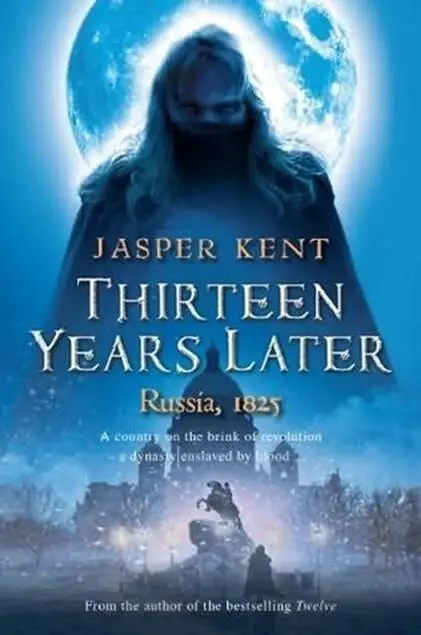
- Название:Thirteen Years Later
- Автор:
- Жанр:
- Год:неизвестен
- ISBN:нет данных
- Рейтинг книги:5 / 5. Голосов: 1
-
Избранное:Добавить в избранное
- Отзывы:
-
Ваша оценка:
Thirteen Years Later: краткое содержание, описание и аннотация
Предлагаем к чтению аннотацию, описание, краткое содержание или предисловие (зависит от того, что написал сам автор книги «Thirteen Years Later»). Если вы не нашли необходимую информацию о книге — напишите в комментариях, мы постараемся отыскать её.
Thirteen Years Later — читать онлайн бесплатно полную книгу (весь текст) целиком
Ниже представлен текст книги, разбитый по страницам. Система сохранения места последней прочитанной страницы, позволяет с удобством читать онлайн бесплатно книгу «Thirteen Years Later», без необходимости каждый раз заново искать на чём Вы остановились. Поставьте закладку, и сможете в любой момент перейти на страницу, на которой закончили чтение.
Интервал:
Закладка:
‘For three then?’ asked Kyesha, misinterpreting Aleksei’s silence. Aleksei nodded, and Kyesha collected the bones without trouble.
‘No,’ said Aleksei. ‘Dmitry didn’t kill Maks either.’ It was as accurate as the answer he had just given concerning himself.
‘There was a famous Dmitry died at this very spot, wasn’t there?’ said Kyesha. Aleksei said nothing, surprised by the change of subject. He glanced down at the knucklebones. Kyesha misread the gesture. ‘You’re not going to make me play for an answer to a question like that, are you?’
Aleksei smiled. ‘I suppose not. You’re right. That was 1606. The first “False Dmitry”.’
‘There was more than one?’
‘There were three – each claiming, falsely, to be the missing heir to the late tsar, Ivan IV. All in the Time of Troubles. He didn’t last long. When the mob had finished with him, they left his body here.’ Aleksei was a little surprised that Kyesha didn’t know all this, but Maks too had had surprising gaps in his knowledge of Russian history. On the other hand, Kyesha might just have been playing dumb. ‘You know why they call this thing Lobnoye Mesto?’ he asked.
‘“Ee, preedya na mesto, nazivayemoye Golgofa, shto znacheet: Lobnoye Mesto…”’ Kyesha recited the words in a monotone, as if he had learned them by rote, long ago, as any good Christian should have. ‘Matthew 27:33,’ he added.
‘And they came to a place named Golgotha, which means: the Place of the Skull…’ At least, that was how the French described it, presumably from the Greek. The literal meaning of the Russian term ‘Lobnoye Mesto’ was closer to ‘the Place of the Forehead’, though that sense was usually forgotten. It was now a phrase that, in reality, meant simply ‘the Place of Execution’. Either way, it was just a description of a rocky outcrop near Jerusalem two millennia before which had a passing resemblance to a human skull, and whatever the etymology, this place represented to the Orthodox Church and to many Russians the spot upon which Christ was crucified.
Aleksei suddenly felt uncomfortable, sitting in the dark in this holy place, gambling with knucklebones, even if they weren’t playing for money. ‘Can we go?’ he said.
‘Just one more round,’ said Kyesha. ‘Look – I’ve already cast.’ Four bones lay on the stone floor, and Kyesha had already picked up the fifth, ready to throw it. ‘Who did kill Maks? For two.’
Aleksei shook his head. He had no reason not to answer the question, but he felt a sudden urge to make life difficult for Kyesha.
‘For three?’
‘For four,’ said Aleksei.
Kyesha considered for a moment, then nodded. He threw the bone into the air, no higher than he had done for earlier rounds. His hand moved at tremendous speed across the stone slabs as it picked up the other bones, faster than Aleksei could have managed – faster than any human could have managed, and the implication was not lost on Aleksei. Kyesha had plenty of time to pluck the last, falling bone from the air before it was anywhere near the ground.
‘So…’ he said.
‘Maks was killed by six Wallachian mercenaries, from a group that at the time numbered nine in total. We called them the Oprichniki, as a joke.’ Aleksei could not recall a moment when it had been funny. ‘Originally there were twelve of them, but Maks had handed three over to the French, who executed them. That’s why the others wanted revenge.’ There had been a time – a very brief period – when that was essentially the story as Aleksei himself had believed it, before he had discovered that all but one of those mercenaries were in fact vampires. He doubted whether Kyesha would have gone to all this effort if his concerns were not in some way related to that fact – it was more than conceivable that he was a voordalak himself; Aleksei had never seen him in daylight. But that sort of information could keep until Aleksei was more certain of its value.
‘What were their names?’ asked Kyesha.
Aleksei pushed the knucklebones towards him. ‘That’s another question,’ he said.
Suddenly, the dais in which they were sitting was filled with light. They both looked towards it. Aleksei’s eyes adjusted, and he saw that its source was no more than a lantern.
‘You can’t sleep here,’ said a voice emanating from behind the light. Aleksei was taken back for a moment to the French occupation, when enemy soldiers had constantly harassed him and other Russians who had remained in the city. But this voice spoke in Russian, not French. It was one of the guards from the nearby Saviour’s Gate of the Kremlin. Aleksei rose to his feet. He would have needed only to show the guard his identification papers for the man to be running back and forth between the Kremlin and the Lobnoye Mesto, bringing them tea and vodka and anything else they might ask for, but he preferred to let the evening end there.
He walked down the stone steps, back into Red Square. Kyesha followed him. The soldier stood above them, at the entrance to the platform, waiting to see that they left.
‘Until tomorrow,’ said Kyesha. He gave a half-hearted salute and then turned away, heading down the hill towards the river. Aleksei’s journey took him north. When he was halfway across the square he glanced back and could see the glimmer of the guard’s lantern as he stood waiting at the Place of the Skull. The next time he looked, the light had gone.
Domnikiia was not asleep when Aleksei slipped into bed beside her. He had kissed Tamara lightly on the forehead as she slept, and she had not woken.
‘Where have you been?’ asked Domnikiia.
It wasn’t a question she normally asked. She knew the nature of his work, and knew therefore that there was much he could not share with her.
‘Just… seeing people,’ he said. ‘You know.’ He gazed up into the darkness, fixing his eyes on a ceiling he could not see. He felt Domnikiia roll over towards him. Her cool, naked thigh curled over his and he felt her cheek on his chest. Her arm reached across him and she squeezed him tightly to her. He stroked her long, dark hair. She said nothing. There was a melancholy to her that he had only known once before, many years ago.
‘What is it?’ he asked.
‘They’re back, Lyosha,’ she said softly.
He was tempted to reply with a patronizing ‘Who?’, but Domnikiia knew him well enough not to be fooled by it. Ever since he’d seen that red lettering scrawled on the walls of his study in Petersburg, he’d known that, in some sense or other, they were back.
‘How do you know?’ he asked.
‘Yelena Vadimovna told me. There’s been a murder – at least, that’s what they’re calling it. A man. They found him out near… near where I used to work. But it wasn’t murder. She told me about the body. The blood. The throat. It sounds just like Margarita.’ The image of the corpse of Domnikiia’s friend and colleague Margarita Kirillovna lying on her bed, naked, with her throat ripped open flashed into Aleksei’s mind. Once he had had no further use for her, Iuda had slaughtered her. Of course, Iuda was not a voordalak, but in killing he had impersonated one. And though Domnikiia had not, Aleksei had seen the bodies of enough victims of true vampires to know that it was a precise impersonation.
‘That could be just exaggeration,’ said Aleksei. ‘Someone’s throat is slit and rumour blows it out of all proportion. It would have been at least third hand by the time it got to Yelena.’
‘I’d have thought that, if you hadn’t come dashing down here to see who left you that message. Did you find him?’
Aleksei had not told her anything since his visit to the theatre. She had not asked, but now that she did, she deserved an answer.
Читать дальшеИнтервал:
Закладка:
Похожие книги на «Thirteen Years Later»
Представляем Вашему вниманию похожие книги на «Thirteen Years Later» списком для выбора. Мы отобрали схожую по названию и смыслу литературу в надежде предоставить читателям больше вариантов отыскать новые, интересные, ещё непрочитанные произведения.








Обсуждение, отзывы о книге «Thirteen Years Later» и просто собственные мнения читателей. Оставьте ваши комментарии, напишите, что Вы думаете о произведении, его смысле или главных героях. Укажите что конкретно понравилось, а что нет, и почему Вы так считаете.