Jasper Kent - Thirteen Years Later
Здесь есть возможность читать онлайн «Jasper Kent - Thirteen Years Later» весь текст электронной книги совершенно бесплатно (целиком полную версию без сокращений). В некоторых случаях можно слушать аудио, скачать через торрент в формате fb2 и присутствует краткое содержание. Жанр: Историческая проза, Ужасы и Мистика, на английском языке. Описание произведения, (предисловие) а так же отзывы посетителей доступны на портале библиотеки ЛибКат.
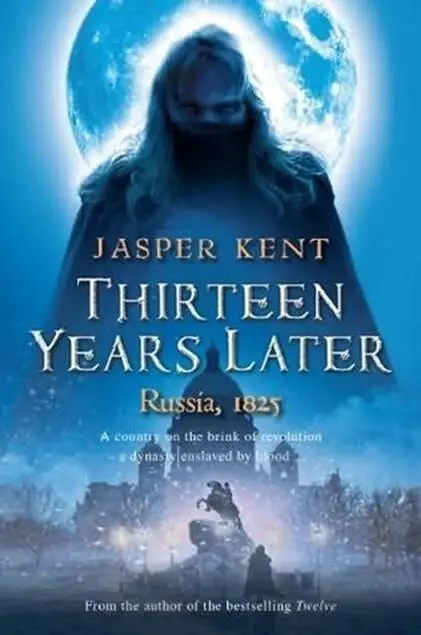
- Название:Thirteen Years Later
- Автор:
- Жанр:
- Год:неизвестен
- ISBN:нет данных
- Рейтинг книги:5 / 5. Голосов: 1
-
Избранное:Добавить в избранное
- Отзывы:
-
Ваша оценка:
Thirteen Years Later: краткое содержание, описание и аннотация
Предлагаем к чтению аннотацию, описание, краткое содержание или предисловие (зависит от того, что написал сам автор книги «Thirteen Years Later»). Если вы не нашли необходимую информацию о книге — напишите в комментариях, мы постараемся отыскать её.
Thirteen Years Later — читать онлайн бесплатно полную книгу (весь текст) целиком
Ниже представлен текст книги, разбитый по страницам. Система сохранения места последней прочитанной страницы, позволяет с удобством читать онлайн бесплатно книгу «Thirteen Years Later», без необходимости каждый раз заново искать на чём Вы остановились. Поставьте закладку, и сможете в любой момент перейти на страницу, на которой закончили чтение.
Интервал:
Закладка:
Aleksei mounted his horse soon after dawn. He took one final look at Maks’ grave, and hoped he would never return. He had no need of a memorial to remember his friend, and he had never felt the urge to return here in all the years since his death. He had only come now because he had been led here. He reached into his pocket and pulled out the theatre ticket. He had three days until the performance. He enjoyed ballet, and though he knew the story of Cinderella well, he had not seen this version. Perhaps this whole journey had been an elaborate way of giving him a present, though his birthday was long past. Perhaps it was just a ploy by Domnikiia to bring him to Moscow.
He laughed at the thought. She needed no such ploys, and whatever the reason he had been invited to the theatre, it was not for entertainment.
He spurred his horse and headed back to Moscow. He did not look behind him again.
Aleksandr could see the small cortège from quite a distance. It had surprised him how much he had missed the company of the tsaritsa. It had been his grandmother Yekaterina who had arranged their marriage, more than thirty years before, as she had arranged everything in his life. She had brusquely decided that neither Aleksandr’s mother nor his father – her own son, the future Tsar Pavel – was fit to raise their child. Yekaterina had controlled every aspect of Aleksandr’s upbringing, from his education to his marriage to Yelizaveta at the age of just fifteen. He had quickly learned to hate his wife, but had grown to despise his grandmother more. He had learned from her too, though. Her reign had been founded on the untimely death of her husband; Aleksandr’s similarly, on the death of his father. Both had successfully kept their hands clean; the garde perdue was not a new idea.
But time had changed Aleksandr’s attitudes, towards both his wife and his grandmother. Russia was a difficult country to rule, and Yekaterina had known that it needed a tsar who emulated his babushka more than it needed one who loved her. He could almost sense her approval of his plans for dealing with the rebels back in Petersburg.
And he had grown to realize the wisdom in her choice of Yelizaveta Alekseevna as his consort. What had seemed at first merely an unhappy political union had evolved into a mutually supportive friendship. He was not restricted to the concept that a man’s wife should be his only lover – Grandmother, of all people, would not have espoused that. Even so, they had had two children, daughters, who had both died before their second birthdays. It seemed too long ago now to think of their deaths as tragedies. Aleksandr had lost another child far more recently. Sophia, his daughter by Maria Naryshkina, had died of consumption in 1824. She had been eighteen. His other daughter with Maria, Zinaida, had died at the age of just four. He had other children by other mistresses, the youngest only four years old, but he thanked the Lord on all their behalves for blessing them with the gift of bastardy. None would inherit from him the heavy yoke that was the crown.
None of this was a secret to the tsaritsa; nor were her infidelities to him. When Sophia died, Yelizaveta had been a great comfort to him, and her own illness had in turn proved to them both how much they cared for each other. For Aleksandr, the future – these next few months in particular – was unclear. To have his wife with him, perhaps for the last time, would be a consolation.
The carriages were closer now. He stood impassively, not wanting to appear over-eager to see his wife, even though he had ridden out specifically to accompany her on the final leg of the journey. She had arrived only ten days after him, and he hoped she had not tired herself. In Taganrog that evening, their first port of call would be the monastery, where the abbot and the monks would line up to greet the tsaritsa, and then a service of thanksgiving would be performed. Her rooms in the palace were all prepared.
But as much as Aleksandr would be pleased to see his wife again, he was impatient for the arrival of another in her party, Prince Volkonsky – a man who was indispensable when it came to matters of state. Volkonsky had been one of those who had overthrown Aleksandr’s father in 1801 – one of the few whom Aleksandr had subsequently allowed to remain close to the throne. Wylie had been another, though he had been less involved – less involved even than Aleksandr. The Scottish doctor had merely signed a politically acceptable death certificate for Pavel, blaming the death on apoplexy. It was strange how those two men remained so close to him. The dispersal of the others to various backwaters of the empire had not been the outpouring of Aleksandr’s guilty conscience; it was simply wise to make it clear to the world that one was unlikely to prosper by daring to overthrow a tsar. Babushka would have been proud.
The retinue of coaches and horses finally drew up. Aleksandr went over to his wife’s carriage and held out his hand to help her down. As she smiled at him, and he at her, he worried that she would notice the swelling tear that had formed in his eye. If she did, he hoped she would take it as an outward sign of the emotion he felt at their being reunited. In truth, that was not the cause. The tear was merely a sign that the tsar’s thoughts had once again turned to his beautiful, young, departed daughter Sophia.
‘Mama!’
Domnikiia turned from the window and looked over to Tamara. Tamara grinned, but could detect a falseness in the smile that her mother returned. She had had no reason to call out, except to cause a reaction. It was simple, safe and reliable. Call out ‘Mama!’ and Mama would reply. It was a confusing word though; sometimes people – visitors to the house – would think that Mama Yelena was Tamara’s mama, and she was told not to contradict them. That’s why she thought of her as Mama Yelena, so, when she spoke to her, she just had to remember not to say ‘Yelena’ and everyone was happy. But she didn’t call her mama ‘Mama Domnikiia’, even though she knew Domnikiia was her name. She was just ‘Mama’ because she was Tamara’s mama. That part was simple.
‘Papa’ was a really difficult word. She never called Valentin Valentinovich Papa, although Rodion did. And Rodion called Mama Yelena Mama. She’d made the mistake once – calling Valentin Valentinovich her ‘Papa’ – and he’d scowled at her, but hadn’t shouted. She remembered him shouting once before at her, when she was very young, and Mama Yelena had said something about Aleksei being her friend and this being her house, and Valentin Valentinovich hadn’t shouted again.
Aleksei was the man who had started visiting again. He was the one that Mama said she should call Papa. She’d told her that before, last time he was here, but Tamara had forgotten. Papa was very nice, whenever he was here, unlike Valentin Valentinovich, who was sometimes nice and sometimes wasn’t. But he was here most of the time, and so, overall, he was nice more often than Papa was. So ‘Papa’ didn’t just mean a different person to her and to Rodion, it also meant a different thing. She preferred her person, but she preferred Rodion’s thing.
‘Mama!’ she shouted again.
Domnikiia turned again. ‘Yes, my darling?’
‘Do you miss Papa?’
Domnikiia smiled, more genuinely this time. ‘Whenever he’s not here. Don’t you?’
Tamara shook her head firmly. ‘I don’t see him enough. If he was here more often, I’d probably miss him when he wasn’t.’
‘He’ll be here for a while. He came back from Desna, didn’t he?’
Tamara nodded. When Papa had left again, so soon after arriving, she’d been upset. She’d woken up early and run into her mama’s room to find her alone and sad. She’d explained that Papa had had to go to Desna, but would be back soon. Tamara vaguely remembered being told he’d be back soon last time he went away, but he hadn’t been – not soon.
Читать дальшеИнтервал:
Закладка:
Похожие книги на «Thirteen Years Later»
Представляем Вашему вниманию похожие книги на «Thirteen Years Later» списком для выбора. Мы отобрали схожую по названию и смыслу литературу в надежде предоставить читателям больше вариантов отыскать новые, интересные, ещё непрочитанные произведения.





Обсуждение, отзывы о книге «Thirteen Years Later» и просто собственные мнения читателей. Оставьте ваши комментарии, напишите, что Вы думаете о произведении, его смысле или главных героях. Укажите что конкретно понравилось, а что нет, и почему Вы так считаете.