Jasper Kent - Thirteen Years Later
Здесь есть возможность читать онлайн «Jasper Kent - Thirteen Years Later» весь текст электронной книги совершенно бесплатно (целиком полную версию без сокращений). В некоторых случаях можно слушать аудио, скачать через торрент в формате fb2 и присутствует краткое содержание. Жанр: Историческая проза, Ужасы и Мистика, на английском языке. Описание произведения, (предисловие) а так же отзывы посетителей доступны на портале библиотеки ЛибКат.
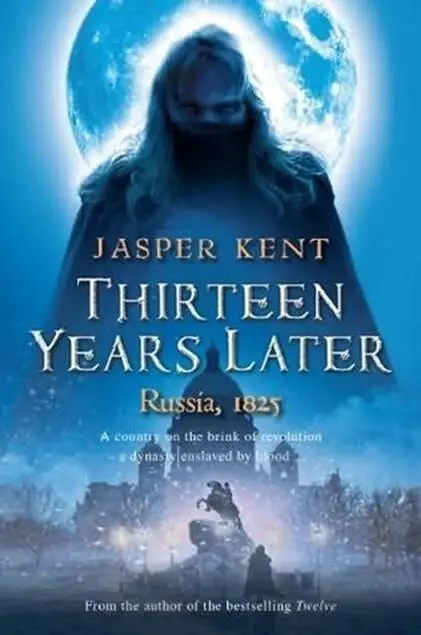
- Название:Thirteen Years Later
- Автор:
- Жанр:
- Год:неизвестен
- ISBN:нет данных
- Рейтинг книги:5 / 5. Голосов: 1
-
Избранное:Добавить в избранное
- Отзывы:
-
Ваша оценка:
Thirteen Years Later: краткое содержание, описание и аннотация
Предлагаем к чтению аннотацию, описание, краткое содержание или предисловие (зависит от того, что написал сам автор книги «Thirteen Years Later»). Если вы не нашли необходимую информацию о книге — напишите в комментариях, мы постараемся отыскать её.
Thirteen Years Later — читать онлайн бесплатно полную книгу (весь текст) целиком
Ниже представлен текст книги, разбитый по страницам. Система сохранения места последней прочитанной страницы, позволяет с удобством читать онлайн бесплатно книгу «Thirteen Years Later», без необходимости каждый раз заново искать на чём Вы остановились. Поставьте закладку, и сможете в любой момент перейти на страницу, на которой закончили чтение.
Интервал:
Закладка:
But this time, he had. He’d come home on Wednesday and he’d been there, with Mama, on Thursday morning and this morning.
‘Will he go away again?’
‘You sound like me.’ Tamara frowned. She didn’t understand what her mother was saying. ‘Like a little voice in my head, when I first knew him. “Will he go away again? When will he be coming back? Will he be coming back?” But I know now. Lyosha always goes away – and he always comes back. To both of us.’
‘Lyosha?’
‘Lyosha – Aleksei – Papa.’ Domnikiia squatted down and held her arms wide open. ‘Now come over here and give Mama a hug.’
Tamara ran over to her mother. She was not as good at running as some people – certainly not as good as Rodion – so she concentrated on keeping her balance, looking at the floor just in front of her, rather than at the thing she was running towards, as grown-ups do. She knew she had arrived when she felt her mother’s arms around her and felt her own legs dangling beneath her as she was lifted into the air. She wrapped her arms around her mother’s neck and pressed her face into her chest.
‘That’s a good girl, Toma,’ whispered her mother.
‘Will Papa be back today, then?’ asked Tamara.
‘Yes, darling.’
‘Will he be back soon?’
‘I hope so.’ Tamara guessed those last words were spoken to comfort them both.
Domnikiia turned back to the window. Tamara lifted her head and followed her mother’s stare. Down below, towards the end of the street, stood a man. He was too far away to see his face clearly, but stood like a young man does – older than Rodion, but not by much. His hands were buried in his pockets. He was gazing down the main road, but as they looked, he glanced up at the window, then quickly looked back down, seeming to pay close attention to the horses and carriages that drove past.
‘Who’s that, Mama?’ asked Tamara.
‘I don’t know,’ she replied. There was something in her voice that made Tamara think she was afraid.
CHAPTER VI
SEAT FOURTEEN WAS EMPTY. IT HAD BEEN FOR OVER AN HOUR, since the ballet began. Seat sixteen was occupied when Aleksei arrived, by an elderly woman whose bony fingers clutched an old military spyglass, most likely a relic of the Patriotic War. They were quite close enough to the stage for her not to need it to view the performance, but the performance was not the object of her attention. She spent the evening scanning the boxes around and behind them. From time to time, she would nudge her husband – who attended neither to the dancers nor to the audience, but spent most of his evening attempting to catch up on his sleep – and keep him abreast of who it was she had recognized, and sometimes waved to, in the vain hope that, had they possessed a spyglass of equal magnification, they would have recognized her.
In truth, Aleksei’s attention was not much captured by the ballet itself either. In general, he preferred ballet to opera. A ballet was a symphony with performers added to keep the eyes from wandering. An opera was a play with music added to please the ear. He would always prefer the case where music was the primary concern. Moreover, he found the stamp of the dancers’ feet less of a distraction than the warbling of the singers’ voices. The only other work he had seen by Sor had been an opera: Il Telemaco nell’isola di Calipso. That had been a long time ago – before Austerlitz. He could scarcely remember it. Tonight he listened to the music, and enjoyed it – he promised himself to come again and to bring Dmitry – but his eyes rarely settled on the stage.
At first, he constantly glanced around the auditorium, anticipating the arrival of whoever had invited him. Three or four times he made eye contact with someone, half suspecting he had seen some flicker of recognition in their eyes, but it had come to nothing. His presumption was that the person, when they came, would be a stranger, but he kept an eye out for a face that he knew. He had dismissed the possibility that he might really be dealing with Maks, the memories that had returned to him in Desna finally having convinced him that his old comrade was truly dead. But one other face haunted his mind, though he felt sure that it too was the face of a dead man. Nevertheless, he prepared himself to confront once again the tall, blond figure of Iuda.
But as the ballet began and the hubbub of the audience’s conversation died down, the empty seat next to Aleksei became an ever more obvious presence. He had been invited to one particular seat, and the only empty space he could see in the whole theatre was that beside him. He felt sure it would be filled before the evening was out. If not, then perhaps there was a further missive already hidden somewhere beneath the seat, or beneath Aleksei’s own. Aleksei would search them at the end of the evening, along with seat sixteen, if the lady with the spyglass did not hang around for too long.
In the meantime, Aleksei’s attention was captured by the architecture of the theatre itself. He had seen the exterior frequently enough, and indeed had seen it growing up over the years, far grander than the original Petrovsky Theatre it had replaced, which had been reduced to ashes some two decades before. The interior, however, was utterly new to him. The stage itself was wide, high and deep. The scenery for the ballet was impressive enough, but Aleksei mistrusted all such façades, knowing they were only cardboard and paper, and could be gone by the following evening. He would rather have seen the stage empty, to see its construction instead of having it hidden.
The auditorium was another matter. Like his friend with the spyglass, but with only his own eyes to observe, Aleksei spent much of the evening craning his neck to look at the space around him. He, however, did not look at the audience, but at where they sat. Surrounding the stalls, six circles rose up, layer upon layer, like stacked horseshoes. The highest – and cheapest – was above the level of the massive chandelier which dominated the chamber, illuminated by a hundred candles. Flights of stairs, through which the audience could enter and exit, cut through the rows of seats, great cavernous tunnels that might lead one to who knew where. That this vast room existed in the centre of Moscow, surrounded and hidden by brickwork indistinguishable from that of the buildings around it, was difficult to imagine. Those stairwells were like gateways to another world – to Dante’s Hell. There there had been nine circles, not six, and they were true circles, connected through a complete 360 degrees, and yet Aleksei could easily imagine the audience in each of those balconies as pagans, lechers, gluttons, misers, sloths, heretics, sodomites and panders. He himself was at the very pit of the theatre, the lowest level of hell – that reserved for traitors. He glanced around, but saw no sign of Brutus or Cassius. Neither was his worst fear fulfilled: he did not see Christ’s betrayer – he did not see Iuda. He returned his eyes to the stage.
‘It’s been a long time, Aleksei Ivanovich.’
The voice came from his right. He knew before he had turned his head that the seat next to him was now occupied. He knew also, the realization dawning upon him even as his eyes fell upon the face beside him, both that the voice which had spoken was not Iuda’s and that in his heart he had been utterly convinced it would be.
He saw it first in profile. It was a young man, scarcely more than a boy – perhaps older than Dmitry, perhaps a little younger. He turned, and Aleksei saw something familiar in him, which he could not place. Aleksei opened his mouth to speak, but the man placed a finger to his lips to silence him. He then pointed to the stage, indicating that they should pay attention to the ballet.
Читать дальшеИнтервал:
Закладка:
Похожие книги на «Thirteen Years Later»
Представляем Вашему вниманию похожие книги на «Thirteen Years Later» списком для выбора. Мы отобрали схожую по названию и смыслу литературу в надежде предоставить читателям больше вариантов отыскать новые, интересные, ещё непрочитанные произведения.









Обсуждение, отзывы о книге «Thirteen Years Later» и просто собственные мнения читателей. Оставьте ваши комментарии, напишите, что Вы думаете о произведении, его смысле или главных героях. Укажите что конкретно понравилось, а что нет, и почему Вы так считаете.